
Why Your Foundation Never Seems to Last
You do everything right. You moisturize, you prime, you pat on your foundation with care, maybe even set it with a powder that promises twelve-hour wear. And by noon, it’s sliding. By 2pm, your T-zone looks like it’s been through a car wash. The crease lines around your nose are back. The coverage you spent twenty minutes building has quietly packed up and left.
It’s one of the most frustrating cycles in makeup, and the beauty industry has been selling solutions to it for decades setting sprays, mattifying primers, full-coverage formulas engineered to survive a tropical climate. Most of them work, sort of, for a while. But there’s a technique that doesn’t get nearly enough attention, one that’s been floating around professional makeup artist kits for years before it slowly leaked onto social media in blurry tutorial clips and offhand comments in the comment sections of Reddit threads. It involves a damp sponge, but not in the way you think.
The Technique Nobody Really Explains Properly
Here’s the thing about the damp sponge method: most people already use a damp beauty sponge to apply foundation. That’s not the trick. The trick is what you do after, and the specific way you do it.
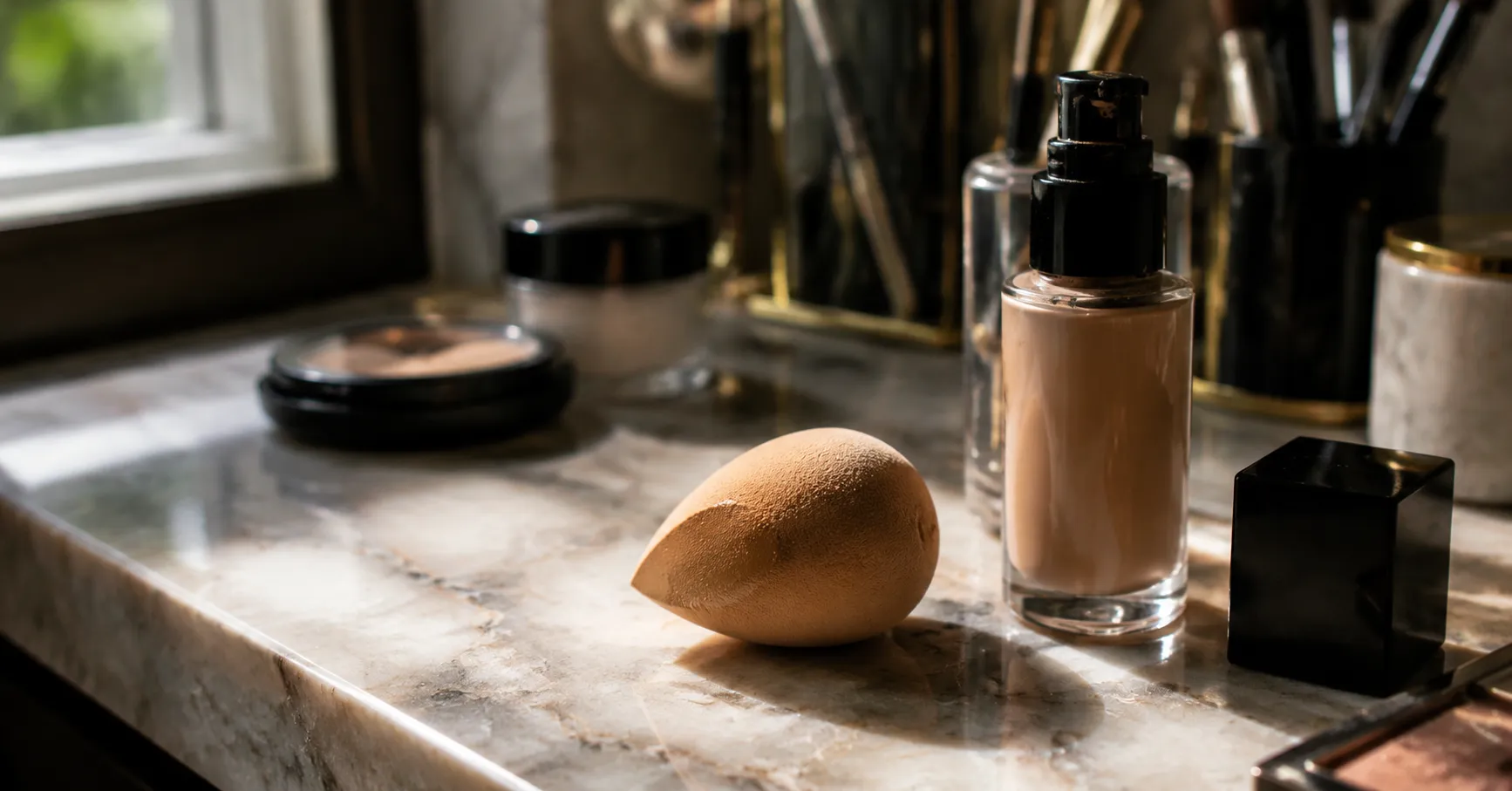
Once foundation is applied by whatever method you prefer, brush, fingers, sponge you take a clean beauty sponge that has been soaked in water and then wrung out aggressively, until it feels barely damp rather than wet. You press it, not swipe, firmly against the skin in short, deliberate sections. Forehead. Each cheek. Chin. The sides of the nose. You’re not blending anything at this point. You’re compressing. The motion is a stamp, not a stroke, and the pressure matters. Light dabbing won’t do it.
What you’re doing is pushing the product into the skin rather than letting it sit on top of it. Foundation that rests on the surface of skin is at the mercy of everything oil production, humidity, facial movement, sweat. Foundation that has been physically pressed into the texture of the skin behaves differently. It has friction to hold onto. The sponge also picks up the excess product that would otherwise be sitting in excess on the surface, the part most prone to sliding, without stripping what’s already bonded to skin.
The Science Hiding in Plain Sight
Skin is not a flat canvas, regardless of how much we treat it like one when we’re standing in front of a mirror. It has texture, pores, fine hair, micro-movements. Foundation applied with a brush or fingers tends to sit on the highest points of all that texture, which is why cakey patches form and why large pores look worse after application rather than better.
A damp sponge pressing technique does something specific to that equation. The moisture on the sponge creates a very slight emulsification effect when it meets a water-in-oil or oil-in-water foundation formula. It softens the outermost layer just enough to allow the product to settle into the skin rather than onto it, without disturbing the layer underneath. The compression motion adds pressure that encourages the foundation pigment to grip the surface of the skin, similar to how a printer presses ink into paper rather than just laying it on top.
Makeup artists have understood this intuitively for a long time. On set, where talent might be under lights for hours without a touch-up, foundation application technique gets obsessive. Pressing, patting, working in layers that are each compressed before the next is added that’s standard practice. The beauty sponge is just a consumer-accessible version of what professionals have been doing with their fingers and specialized sponge tools for decades.
Why the Dampness Level Is Everything
This is where most people who try this technique go wrong. Too wet, and the sponge dilutes the foundation, sheering out coverage, making the whole thing feel patchy and unstable. Too dry, and you lose the emulsification effect you’re just pressing a foam tool against your face, which doesn’t accomplish much.
The ideal sponge is what some makeup artists describe as “barely there” damp. Run it under the tap, squeeze it until no water drips out, then squeeze it again with a dry towel wrapped around it. When you press it against the back of your hand, you should feel cool but not wet. There shouldn’t be any transfer of moisture visible on your skin. If there is, keep squeezing.
Temperature also matters more than you’d expect. A cold damp sponge is more effective than a room-temperature one. Cold causes slight pore tightening, which helps hold product in place. Some people keep their beauty sponge in a small container in the refrigerator, which sounds excessive until you try it in summer and realize it genuinely changes the finish.
Layering the Technique for Longer Wear
The sponge trick on its own buys you more longevity than standard application. Combined with a few other practices, it can genuinely take a foundation from four-hour wear to eight or ten hours without the kind of heavy-duty setting products that often look masklike by mid-afternoon.
Skin prep matters, and specifically, the kind of skin prep that doesn’t leave a slick residue. Heavy moisturizers, while great for skin health, can work against foundation adhesion. If long wear is the priority, a lightweight gel moisturizer or a hydrating serum that absorbs completely gives the skin moisture without the slip. Let it sit for at least five minutes before touching any makeup. Skin that’s still absorbing moisturizer is still in motion, in a sense, and foundation applied to moving skin doesn’t set evenly.
After the foundation is compressed with the damp sponge, a very light dusting of translucent setting powder over just the oiliest zones not the entire face creates a matte anchor point without that all-over powdered look. Then comes one more pass with the lightly damp sponge over the powdered areas. This is the step most tutorials skip. That second press after powder melds the powder into the foundation, rather than letting it sit on top like a separate layer. The result looks more like skin and less like makeup that has been set by makeup.
What Type of Foundation Actually Benefits Most
Not every formula responds to this technique equally. Medium to full coverage liquid foundations gain the most from it, particularly those with a satin or natural finish. Dewy foundations can actually get a slight mattifying effect from the press, which might be welcome or not depending on the look you’re going for. Mousse foundations and whipped formulas, which already have a light, porous texture, can respond beautifully the compression flattens the formula into skin in a way that looks remarkably natural.
Powder foundations don’t need this technique at all, and mineral powder formulas can actually go patchy if a damp sponge gets involved. Stick foundations are interesting applied with fingers and then compressed with a damp sponge, they can achieve a skin-tint effect that’s deceptively difficult to achieve with other methods.
The one category where this doesn’t help much is ultra-sheer or tinted moisturizer formulas. Those are designed to sit lightly on skin by nature, and the compression doesn’t have enough product to work with. For those, the technique is unnecessary.
The Part That Changes How You Think About Makeup Application
There’s something worth sitting with here, beyond the practical tips. Most of us were taught to apply foundation as a surface treatment you cover the skin, smooth it out, set it in place. The damp sponge technique asks you to think about it differently. It’s less about coverage and more about integration.
When foundation is integrated into the skin’s surface rather than layered on top of it, the whole face reads differently. Touch-ups later in the day become less about re-applying product and more about light maintenance. Skin looks more like skin. The uncanny smoothness that reads as “full coverage” gives way to something that’s harder to pinpoint but easier to wear.
That might be why this trick, weird as it sounds when you describe it, tends to convert people the first time they actually try it. The results don’t require explanation. You just look in the mirror at4pm and notice that something, for once, didn’t move.