

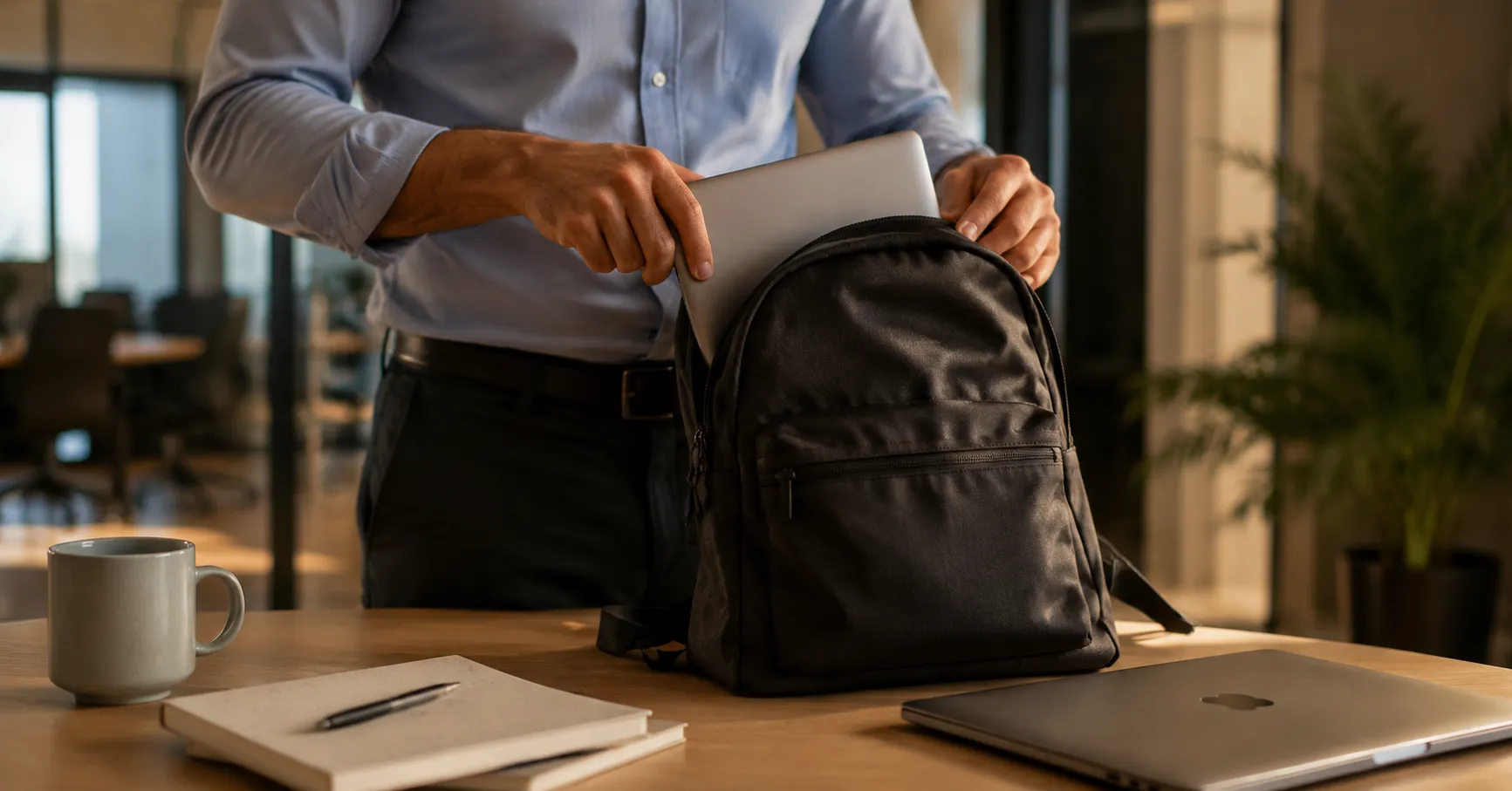
There’s a moment most commuters know well. You’re standing on a packed subway car, shoulder bag cutting into your neck, laptop digging into your ribs, coffee in one hand and phone in the other, and you glance across the aisle at someone wearing a backpack both hands free, posture relaxed, looking like they just stepped off a trail in Patagonia and you think: why am I doing this to myself?
But then you walk into the office. And suddenly the backpack doesn’t feel quite so carefree. It feels like a statement. Maybe the wrong one.
The question of whether a backpack is acceptable office attire sounds trivial. It isn’t. It sits at the intersection of professional image, physical health, workplace culture, and the slow but undeniable shift in what “looking like you belong” actually means in contemporary work life. Unpacking it if you’ll forgive the pun reveals something about how offices have changed, and how our anxieties about them haven’t quite caught up.
The Bag as a Proxy for Everything Else
Offices have always been semiotic spaces. What you carry, wear, and project sends signals before you open your mouth. For decades, the briefcase was the universal symbol of professional seriousness structured, purposeful, slightly theatrical. It said: I am here on business. The shoulder tote came next, softer in line but still intentional, still dressed up.
The backpack broke that visual grammar. It arrived from campus culture, hiking trails, and tech startup floors where the dress code was “whatever.” When it migrated into traditional office environments, it carried all that connotational baggage with it youth, informality, the suggestion that you might not fully grasp the codes of professional life.
That perception is fading. But it hasn’t disappeared entirely, and whether it matters to you depends enormously on where you work, what you do, and who’s watching.
It Depends on the Office Which Sounds Like a Cop-Out, but Isn’t
In a creative agency, an architecture firm, a tech company, or a media organization, backpacks are essentially invisible. No one notices them because no one is looking for them. The dress code is relaxed enough that the bag is just a bag.
In a law firm, a legacy financial institution, a government office, or any environment where the professional costuming still leans formal, the backpack registers differently. It doesn’t necessarily disqualify you, but it creates a small friction a micro-impression that can accumulate if you’re junior, if you’re trying to build credibility, or if you’re walking into a room full of people who are quietly reading everything about you.
This isn’t about fairness. It’s about reading the room accurately. A senior partner at a white-shoe law firm can probably show up with whatever bag they want. An associate trying to make partner cannot afford the same casual indifference to optics. That’s not a rule about backpacks it’s a rule about power and where you sit relative to it.
The Ergonomic Argument That Nobody Talks About Enough
Here’s the part of the conversation that gets lost under all the image anxiety: carrying a single-shoulder bag for any substantial distance is genuinely bad for your body. Chronic neck tension, uneven muscle development, compressive stress on the spine physical therapists will tell you this all day. The backpack distributes weight evenly across both shoulders, keeps your center of gravity stable, and gives your carrying arm a break from the death grip on a tote handle.
When you’re commuting with a laptop, charger, water bottle, lunch, and whatever else the modern office day demands, that weight adds up fast. Choosing a bag that protects your body shouldn’t require a cultural apology.
The ergonomic case for the backpack is strong enough that it probably deserves more weight in this conversation than it typically gets. We’ve become so accustomed to prioritizing how things look over how they function that we’ll endure real physical discomfort to maintain a professional image which, when you say it plainly, sounds a little absurd.
Not All Backpacks Are Equal
Part of why the backpack debate has lingered is that the category is enormous. A neon hiking pack with carabiner clips and a hydration bladder port is a different object from a slim, structured leather or canvas backpack in a neutral color. They both technically qualify as backpacks. They send entirely different messages.
The former looks like you came from a campsite. The latter looks like a deliberate choice modern, functional, considered. Brands like Tumi, Bellroy, Aer, and Filson have spent years designing backpacks that occupy exactly this space: the professional commuter pack that signals intentionality rather than accident.
If you’re navigating an office environment where the backpack still carries some image risk, the design of the bag matters enormously. Structured shape. Minimal external hardware. Subdued colors. Clean lines. These aren’t compromises they’re the difference between a bag that reads as casual and one that reads as deliberate.
Gender, Power, and the Uneven Playing Field
It would be dishonest to have this conversation without acknowledging that the backpack question lands differently depending on who’s asking it. Men in office environments have historically had more latitude with bag choices the messenger bag, the backpack, even the laptop-in-hand-no-bag look have all been available to them without significant professional penalty.
Women navigating formal office spaces have often faced a narrower range of “acceptable” bag options, where deviation from the structured tote or handbag triggers more visible judgment. That’s changing, but slowly, and unevenly across industries. The backpack question, for a woman in a conservative office, may carry more social calculation than it does for her male counterpart in the same role.
This is worth naming, not because it changes the practical advice, but because “just wear the backpack” flattens a reality that isn’t flat.
The Commute Versus the Office
One pragmatic resolution that a lot of people land on: the backpack for the commute, swapped out at the office. Keep a tote or slim briefcase under your desk, transfer what you need, stow the backpack. It’s a small logistical accommodation for the reality that the environment shifts when you walk through the door.
But this solution also reveals something a little uncomfortable the idea that you need to transform yourself at the threshold of professional space, that the body that commuted here is not quite fit to present itself. That’s a real tension, and how much it bothers you probably tracks closely with how you feel about professional codes in general.
Some people find the code itself worth following, a social compact that signals mutual respect for the environment. Others find it an arbitrary holdover from a corporate culture that’s already dissolving around the edges, and they’d rather just wear the bag and let the work speak.
Neither position is wrong. What matters is knowing which one you actually hold and accepting the consequences, real or imagined, that come with it.
The backpack will keep showing up in offices. The question of what it means there is really a question about what those offices are becoming.