
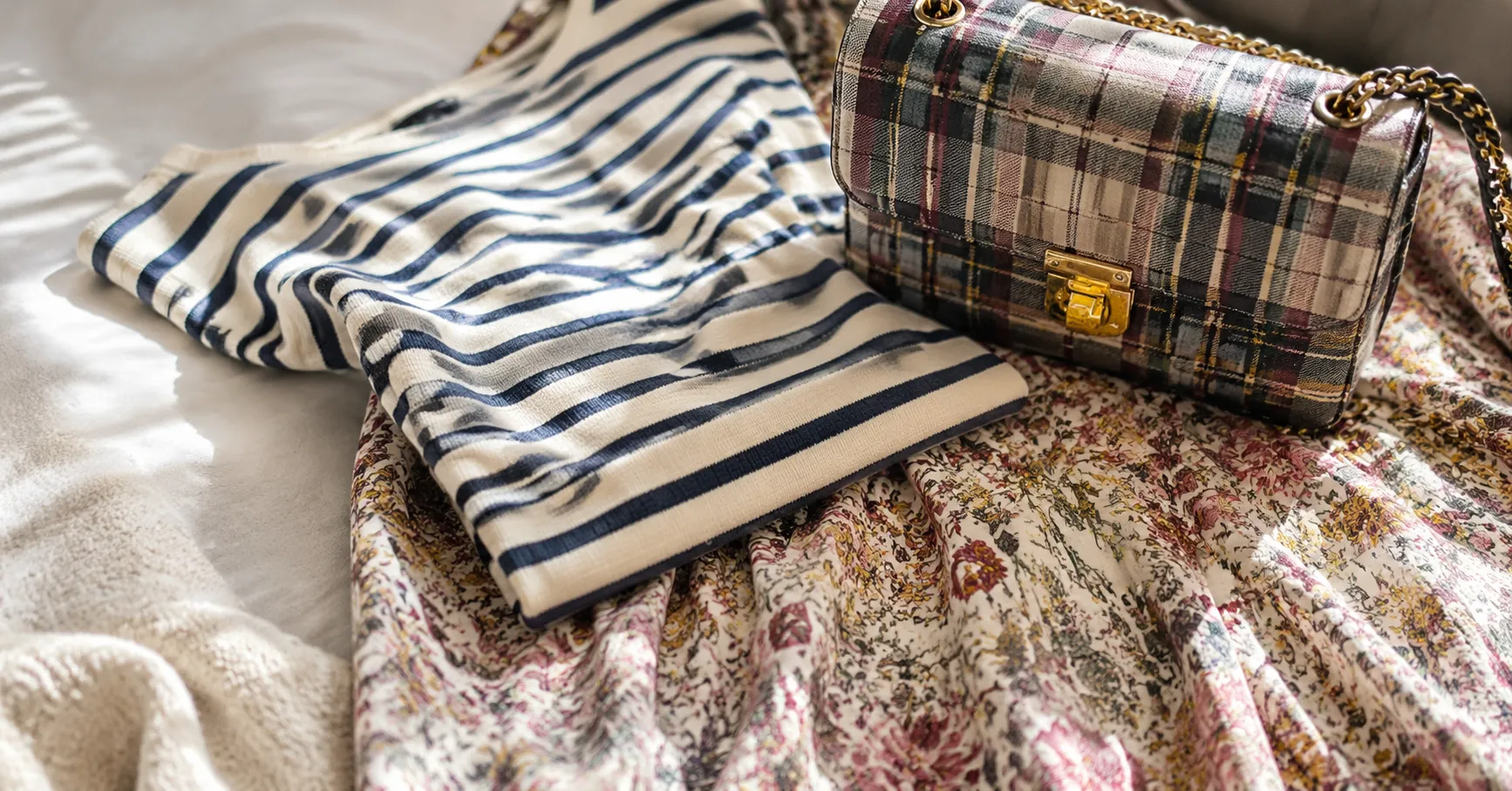
There’s a particular kind of confidence that comes from wearing a striped top with a floral skirt and a plaid bag and actually pulling it off. Most people play it safe. They reach for solid colors, neutral totes, anything that won’t “fight” with the rest of the outfit. But that instinct to retreat into safety is exactly what keeps a look forgettable. The real question isn’t whether to mix patterns. It’s learning to do it in a way that feels intentional rather than accidental.
Pattern mixing is one of those skills that looks effortless on the people who understand the underlying logic and chaotic on everyone else. The gap between those two outcomes usually comes down to a few principles that nobody talks about clearly enough.
Start with Scale Before You Touch Color
Most people approach pattern mixing backwards. They look at color first and ask whether two prints “go together” tonally. But the more reliable starting point is scale the physical size of the repeated motif in each pattern.
When two patterns share a similar scale, they compete. A medium-sized floral on your dress and a medium-sized check on your bag create visual noise because your eye can’t decide which one to follow. The patterns are too evenly matched, and the result feels like an argument neither side is winning.
The fix is contrast in scale. A large, loose botanical print on a jacket pairs naturally with a small, tight geometric on a bag because the eye processes them as two different visual layers rather than two things fighting for the same space. Think of it like typography a headline and body text work together precisely because they’re not the same size. Your outfit follows the same logic.
This is why a classic preppy combination like a chunky cable-knit sweater and a small houndstooth bag reads as polished. The cable pattern is bold and dimensional, the houndstooth is fine and flat. They occupy different “frequencies,” so to speak, and that separation is what makes them compatible.
The Color Bridge That Actually Works
Once you’ve sorted scale, color does become important but not in the way most style guides suggest. The advice to “pull one color from each pattern to create harmony” is technically correct but practically incomplete. It treats color as a matching exercise, which leads to outfits that look coordinated but not interesting.
A more useful approach is finding what designers call a color bridge: a single hue that appears in both patterns, even subtly. It doesn’t have to be the dominant color in either piece. A burgundy stripe in an otherwise green plaid skirt can anchor a bag with a deep red motif. The shared undertone creates a visual thread without making the combination feel matchy.
This is also where neutral patterns earn their place. Stripes, particularly narrow ones in black and white or navy and cream, behave almost like neutrals because they read as structure rather than color. A crisp black-and-white stripe cancoexist with nearly any other pattern precisely because it’s bringing geometry rather than hue to the conversation.
The Role Your Bag Plays in All of This
Here’s something that doesn’t get addressed enough: your bag is not a passive accessory. It’s one of the loudest visual anchors in any outfit because it’s held or carried at a different plane than your clothing. It moves. It catches light from different angles. And because it’s often leather, canvas, or another distinct material, it already introduces a texture contrast before the pattern question even comes up.
This means a patterned bag requires more thought than a patterned scarf or a patterned belt. The bag sits in open space and your eye goes to it regularly. If it’s clashing with your top, there’s no escape it will bother you all day.
The practical implication is that when you’re building a pattern-mixed outfit around a patterned bag, let the bag be the statement piece. Everything else can carry smaller, quieter patterns that support rather than compete. A bold leopard print bag which, despite being technically a pattern, reads almost like a neutral in practice because it’s so familiar can anchor an outfit with a delicate stripe and a subtle texture. The bag gets the attention; the other patterns add richness.
If you want two equally bold patterns to coexist, the bag and the clothing need that scale contrast to be especially pronounced. A large-scale abstract print on a tote bag with a fine micro-gingham shirt? That works. The same large-scale abstract bag with a large-scale botanical blouse? Too much surface area competing at the same volume.
Texture as the Secret Mediator
There’s an underrated factor that experienced pattern mixers use instinctively: texture. Two patterns on completely different materials don’t fight in the same way that two patterns on similar fabrics do.
A woven tapestry bag alongside a silk blouse with a printed pattern creates a kind of truce through material contrast. The eye recognizes that these two patterned items belong to different categories one is structural, one is graphic and gives them room to coexist. Tactile contrast does the mediating work that color or scale alone sometimes can’t.
This is partly why leather bags with embossed patterns or woven straw bags with natural texture can be paired with almost anything printed. The material itself signals a different kind of pattern one that’s three-dimensional and inherent rather than applied. Your brain processes it differently, and the potential clash disappears.
When Rules Are Meant to Break
All of this framework exists so you can eventually ignore it consciously rather than just accidentally. The outfits that genuinely stop people on the street are often the ones where someone bent every principle here and still made it work because they bent the rules with full awareness of what they were doing.
A maximum-pattern look, where three or four bold prints collide across a full outfit and bag, can be extraordinary. It requires that every piece share at least one color, that the overall mood is consistent (maximalist doesn’t mean random), and that the person wearing it carries it with absolute conviction. The same combination worn hesitantly reads as mess. Worn confidently reads as vision.
The more useful takeaway might be this: clashing isn’t actually about the patterns themselves. It’s about whether the choices feel deliberate. Two patterns that technically shouldn’t work together can look stunning when worn by someone who clearly chose them on purpose. Two patterns that follow every guideline can look wrong when the wearer seems unsure about them.
So the technique matters. The principles here will save you from genuine mistakes and help you build combinations you wouldn’t have trusted otherwise. But style has always been, at its core, a posture. You can learn the grammar, but the voice has to be yours.