

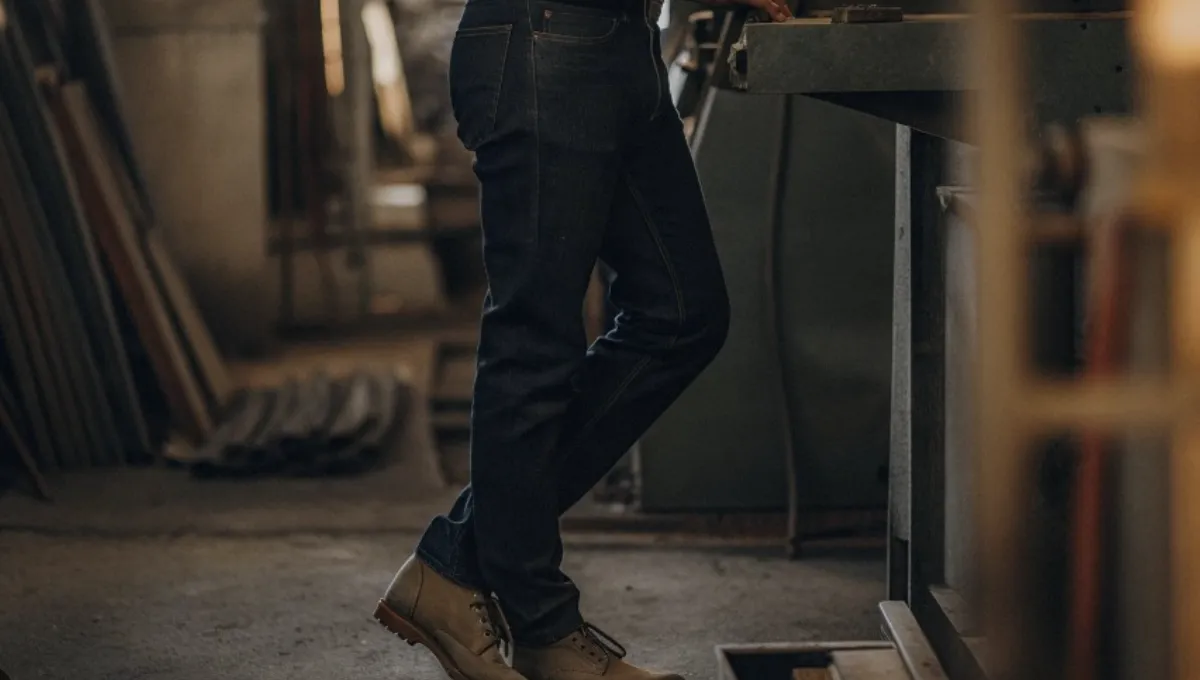
There’s a good chance you’re wearing them right now. Or they’re folded on a chair nearby, slightly stiff from the last wash, waiting. Denim jeans are so deeply embedded in daily life that most people never stop to wonder where they actually came from or how strange and accidental that origin really was.
The real story isn’t the one on the label.
Gold, Dust, and a Fabric That Almost Wasn’t
The year is 1853. California is in full fever. Tens of thousands of men are tearing apart riverbeds with their bare hands, and the one thing wearing out faster than their patience is their pants. Enter Levi Strauss, a Bavarian-born dry goods merchant who had sailed to San Francisco not to mine gold, but to sell to the people doing the mining.
The fabric he originally intended to use for tents and wagon covers a sturdy brown cotton canvas turned out to be almost perfectly suited for workwear. He pivoted fast. But the pants he started making still had a problem: the seams kept blowing out under pressure, specifically at the pocket corners, where miners stuffed tools, rocks, and whatever else they were hauling around all day.
The solution came from Jacob Davis, a Latvian-born tailor working in Reno, Nevada. Davis had started reinforcing pocket corners with copper rivets the same rivets used on horse blankets and the results were so good that his customers kept coming back. He knew he was onto something real. He just didn’t have the money to file a patent.
So he wrote to Levi Strauss, proposed a partnership, and in 1873they were granted U.S. Patent No. 139,121 for “Improvement in Fastening Pocket-Openings.” That patent not a fashion vision, not a cultural statement is the actual birth certificate of blue jeans as we know them.
Why Blue? The Indigo Answer
The color wasn’t chosen because it looked good. It was chosen because it worked.
Indigo dye has a peculiar chemical property: it binds to the outer surface of cotton fibers rather than penetrating them fully. This means the dye fades with wear and washing, which sounds like a flaw but turned out to be one of the most seductive qualities denim has ever had. Every pair slowly becomes unique to the person wearing it a physical map of how you move, where you sit, what you carry. No two pairs age the same way.
There’s also a practical dimension. Indigo was, for centuries, one of the most stable and widely available natural dyes in the world. Before synthetic alternatives were developed in the late 19th century by German chemist Adolf von Baeyer work that eventually earned him a Nobel Prize indigo was a global commodity with trade routes stretching from India to Europe to the Americas. Levi Strauss didn’t choose blue out of aesthetic preference. He chose it because the supply chain already existed.
The Long Walk From Workwear to Rebellion
For the first several decades of their existence, jeans were purely utilitarian. Cowboys wore them. Railroad laborers wore them. Farmers wore them. They showed up in Sears catalogs alongside work boots and suspenders, marketed to men who needed clothing that could survive a full day of physical punishment.
The cultural shift started in the 1930s, when Hollywood Westerns introduced denim to audiences who had never set foot on a ranch. John Wayne wore jeans. Gary Cooper wore jeans. The garment began to accumulate symbolic weight ruggedness, self-reliance, the mythology of the American frontier entirely separate from its actual function.
Then came the 1950s, and everything accelerated. Marlon Brando in The Wild One. James Dean in Rebel Without a Cause. Suddenly denim wasn’t just workwear or Western wear it was a uniform for a certain kind of attitude. Schools started banning jeans precisely because of what they signaled. That reaction, of course, only made them more appealing.
This is worth sitting with for a moment. The garment that had been designed to keep miners’ pockets intact during the California Gold Rush became, within a century, a symbol of youth rebellion in postwar America. Not because anyone planned it that way. Because clothes absorb the stories of the people wearing them.
The Global Factory and the Seams Nobody Sees
By the late 20th century, denim had become one of the most manufactured textiles on the planet. And the industry built to produce it operates on a scale that most consumers never see and rarely think about.
A single pair of jeans requires roughly 1,500 gallons of water to produce when you account for the entire supply chain cotton cultivation, dyeing, finishing, washing. The Aral Sea, once one of the world’s largest lakes, was drastically reduced in part due to the intensive irrigation demands of Central Asian cotton farming that fed the Soviet textile industry. The ecological damage is still visible from space.
The denim washing process the one that creates those lived-in fades and worn-out textures before the jeans ever reach a store shelf has historically relied on sandblasting, a technique that produces highly realistic distressed effects but also fills workers’ lungs with silica dust, causing a lung disease called silicosis. Campaigns by labor rights organizations eventually pressured major brands to phase out the practice, but it took years of sustained pressure and multiple documented worker deaths before the industry moved.
None of this shows up on the care label.
Selvage, Sanforization, and the Obsessives
While the mainstream denim industry industrialized rapidly after World War II, a quieter counter-current was developing among people who became almost fanatically attached to how jeans used to be made.
Selvage denim produced on narrow shuttle looms that create a self-finished edge on the fabric was largely abandoned in the 1950s when projectile and rapier looms allowed manufacturers to produce fabric much faster and wider. The trade-off was quality: the newer looms produced a looser weave that faded differently and wore out faster. Most consumers never noticed or cared.
But some did. Japanese denim enthusiasts, starting in the 1970s and accelerating through the 1980s and 90s, began acquiring vintage American denim with almost scholarly intensity. They reverse-engineered the fabrics, tracked down the old shuttle looms, and started producing selvage denim that in some cases was more faithful to mid-century American construction than anything being made in the United States at the time. The irony is dense: Japanese manufacturers became the global custodians of a textile tradition that originated in American workwear.
Today, a premium pair of Japanese selvage denim jeans can cost several hundred dollars and will be discussed online with the kind of precision usually reserved for wine or vintage watches. Thread count, loom type, indigo rope-dyeing technique, rivets, stitching width entire communities exist to parse these details. It’s a long way from a Reno tailor looking for a way to stop pocket seams from tearing.
What You’re Actually Wearing
There’s something quietly remarkable about the fact that a design solution patented in 1873 is still, in its essential form, what most of the world puts on in the morning. The five-pocket design. The copper rivets. The indigo dye that fades into something personal over time.
Denim absorbs everything labor history, youth culture, ecological consequence, craftsmanship obsession, global economics and still manages to look like it’s just sitting there, unbothered, waiting for you to decide what to do with your day.
Maybe that’s the actual secret. Not that jeans have a hidden history, but that they carry it so lightly you never feel the weight.