

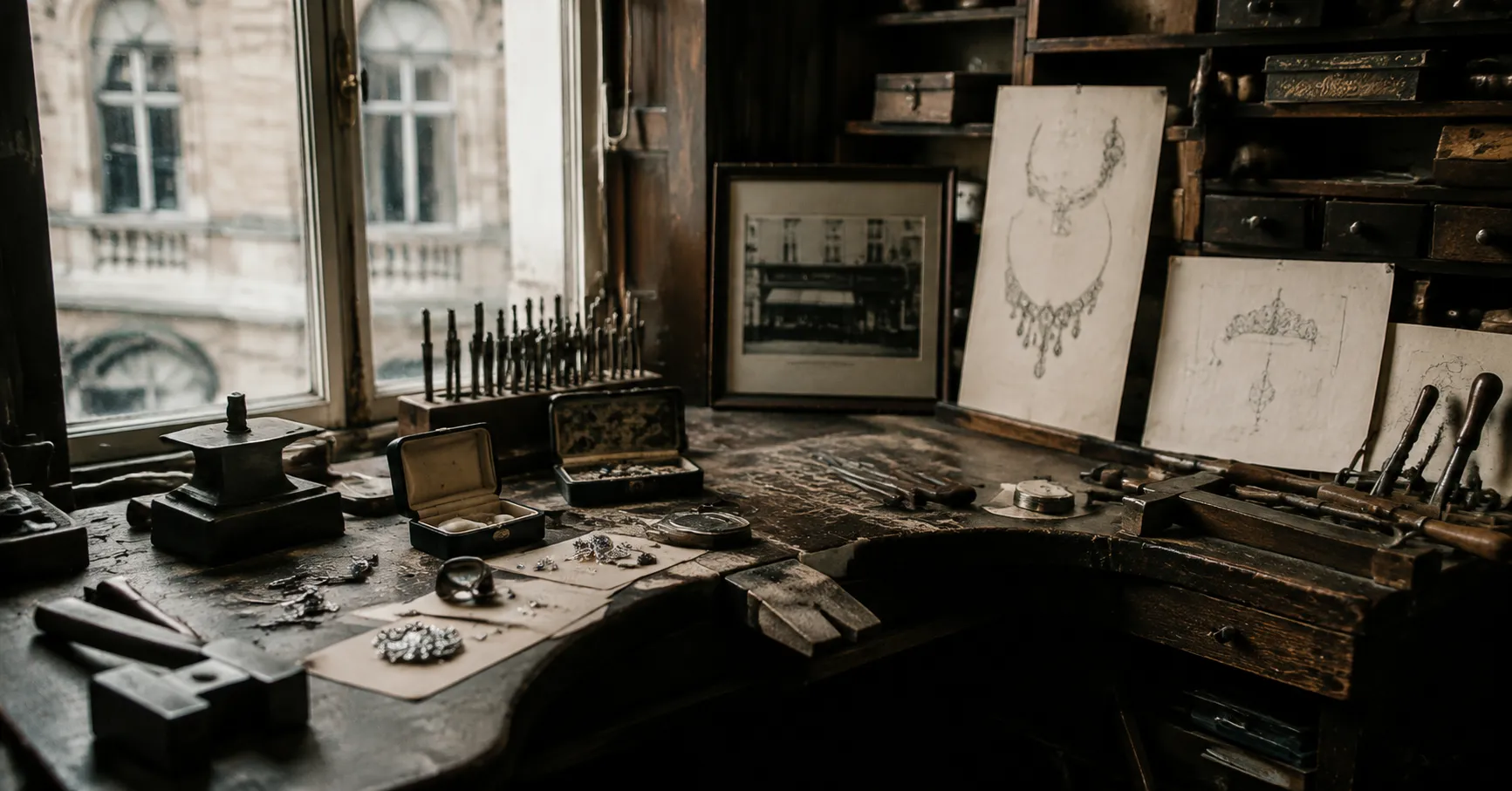
The Stories They’d Rather You Forget
There’s a particular kind of glamour that surrounds fine jewelry the velvet boxes, the hushed boutiques, the careful way a salesperson holds a piece up to the light as if presenting something sacred. We’ve been trained to see these brands as timeless, almost mythological. Cartier. Tiffany. Van Cleef & Arpels. The names alone conjure something aspirational, something ancient and untouchable. But scratch beneath the polished surface and what emerges is far messier, stranger, and frankly more interesting than any advertisement would have you believe.
The founding stories of the world’s most celebrated jewelry houses read less like fairy tales and more like the kind of novel you can’t put down because the characters keep making questionable decisions at exactly the right moment.
Cartier’s Empire Was Built on a Royal Debt
Louis-François Cartier opened his first workshop in Paris in 1847, which sounds like a confident entrepreneurial leap until you realize he essentially inherited it from his master, Adolphe Picard, under murky circumstances that historians still debate. The real turning point, though, came from something more theatrical.
King Edward VII of England then still the Prince of Wales and famous for his extravagant tastes reportedly called Cartier “the jeweler of kings and the king of jewelers.” That quote became legend, but what’s less discussed is how the relationship actually developed. Alfred Cartier, Louis-François’s son, cultivated royal connections with a systematic shrewdness that bordered on the obsessive. He supplied tiaras for coronations. He extended credit to cash-poor aristocrats at a moment when old European money was hemorrhaging wealth and new money desperately wanted legitimacy. Cartier sold to both sides of that equation simultaneously.
By1902, they had a royal warrant from Edward VII followed by warrants from the courts of Spain, Portugal, Russia, and Siam within a decade. The brand didn’t just dress royalty. It helped define what royalty looked like to a watching world. And much of that machinery ran on aristocratic debt, social anxiety, and the very human need to signal status when everything else was falling apart.
Tiffany Was Almost a Stationery Store
The iconic blue box. The Fifth Avenue flagship. Audrey Hepburn eating a croissant on the sidewalk outside. Tiffany & Co. has one of the most recognizable visual identities in consumer culture, which makes it quietly extraordinary that the company started in1837 as a “stationery and fancy goods emporium” in lower Manhattan.
Charles Lewis Tiffany and his business partner John Young opened with $1,000 borrowed from Tiffany’s father roughly $35,000 today and on that first day, they made $4.98 in sales. The early inventory included umbrellas, walking sticks, pottery, and Japanese curiosities. Jewelry came later, almost incidentally.
What actually transformed Tiffany into Tiffany was a single audacious moment in 1848. As the French monarchy collapsed and European aristocrats fled the Continent in panic, Tiffany sent a buyer to Paris who purchased an enormous quantity of diamond jewelry at catastrophically deflated prices. He came back with jewels that had belonged to French nobles who needed cash faster than they needed sentiment. Tiffany repackaged those pieces, sold them to New York society, and the reputation was made. The brand had essentially built its identity on the anxieties of a dying European order.
The Tiffany Yellow Diamond one of the largest yellow diamonds ever found, purchased in 1878 came later and cemented the mythology. But behind the mythology is a story about timing, opportunism, and a founder who understood that someone else’s catastrophe could become your cornerstone.
Van Cleef & Arpels Started With a Love Story That Actually Happened
It’s tempting to dismiss the founding narrative of Van Cleef & Arpels as marketing confection two families united, a marriage, a jewelry empire born from romance. These things rarely survive scrutiny. This one mostly does.
Alfred Van Cleef, the son of a stonecutter, married EstelleArpels, daughter of a gem dealer, in 1895. The families’ complementary expertise made a partnership logical, but what made it work was a particular aesthetic sensibility that Estelle helped shape. Their first boutique opened on Place Vendôme in Paris in 1906, and from the beginning, the house had an unusually feminine perspective on design not feminine in the diminishing sense, but attuned to how a woman actually moves through the world while wearing jewelry.
The Mystery Setting, patented in 1933, is their most technically remarkable invention. Gemstones appear to float in a piece with no visible prongs or settings an illusion achieved through a system of microscopic rails and grooves that took craftsmen years to develop and still takes hundreds of hours per piece to execute. The technique was so complex that the house kept it classified for decades. Even today, only a handful of artisans in their workshop know the full method.
What Van Cleef created was a brand whose technical innovation was genuinely radical, but whose public story was consistently told as romance. They understood early that people buy into a feeling before they buy into a price tag.
The Complicated Origins of De Beers
No history of jewelry is complete without confronting De Beers, the diamond cartel that arguably shaped the entire industry’s economics across the 20th century and whose origins are entangled with colonial violence in southern Africa in ways the brand has spent considerable energy softening over the years.
Cecil Rhodes founded De Beers Consolidated Mines in 1888 in what is now South Africa. Rhodes was a British imperialist whose political ambitions were as large as his commercial ones he eventually served as Prime Minister of the Cape Colony and had a country named after him (Rhodesia, now Zimbabwe and Zambia). His diamond operation was built on a labor system that was exploitative by any contemporary standard and catastrophic by any honest one.
What followed under the De Beers corporate structure was decades of market manipulation on an almost incomprehensible scale. The company accumulated diamonds and released them strategically to maintain artificially high prices. In the 1940s and 50s, their advertising agency N.W. Ayer crafted one of the most effective marketing campaigns in commercial history: “A Diamond Is Forever.” Four words that took a relatively ordinary gemstone and turned it into a cultural requirement for romantic commitment. Engagement ring sales surged. The psychological association between diamonds and eternal love was manufactured, deliberately and efficiently, by a cartel that controlled global supply.
That campaign didn’t just sell diamonds. It rewrote the social script for how love gets performed. The fact that most people proposing today still instinctively reach for a diamond is, in no small part, a 70-year-old advertising strategy still running its course.
Bulgari’s Postwar Reinvention
Bulgari gets less attention than the French houses in most historical accounts, which is a shame because their trajectory is genuinely unusual. Founded in Rome in 1884 by a Greek silversmith named Sotirio Bulgari, the brand spent its early decades as a solid but unremarkable craft business. The transformation happened in the aftermath of World War II, and it happened because of a city, not just a company.
Rome in the 1950s was experiencing its cinematic golden age. Hollywood productions were filming on location it was cheaper, and the light was extraordinary and the Via Condotti boutique became something of a daily destination for actors like Elizabeth Taylor, Audrey Hepburn, and Sophia Loren. Taylor in particular visited so frequently that Bulgari’s staff became characters in the unofficial memoir she never quite wrote. She once remarked that Bulgari was “the only Italian word I know,” which is probably apocryphal but captures something true about the relationship.
What Bulgari understood, and capitalized on brilliantly, was that being worn by those specific women in that specific cultural moment was worth more than any advertisement. They leaned into bold, colorful designs that photographed well and stood apart from the more restrained French aesthetic. The chunky gold, the cabochon gemstones, the sculptural heaviness all of it communicated something brazenly Italian and entirely intentional.
What These Stories Actually Tell Us
Behind every storied brand is a founder who bet on the right moment, or inherited someone else’s misfortune, or told a story clean enough to survive the mess beneath it. The diamonds that sparkle in those famous cases passed through wars, colonial extraction, aristocratic desperation, and decades of manufactured desire before arriving in their velvet beds.
None of this makes the craftsmanship less real or the beauty less genuine. A Van Cleef Mystery Setting is still a small miracle of human patience and skill. A Cartier panther brooch is still extraordinary. But knowing the actual histories changes the nature of the glamour makes it earthier, stranger, more human.
Perhaps that’s what endures in these objects. Not the mythology, but the evidence that people have always wanted to hold something beautiful tightly enough to forget, for a moment, what it cost to make it.