
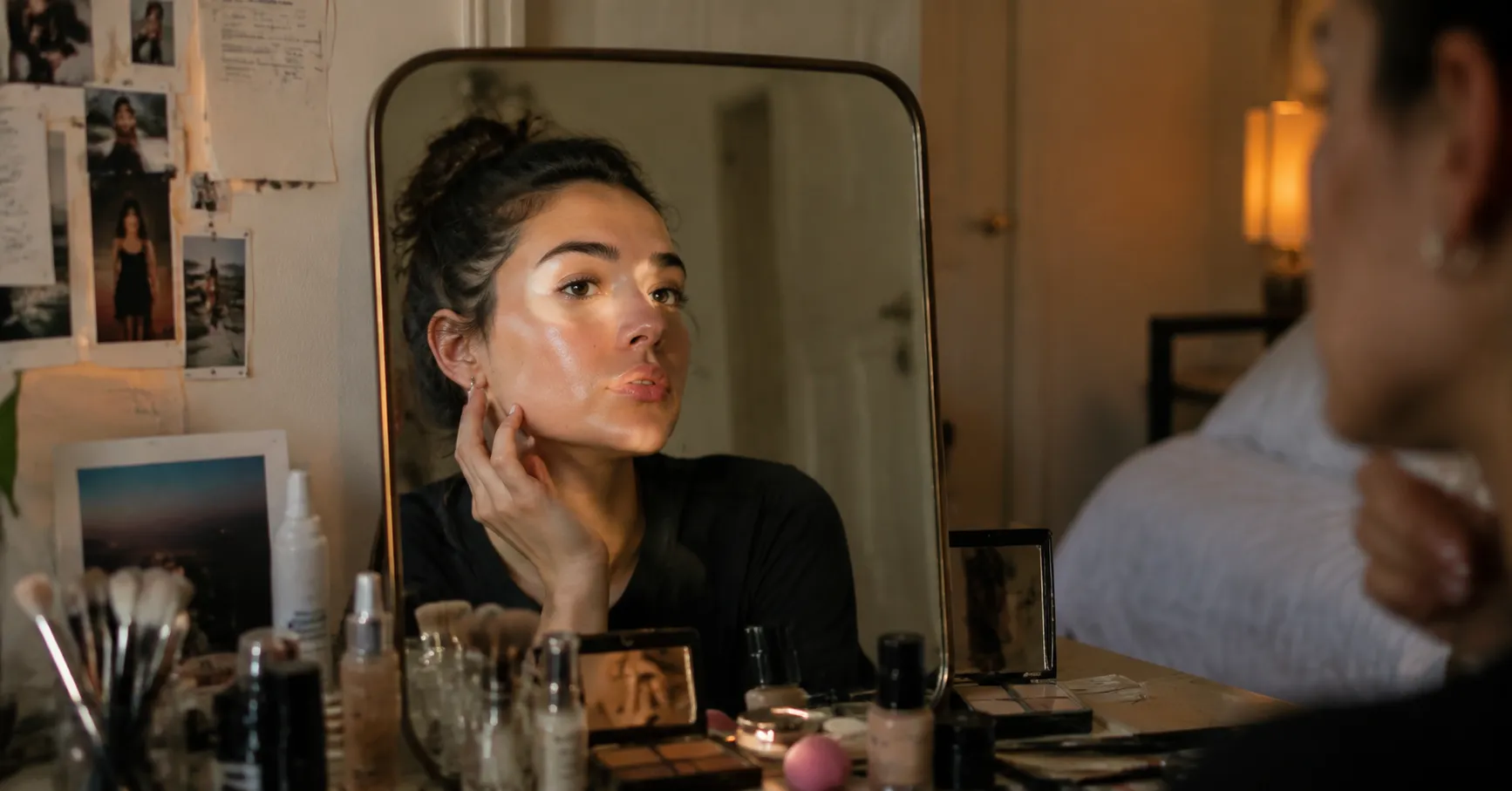
It started, like most bad ideas, with a YouTube rabbit hole at midnight.
I was watching a behind-the-scenes interview with a celebrity whose red carpet looks I’d been quietly obsessing over for months. Not the gowns, not the jewelry the skin. Specifically, the way her foundation looked at hour six of an awards ceremony the same way it looked at hour one. Dewy but not greasy. Present but not cakey. Alive. I kept rewinding the clip, zooming in on my phone screen like I was analyzing evidence at a crime scene, muttering “how” to no one in particular.
Her makeup artist eventually gave an interview to a beauty publication where he broke down the full routine. Setting spray. Primer. A specific tinted moisturizer layered under a second, heavier foundation. Translucent powder baked in three zones. Another setting spray. Blotting papers on standby. It read less like a beauty routine and more like a structural engineering project, each layer load-bearing, each product chosen for a specific job.
I screenshot the entire article. I bought seven products. Three weeks later, on a Saturday with no plans and nowhere to be, I started at 7 a.m.
The Prep Work Nobody Talks About
Here’s the thing about celebrity makeup that doesn’t make it into the highlight reels: it begins hours before the first drop of foundation touches skin. The makeup artist had mentioned skincare prep almost in passing, like it was obvious, but I’ve learned the hard way that skipping it is like painting a wall without sanding it first. You can use the best paint in the world and it still looks wrong.
I did a gentle exfoliation the night before. Morning of, I used a hydrating serum, waited a full three minutes for absorption actually waited, didn’t just immediately layer over it and then applied a thin moisturizer followed by sunscreen. The sunscreen step felt almost counter-productive because it left a slight cast and a texture I was nervous about, but every professional source I’d read insisted it was non-negotiable. So I sat with the discomfort and moved on.
The primer was where things started to get interesting. The specific one called for in the routine was silicone-based, designed to fill fine lines and create what makeup artists describe as a “blurred” surface. I applied it the way the video tutorial demonstrated: pressing it in with fingertips rather than spreading it, working outward from the center of the face. It felt like nothing. Literally nothing. My face looked almost identical to before. That’s apparently the point primer is infrastructure, not decoration.
Layering With Intention
The tinted moisturizer went on first, and I almost stopped there because it looked genuinely good. Light, natural, my skin but slightly more resolved. The temptation to call it done is real. But the routine called for a second layer a buildable medium-coverage foundation applied only to specific areas: center of forehead, sides of nose, chin, and any discoloration. Not an all-over application. Targeted placement.
This is where I started to understand the philosophy behind the look. It isn’t about masking the face uniformly. It’s about selective refinement. The areas that tend to catch light and show imperfection get more attention; the areas that already look fine are left alone. The result, even at this stage, was more dimensional than anything I’d achieved with my usual full-coverage approach. My face still looked like a face. Just a better-rested, more symmetrical version of it.
Baking the powder was new territory for me. The technique involves applying a generous amount of translucent powder to specific zones under the eyes, the center of the forehead, the chin and leaving it to sit for several minutes while it “bakes” into the skin from body heat. It looks absurd in the mirror. You look like you’ve been lightly dusted with flour. Then you brush away the excess and the concealer underneath is set, crease-resistant, and somehow both matte and smooth at once. I did it for five minutes. The before and after was quietly remarkable.
What the Setting Spray Actually Does
I’ve owned setting sprays for years and used them the wrong way the entire time. I used to hold the bottle close and mist lightly, like I was watering a delicate plant. The correct method, according to every professional source I eventually found, is to hold it further back eight to ten inches and do an X and then a T motion across the face to ensure even distribution. The mist needs to fall onto the skin rather than be blasted at it.
I used the spray twice in this routine: once after the powder and concealer layers were complete, and once as the absolute final step after everything else was done. The first application is about melting the layers together, eliminating that powdery surface texture. The second locks everything in place. Between those two applications, I did bronzer, blush, highlight, brow gel, and a lip product. Each step built logically on the last.
By the time I finished, it was close to 9 a.m. I’d been at it for nearly two hours.
The 16-Hour Test
I want to be clear that I did not spend those sixteen hours in a climate-controlled studio being touched up by an assistant every forty minutes. I went to a farmer’s market in August heat. I had lunch. I drove with the windows down. I made dinner, which involved hovering over a pot of boiling pasta for a while. I sat on my couch and fell asleep for forty minutes around 4 p.m. with my face pressed into a cushion.
At 11 p.m., I went to the bathroom mirror and looked.
The under-eye concealer had not creased. The foundation had not oxidized into that familiar strange orange undertone I get by evening. My nose wasn’t shiny. The blush was still visible, slightly softer than it had been in the morning but present, like a memory of the original color rather than a smear. The mascara had done its usual thing and smudged slightly, which I’ve accepted as simply being my face’s relationship with mascara regardless of product.
It held. It genuinely held.
What Actually Made the Difference
I’ve spent the weeks since that day thinking about what actually created the result, because I don’t think it was any single product. It was the sequence. The logic of layering hydration first, then barrier, then color, then set each layer respecting the one beneath it. Celebrity makeup looks the way it does not because the products are necessarily inaccessible or categorically superior, but because the application methodology is built on actual understanding of how product chemistry interacts with skin over time.
The baking step was probably the biggest revelation. The double setting spray was the second. The targeted foundation placement was the third. None of these cost extra money. They just required slowing down and caring about the process rather than racing toward the result.
There’s something almost philosophical about that, about the way patience creates structure, and structure creates longevity. Though I’m aware that sounds like a lot to extract from a Saturday morning spent staring into a magnifying mirror.
The routine lives on my phone now, screenshot still intact. I don’t do the full version often two hours is genuinely a long time to spend on your face on a regular basis. But I do the prep work every time. And I hold the setting spray further back. Some things, once you know them, just quietly stay with you.