
Sensitive Skin Approved: Long-Lasting Finishes That Won’t Cause Irritation
The Skin That Remembers Everything
Sensitive skin keeps score. That foundation you wore to a wedding three years ago that left your cheeks raw and blotchy by the reception it remembers. The setting spray that promised a dewy glow but delivered a burning sensation within minutes it remembers that too. For people navigating reactive, easily irritated skin, beauty products aren’t just about aesthetics. They’re a risk calculation made every single morning in front of a mirror.
What makes this especially complicated is that “long-lasting” and “gentle” have historically lived on opposite ends of the makeup spectrum. Longevity typically meant more film-forming agents, more alcohol, more fragrance to mask the chemistry all the things that make sensitive skin revolt. The idea that a finish could stay put for eight, ten, twelve hours without triggering redness, tightness, or a full inflammatory response felt, for a long time, like wishful thinking.
That’s no longer the case. But understanding why requires getting underneath the surface literally.
What “Sensitive Skin” Actually Means at the Barrier Level
The term gets thrown around loosely, but sensitive skin has a real physiological basis. It typically involves a compromised or thinner-than-average skin barrier the outermost layer of the epidermis that acts as the body’s first line of defense. When that barrier is weakened, whether by genetics, environmental damage, overuse of active ingredients, or chronic conditions like rosacea and eczema, the skin becomes permeable in ways it shouldn’t be.
Irritants pass through more easily. The immune response fires faster and with less provocation. The nerve endings sit closer to the surface, which is why some people feel a stinging or burning sensation from products that don’t visibly damage the skin at all the sensory irritation is real even when there’s no visible reaction.
This is the context in which every makeup product needs to be evaluated. It’s not just about what’s in the formula. It’s about how deeply it penetrates, how long it sits on the skin, and what happens when the barrier is already fighting to hold itself together.
The Ingredient Landscape: What to Avoid and Why It’s Still Everywhere
Walk down the makeup aisle and the hostile ingredients aren’t hard to find they’re just not always labeled in obvious terms. Fragrance is the most pervasive offender, listed under aliases like “parfum,” “aroma,” or buried within vague “proprietary blend” language. Synthetic fragrance contains dozens of potential sensitizers, and because manufacturers aren’t required to disclose individual fragrance components, avoidance becomes nearly impossible unless the product explicitly states fragrance-free.
Alcohols are a more complicated story. Denatured alcohol (SD alcohol, alcohol denat.) is genuinely drying and disruptive to barrier function, particularly in leave-on products. But fatty alcohols cetyl, stearyl, cetearyl are emollients that support the barrier. The label says “alcohol,” the skin responds very differently depending on which kind.
Preservatives are necessary and often misunderstood. Without them, products grow bacteria and mold. But certain preservatives, particularly older-generation parabens and some formaldehyde-releasing agents like DMDM hydantoin, can trigger contact dermatitis in sensitized individuals. The shift toward phenoxyethanol, ethylhexylglycerin, and natural preservation systems was largely a response to this problem though phenoxyethanol itself can cause reactions in a subset of people with particularly reactive skin.
Then there are the physical irritants mica particles with sharp edges, certain mineral oxides in non-micronized forms, and synthetic dyes that serve no functional purpose except color. A formula can be entirely free of chemical sensitizers and still cause mechanical irritation through texture alone.
How Modern Long-Wear Formulas Are Solving the Conflict
The breakthrough in modern sensitive-skin-friendly long-wear makeup has come from a few converging directions. Silicone technology evolved. Film-forming polymers got smarter. And skincare science started bleeding into cosmetic chemistry in ways that changed what a foundation or setting product could actually do for the skin while it sat on it.
Dimethicone and cyclopentasiloxane, the silicones that create that smoothing, blurring effect and contribute to wear, happen to be among the most inert cosmetic ingredients available. They don’t penetrate deeply, they don’t react with skin chemistry, and they create a flexible, breathable film rather than a suffocating seal. For sensitive skin, this is significant longevity without the biological interference.
Mineral-based formulas, particularly those built on zinc oxide and titanium dioxide, have long been the recommendation for reactive skin types. But older mineral makeups had texture issues chalky, heavy, prone to oxidizing. Micronization changed that. The same protective oxides, ground to finer particle sizes, layer more naturally on the skin and can now be incorporated into lightweight formulas that actually last through a full day.
Hyaluronic acid, niacinamide, and ceramide complexes showing up in foundation formulas aren’t just marketing. Niacinamide specifically has demonstrated anti-inflammatory properties and can help rebuild the barrier over time the idea being that the product you’re wearing is simultaneously working to make your skin less reactive to future exposures. Whether a rinse-off product would be more effective is a fair question, but in a leave-on context, even minor barrier support adds up.
The Setting Question: When the Final Step Undoes Everything
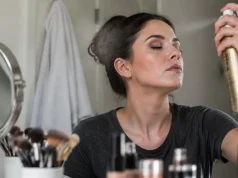
Someone can build a beautifully sensitive-skin-appropriate base and then use a setting spray that dismantles it entirely. This is where a lot of people lose the thread. Setting products sprays, powders, primers used as sealants are often formulated with alcohol as the primary carrier because it evaporates fast and creates that instant-set effect. On sensitive skin, this is the equivalent of finishing a careful construction project and then throwing a lit match at it.
Alcohol-free setting sprays have improved dramatically. Water-based formulas using glycerin, aloe vera, and gentle film-forming agents can extend wear without the inflammatory payload. The finish may not be as instantaneously locked as the alcohol versions, but the difference in longevity is smaller than it once was, and the absence of redness and burning is not a small thing.
Setting powders carry their own considerations. Translucent powders with high talc concentrations can be drying over the course of a day, particularly for skin that skews toward sensitivity combined with dryness. Finely milled rice powder-based formulas or those with added skin conditioning agents tend to sit more comfortably. The key is avoiding anything with added fragrance a surprisingly common addition to face powders given that their entire job is to sit on the face for hours.
Reading the Room: Patch Testing, Ingredient Lists, and the Reality of Individual Variation
There is no universal sensitive skin formula. That’s the uncomfortable truth that sits underneath all of this. The ingredient that triggers a reaction in one person may be completely tolerated by another, and the physiology of why is still not fully understood. A person with rosacea has different triggers than someone with eczema or contact dermatitis, even though both might describe themselves as having sensitive skin.
Patch testing on the inner arm before full-face application is a recommendation so frequently given that it’s become background noise but it genuinely does catch reactions before they become full-face disasters. Cosmetic dermatologists increasingly recommend a48-to-72-hour patch test for new products, not just a quick10-minute check.
There’s also the cumulative exposure problem. A formula might be individually tolerable, but worn on skin that’s already using a retinol-based serum, a chemical exfoliant, and an active vitamin C treatment, the total burden on the barrier tips it into reaction territory. Long-wear makeup sits on top of everything else, extended contact multiplies the potential for sensitization, and it’s worth thinking about the full stack of what’s touching the skin rather than evaluating each product in isolation.
When Wear Really Works
The products that consistently perform for sensitive skin aren’t necessarily the ones marketed loudest in that category. Some of the most effective gentle long-wear formulas come from brands that built their entire identity around dermatological standards not because of better marketing, but because the formulation philosophy was different from the start. Fewer ingredients. No fragrance by design rather than as an afterthought. Preservation systems chosen for efficacy with minimal reactivity.
Wear time on sensitive skin is also partly a skin prep story. A well-moisturized, barrier-supported skin surface holds makeup more evenly and reduces the mechanical stress of a formula trying to adhere to dry, uneven patches. The foundation doesn’t have to work as hard, and working less hard means less friction, less potential for sensitization over the course of a day.
The old assumption that glowing, lasting, polished skin and reactive skin were simply incompatible was always more about formulation limitations than skin limitations. The skin has its own rules. It just took the industry a while to start actually listening.