
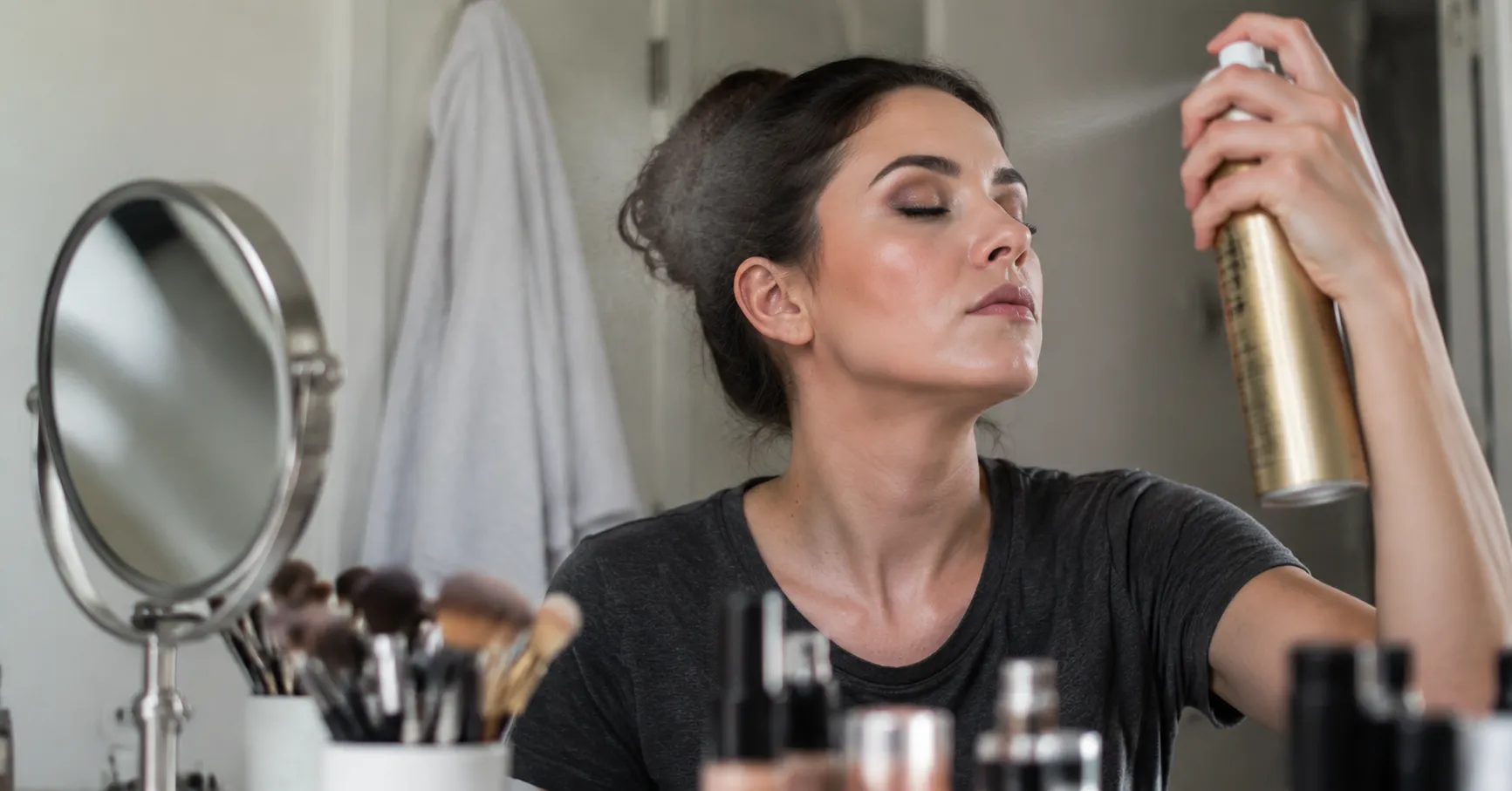
There’s a particular kind of confidence that lives on TikTok. It shows up in the form of a30-second video, a ring light, and someone holding a can of Elnett like it’s the answer to every beauty problem you’ve ever had. The claim sounds almost too practical: spray hairspray over your finished makeup, and it locks everything in place for hours. No expensive setting spray needed. No trip to Sephora. Just the same can sitting on your bathroom shelf since last winter.
We tried it. So did a lot of people. And the results were… instructive.
Where the Idea Comes From
The logic isn’t entirely baseless, which is part of why it spread so fast. Hairspray and setting spray do share some surface-level chemistry both are designed to hold something in place using polymer-based formulas. Setting sprays typically use ingredients like alcohol, water, and film-forming polymers specifically calibrated for facial skin. They’re tested for eye safety, skin sensitivity, and wear time on makeup. Hairspray uses many of those same polymer families, but it’s engineered for a completely different substrate: the hair shaft.
That distinction matters more than it sounds. Hair is dead. Skin is not.
The versions of this hack circulating online tend to trace back to older beauty forums from the early 2010s, when budget beauty workarounds were a real genre. Back then, the idea had a certain scrappy appeal. Setting sprays were less accessible, and the overlap in function seemed reasonable enough to try. What TikTok did was strip away the caveats, compress a decade of trial-and-error into a trend sound, and deliver it to14million people in the span of a week.
What Actually Happens When You Spray It On Your Face
The first thing you notice is the smell. Hairspray is not shy about its chemical presence. On hair, that dissipates quickly the spray lands and you move on. On your face, held close to your nose and mouth, the alcohol and fragrance hit differently. Several people who tried the hack on camera mentioned an immediate stinging sensation around the eyes, which makes sense: most hairsprays carry warnings against exactly that kind of exposure.
Within a few hours of wear, the skin starts to feel tight in a way that’s distinct from a normal setting spray finish. Setting sprays are formulated to be flexible they move with facial expressions, they allow for moisture transfer. Hairspray creates a more rigid film. On the hair shaft, rigidity is the point. On skin that smiles, squints, and stretches, that film starts to crack and pull unevenly. The makeup underneath doesn’t so much “set” as it does fracture along expression lines by mid-afternoon.
For people with drier skin, the effect is amplified. The alcohol content often higher in aerosol hairsprays than in setting sprays strips surface moisture and leaves the face feeling parched. For oilier skin types, the rigid film traps sebum underneath rather than managing it, leading to a slightly concerning texture shift by hour three.
None of this is catastrophic in a single-use scenario. But “not catastrophic once” is a low bar.
The Dermatology Side of the Argument
The skin on your face is thin, sensitized by years of product use, sun exposure, and general living. It’s also full of openings pores, hair follicles, sebaceous glands that are actively doing things throughout the day. Introducing a product designed for a non-porous surface into that environment invites some predictable problems.
Hairspray formulas often contain strong hold polymers like PVP (polyvinylpyrrolidone) and VA/Crotonatescopolymers. These are generally considered safe for cosmetic use on hair but haven’t undergone the same kind of facial skin safety testing that regulated cosmetic products require. When they sit on skin for hours and then get removed often with more rubbing and effort than a standard makeup removal routine there’s opportunity for barrier disruption.
Fragrance is the other issue. Fragrance in hairspray is rarely formulated with sensitive facial skin in mind. It’s there to cover the alcohol smell and give the product a pleasant in-shower association. On the face, those fragrance compounds are sitting close to mucous membranes, in contact with thin periorbital skin, for extended periods. Dermatologists have been consistent on this point for years: fragrance on the face is one of the most common triggers for contact dermatitis, and hairspray fragrances aren’t optimized for that context.
None of which means everyone who tries this hack will break out or have a reaction. Skin varies enormously. But the risk profile is real, and it’s asymmetric the downside (irritation, breakouts, sensitization over time) is meaningfully worse than the upside (saving $18 on a bottle of setting spray).
The Economics of the Hack Don’t Actually Add Up
The appeal of the hack is framed as a money-saving move, and that framing is worth interrogating. A decent setting spray costs somewhere between $10 and $30 and lasts three to six months with regular use. Hairspray costs roughly the same. You’re not saving money you’re substituting one expenditure for another while also assuming a product risk that the cheaper item wasn’t designed to carry.
The real savings argument would require someone to already own hairspray and not own setting spray, and to somehow acquire setting spray at a cost that exceeds the dermatological risk of skipping it. That’s a narrow scenario. For most people watching the video, trying the hack means using a product they probably already use for its intended purpose and hoping it performs a different job equally well.
There are genuinely good budget beauty alternatives. Glycerin mixed with water in a small spray bottle approximates the hydrating function of many setting sprays. Some rosewater sprays genuinely help lock in powder products. These aren’t as dramatically counterintuitive as the hairspray hack, which is probably why they don’t go viral but they’re also not asking your pores to host a polymer film designed for the dead ends of keratin strands.
What This Says About How We Learn Beauty Now
The hairspray hack isn’t really about hairspray. It’s about the specific way TikTok transmits information compressed, confident, stripped of context. A video that shows a glowing face and credits hairspray has no room for “unless you have sensitive skin” or “results varied significantly across testers.” The format selects for spectacle over nuance, and beauty content is particularly susceptible to that dynamic because the results are so visually legible. The face either looks good or it doesn’t. What’s happening inside the pore is invisible.
There’s also something about the aesthetic of the resourceful workaround that makes us want it to be true. Using a household staple as a luxury substitute feels clever. It feels like insider knowledge. It has the emotional texture of a tip passed between friends rather than the sterile authority of a product label. And that feeling is persuasive in a way that a dermatologist’s measured caution rarely is.
Which is not to say all TikTok beauty hacks are wrong. Some are genuinely useful silk pillowcases do reduce hair breakage, slugging with petroleum jelly does help moisture retention, and the cold water hair rinse has real basis in cuticle biology. The platform isn’t uniformly bad at beauty information. It’s just bad at communicating the limits of that information, and the hairspray hack is a clean example of what happens when the limits are the whole story.
The can is still on your shelf. It does its job well. It just doesn’t need a new one.