

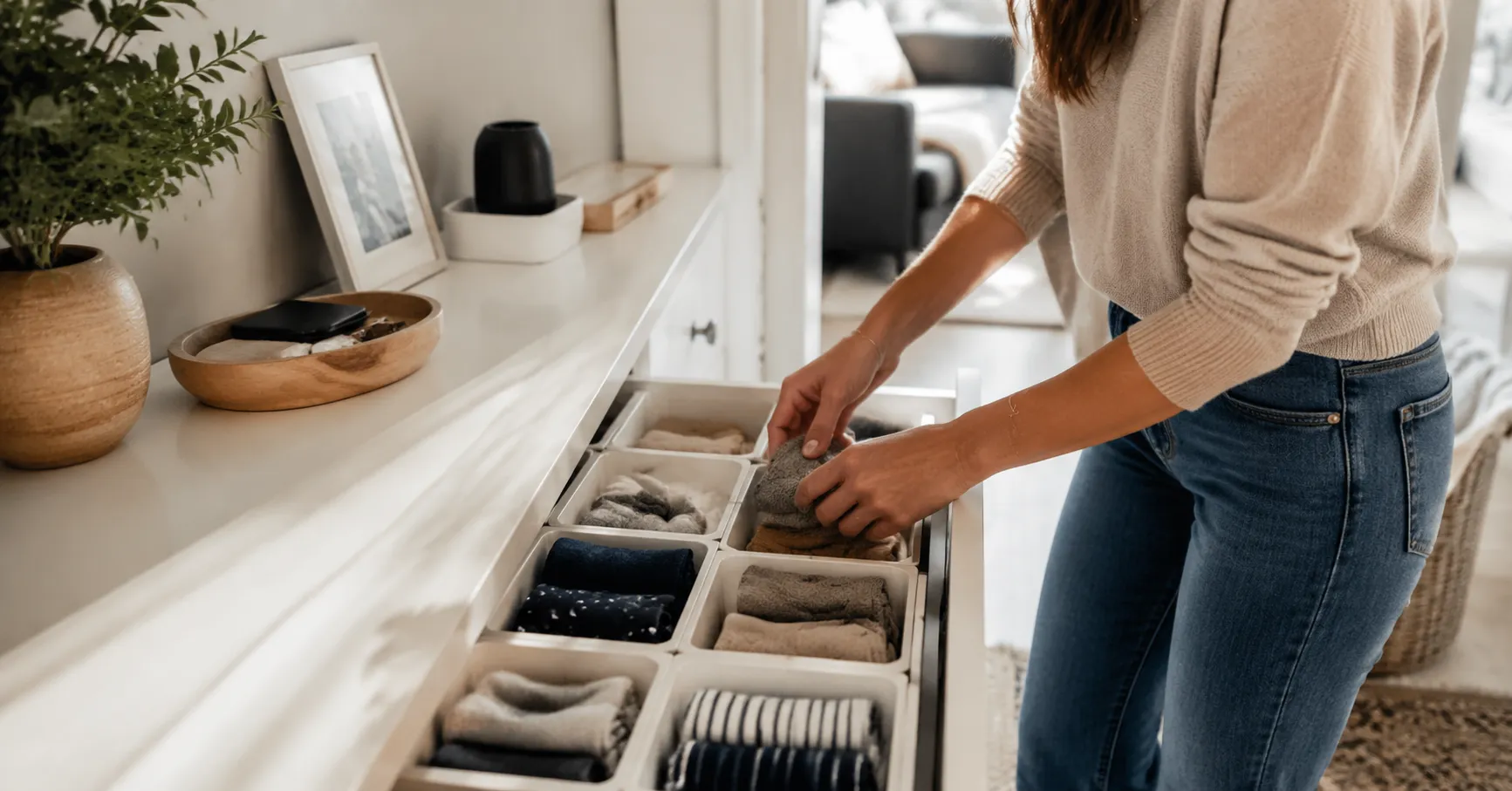
There’s a certain kind of home that stops you the moment you walk in. Nothing is out of place. The surfaces are clear. The air feels lighter somehow. You look around trying to find the catch a junk drawer left open, a stack of mail on the counter, a pair of shoes kicked off near the door and there isn’t one. You leave thinking the person who lives there must have some extraordinary gift for tidiness, or maybe just way too much free time.
Neither is usually true.
The real explanation is less glamorous and far more useful. People whose homes consistently look clean and organized aren’t cleaning more than everyone else. They’ve just built a completely different relationship with their space one where disorder doesn’t get a chance to accumulate in the first place.
It’s Not About Cleaning. It’s About Systems.
Most people think of cleaning as something you do when things get bad enough. The dishes pile up, the laundry overflows, the bathroom reaches a certain threshold of grime, and then you spend a Saturday afternoon fixing it. That cycle feels normal because for most of us, it is. But it also means you’re always reacting, always catching up, always spending more time and energy than you would if things hadn’t drifted so far.
People with perpetually clean homes operate differently. They don’t wait for the mess to demand attention. They’ve set up small, nearly automatic habits that prevent the mess from forming at all. The dishes get washed while the coffee is brewing. Clothes go directly into the hamper or back on the hanger, never onto the chair. Mail gets sorted the second it comes through the door.
None of these actions take much time individually. That’s precisely the point. A task that takes forty-five seconds now will take fifteen minutes later once it’s merged into a pile of other forty-five-second tasks you also postponed.
The Invisible Architecture of an Organized Space
Walk through a chronically cluttered home and a habitually clean one, and you’ll notice a structural difference before you notice anything else. In the cluttered home, things exist wherever they were last used or last put down. In the clean home, nearly everything has a designated place and those places were chosen deliberately, based on how the home is actually lived in rather than how someone imagined it might be lived in.
This distinction matters more than it sounds. A lot of organizing efforts fail because people buy storage solutions that look good but don’t match their real behavior. They put the keys on a hook by the back door when they always enter through the garage. They designate a charging station in the office when they actually use their phone in the living room. The system fights the habit, and the habit wins every time.
The homes that stay organized are built around honest observation. Where do you actually put your coat when you come in? Where does your kid actually drop their backpack? Where do the remotes actually end up? Design storage around the answers to those questions, not around the ideal version of yourself you’re hoping to become.
Owning Less Is a Form of Maintenance
There’s a reason why people who’ve significantly pared down their possessions tend to have cleaner homes, and it’s not just that there’s less stuff to put away. It’s that every object you own is a small ongoing commitment. It needs to be stored somewhere, cleaned occasionally, moved when you’re looking for something else, and considered every time you’re trying to organize the space around it.
Multiply that by hundreds or thousands of objects, many of them things you rarely use or don’t particularly love, and you start to understand why some homes feel exhausting just to maintain. The problem isn’t the cleaning. It’s the inventory.
This doesn’t mean you have to become a minimalist in any extreme sense. It means periodically asking a very simple question about the things in your home: does this earn its space? A great knife that you use every day earns its counter space. A blender you’ve used three times in four years probably doesn’t earn a full cabinet shelf. Applying that question honestly, even once a year, does more for the long-term cleanliness of a home than any organizational system you could build around the clutter.
The Psychology of Visual Noise
Clean homes look clean even when they’re not perfectly clean. That sounds like a contradiction until you understand what the eye actually registers. Mess is primarily a visual experience. What makes a space feel chaotic isn’t microscopic bacteria or hidden dust it’s the visual noise of too many unrelated objects competing for attention at the same time.
Contain the visual noise and the space feels ordered, even if it isn’t scrubbed. This is why a room with clean surfaces and a hidden pile of unsorted things in the closet will feel calmer than a spotless room with twenty small decorative objects scattered across every flat surface. Your eye can only process so much before it signals overwhelm.
People who maintain beautiful homes tend to be ruthless about horizontal surfaces. Counters, tables, shelves, nightstands these are not storage areas. They’re stages. What sits on them should be intentional, whether that’s a single plant, a lamp, or nothing at all. The moment a surface becomes a landing zone for random objects, the room starts to read as chaotic regardless of how clean everything technically is.
The Habit Most People Skip
There’s a specific practice that shows up in almost every consistently clean home, and it rarely gets mentioned in cleaning advice because it sounds too simple: a short reset at the end of each day.
Not a full clean. Not a deep dive into the kitchen or a reorganization of the closet. Just ten minutes, maybe fifteen, of returning things to where they belong. Cushions straightened. Dishes done. Items left out during the day put back in their places. Papers filed or moved to a designated spot for tomorrow.
It costs almost nothing in time. But it means you never wake up to a home that already feels behind. It means guests can arrive with an hour’s notice and find a space that feels lived-in but controlled. More than that, it creates a subtle but real psychological effect the feeling that your environment is something you manage rather than something that manages you.
That feeling compounds. When a space feels controllable, people naturally keep it more controlled. When it feels already lost, the effort of one more item out of place seems pointless. The reset habit doesn’t just maintain the home. It maintains the mindset that makes the home worth maintaining.
What Nobody Tells You About Cleaning Motivation
The people who struggle most with keeping a home clean often describe it as a motivation problem. They know what needs to be done. They just can’t make themselves do it consistently. What they usually don’t recognize is that the problem often runs in the opposite direction from what they assume.
They think: if I could just get motivated, I’d clean more, and then my home would look better, and then I’d feel better about it. But the actual sequence tends to be reversed. When the space looks reasonably good, maintaining it feels manageable. When it’s already in a state of visible disorder, every cleaning task feels like it has to compete against all the other cleaning tasks before any of them are worth starting.
Start with the smallest possible action clear one counter, deal with one pile, do one load without worrying about the rest. The environment begins to shift, and the motivation tends to follow the action rather than precede it. That’s not a trick. It’s just how humans actually function, which is something that most advice about organization quietly skips over.
The homes that always look clean aren’t maintained by people who never feel tired or busy or overwhelmed. They’re maintained by people who learned, at some point, that the cost of staying on top of a space is almost always lower than the cost of reclaiming it. Once that math becomes intuitive, the whole thing gets easier. Not easy. Just easier.