
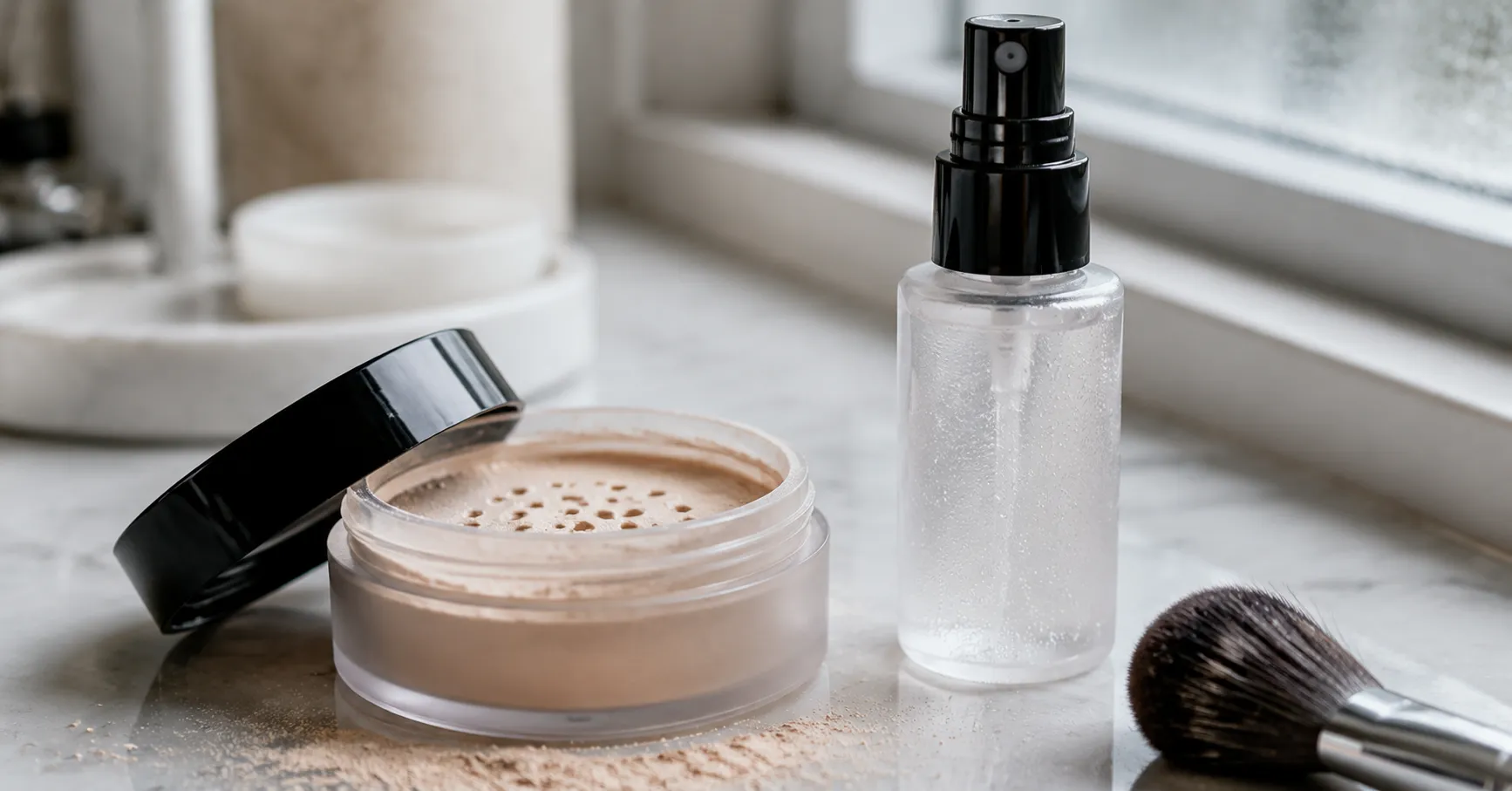
There’s a moment every makeup wearer knows well you’ve blended everything perfectly, your base looks seamless, and then comes the quiet anxiety: will this actually last? That’s where setting products enter the conversation. But standing in front of a vanity full of options, or scrolling through an endless feed of beauty recommendations, the choice between a setting powder and a setting spray can feel genuinely confusing. They both promise longevity. They both claim to “lock in” your look. So what’s actually different, and more importantly, which one belongs in your routine?
The answer isn’t one-size-fits-all and that’s precisely what makes this worth unpacking properly.
What Each Product Is Actually Doing to Your Skin
Setting powder and setting spray aren’t just different formats of the same idea. They work through entirely different mechanisms, and understanding that is the foundation of making a smart choice.
Setting powder is a physical product finely milled particles, typically made from silica, talc, kaolin clay, or rice starch, that sit on top of the skin and absorb excess oil. When you press or dust powder over your foundation, you’re essentially creating a matte layer that reduces shine and helps prevent makeup from sliding. It also does something more structural: it sets emulsion-based foundations by drawing moisture out of them, allowing them to “cure” and adhere more firmly.
Setting spray works differently. Most formulas are water-based and contain film-forming agents polymers that essentially create a thin, flexible mesh over your makeup as the water evaporates. Some sprays also contain alcohol, which speeds up that evaporation and creates a tighter seal. The result is that all the layers of your makeup primer, foundation, concealer, contour get fused together rather than sitting as separate, moveable components. It doesn’t just top off your look; it binds it.
Knowing this, you can already start to see why skin type matters so much here.
Oily Skin: Where Powder Has the Obvious Advantage
If your skin produces a lot of sebum throughout the day, setting powder is probably your most reliable ally. The absorbent ingredients in a translucent or mattifying powder actively soak up that oil, which is exactly what oily skin needs. A setting spray, by contrast, adds a layer of hydration back onto skin that’s already dealing with excess moisture not always ideal.
That said, the picture isn’t entirely black and white. Oily skin users who want a natural, skin-like finish rather than a matte one can use a setting spray with a light hand, focusing on areas that genuinely need the longest-lasting hold (like under the eyes, where concealer tends to crease). Pairing both powder where you need oil control, spray to finish is actually a technique many professional makeup artists use on clients with combination skin or oily T-zones. The powder handles the biology; the spray handles the cohesion.
One caveat for oily skin: heavy-handed application of powder can look cakey as the day goes on, especially if oil eventually breaks through and mixes with the product. Pressed powders tend to be more concentrated than loose powders, so loose translucent powder applied with a light dusting motion often ages better on the skin throughout the day.
Dry Skin: Where the Equation Flips
For dry skin, powder can be genuinely problematic. It pulls moisture from wherever it lands, and on already-dehydrated skin, that means fine lines and dry patches become more visible, sometimes almost immediately. There’s a specific kind of texture horror a powdery, almost chalky look that happens when setting powder meets dry skin, and it’s difficult to undo once it’s set.
A setting spray is typically the much friendlier option here. It adds a slight veil of hydration, and the film-forming effect can actually make dry skin look more plump and luminous rather than tight and dusty. Hydrating setting sprays with ingredients like glycerin, aloe vera, or hyaluronic acid are particularly well-suited to this skin type they’re not just locking in your makeup, they’re supporting your skin barrier at the same time.
If you have dry skin and feel you need some powder for coverage reasons (to set under-eye concealer, for example), targeted application with a small brush or a beauty sponge used to press rather than dust can minimize the drying effect. Following immediately with a setting spray helps re-introduce that moisture and smooth out any powder texture before it becomes a problem.
Sensitive and Acne-Prone Skin: Look Beyond the Format
This is where the powder vs. spray debate matters less than what’s actually in the formula. Sensitive skin can react poorly to fragrance, alcohol, talc, and certain preservatives all of which appear in both powders and sprays depending on the brand.
For acne-prone skin specifically, heavy powders containing talc can occasionally contribute to clogged pores, while alcohol-heavy setting sprays can disrupt the skin barrier and trigger breakouts or irritation. Neither format is inherently safe or unsafe; the ingredient list is what demands attention.
Non-comedogenic, fragrance-free options exist in both categories. Mineral-based setting powders those built on silica ormica without talc tend to be gentler. Water-based setting sprays with minimal ingredients and no denatured alcohol are usually the better choice for reactive skin. The format is secondary; the formulation is everything.
The Finish Factor: Matte, Dewy, or Natural
Beyond skin type, the finish you want plays a significant role in this decision and it’s something that often gets overlooked in favor of the oil-control conversation.
Mattifying powders, as the name suggests, reduce shine and create a flat, even finish. This is ideal for photography, long days in warm environments, or anyone who simply prefers a polished, less-shiny look. But matte isn’t always flattering on certain skin tones and textures, an overly flat finish can make skin look less dimensional and even somewhat dull.
Setting sprays tend to preserve whatever finish your foundation already has, while adding a slight luminosity from the water content. Some sprays are specifically formulated to be “dewy” or “glazed,” actively enhancing glow. Others are “matte” sprays that contain more alcohol and film-forming agents to reduce shine. The category has become remarkably specific.
There’s also the question of what you’re setting. A full-coverage matte foundation on combination skin might benefit from a light translucent powder through the T-zone, then a hydrating spray over the rest of the face. A tinted moisturizer on dry skin probably wants nothing more than a quick mist of a setting spray to extend wear. The product should serve the look, not override it.
Longevity in Real Conditions
Lab conditions and real life are very different things. A setting product that performs beautifully in an air-conditioned office can fall apart in summer humidity or during a long shift on your feet. This is worth thinking about honestly.
Setting sprays generally outperform powders in humid conditions because they form that binding layer over everything rather than sitting on top as a separate, potentially unstable coat. The physical layer of powder can dissolve or shift when moisture hits it from the outside (humidity, sweat) combined with moisture from underneath (sebum). A spray-set face tends to hold its shape better because the layers are fused.
Powders, on the other hand, tend to have the edge in dry or cool conditions and for touch-ups throughout the day. You can’t realistically carry a setting spray and give yourself a mid-afternoon refresh in a public bathroom, but a compact powder is entirely practical. Convenience matters. Routine adherence matters. The best product is often the one you’ll actually use consistently.
Can You Use Both?
Yes, and many people should. The “baking” technique applying thick translucent powder under the eyes and letting it sit for several minutes before brushing away is traditionally finished with a setting spray to melt the powder into the skin and prevent a cakey finish. It’s a widely used method in drag and stage makeup precisely because it offers both the structural durability of powder and the skin-like blending of a spray.
For everyday use, a light dusting of powder to control oil in key areas followed by a fine mist of setting spray tends to give the most balanced result across skin types. The two products are less in competition than they are complementary tools that solve different parts of the same problem.
The real question was never which one is better. It was always: what does your skin actually need today?