

There’s a reason your skincare routine sometimes feels like throwing money at a wall. You’ve tried the serums, the overnight masks, the exfoliants with the intimidating ingredient lists and yet your skin still looks dull, feels tight, or breaks out in ways that make no sense. The products aren’t necessarily bad. The problem, more often than not, runs deeper. It lives in something most people walk past in beautyaisles without ever stopping to consider: the skin barrier.
It’s not a glamorous concept. It doesn’t have the aspirational ring of “glass skin” or the clinical prestige of retinol. But the skin barrier that thin, complex outer layer made up of cells and lipids is the actual architecture everything else rests on. Ignore it, and no amount of niacinamide or vitamin C is going to save you.
What the Skin Barrier Actually Is (and Why It Gets Damaged)
Think of the skin barrier as a brick wall. The cells are the bricks; the lipids ceramides, fatty acids, cholesterol are the mortar holding them together. When that mortar is intact, moisture stays in and irritants stay out. When it degrades, the whole structure becomes porous and reactive. Water escapes. Allergens, pollution, and bacteria slip through.
The trouble is, modern skincare culture has a complicated relationship with this wall. We’ve become obsessed with “active” ingredients acids that exfoliate, retinoids that accelerate cell turnover, vitamin C formulas that sting a little and somehow feel more effective because of it. All of these can be genuinely useful. But applied too aggressively, too frequently, or on top of a barrier that’s already compromised, they don’t fix your skin. They accelerate the breakdown.
Environmental factors pile on from the outside: UV radiation, pollution, low humidity, hard water, and cold air all strip away those critical lipids over time. Add a harsh cleanser used twice a day, a few aggressive exfoliating sessions a week, and the occasional “why not” peel, and you’ve essentially been sandblasting a wall that was already crumbling.
The Signs Are There If You Know How to Read Them
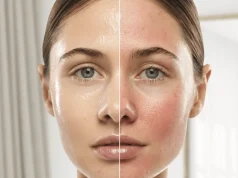
Barrier damage doesn’t always announce itself loudly. Sometimes it looks like redness that never fully clears up. Sometimes it’s a persistent dry patch near the corners of your mouth, or the way your skin feels tight ten minutes after washing even though you moisturize religiously. Sensitivity that seems to come out of nowhere products you’ve used for years suddenly causing stinging or breakouts is one of the most telling signs.
Acne-prone skin is particularly misread here. The instinct when breaking out is to reach for stronger actives, more aggressive acids, higher-percentage treatments. But chronic breakouts in adults are often a barrier story in disguise. When the skin’s protective layer is weak, the microbiome shifts. Pathogenic bacteria find it easier to take hold. Inflammation becomes the default state. You treat the breakouts and create more barrier damage in the process and then wonder why the cycle never ends.
Eczema, rosacea, and perioral dermatitis are conditions with distinct pathologies, but impaired barrier function is a thread running through all of them. This isn’t coincidental. It suggests that the barrier isn’t just about keeping skin hydrated and plump it’s central to how skin regulates its own immune response.
What Repair Actually Looks Like
Healing a damaged barrier is less about adding things and more about removing the wrong ones. For most people, that means a temporary simplification fewer products, gentler formulations, longer gaps between actives. The skin needs time to do the work it’s designed to do, which it can’t accomplish when it’s constantly managing chemical inputs.
Ceramide-based moisturizers are the clearest category of support. Ceramides are one of the primary lipids the barrier depends on, and they deplete with age, over-washing, and UV exposure. Replacing them topically has a documented effect on barrier integrity. Products containing ceramides alongside cholesterol and fatty acids in a ratio that mirrors the skin’s natural composition tend to perform better than those with ceramides alone the skin appears to absorb and integrate them more efficiently when the surrounding formula resembles what it’s trying to rebuild.
Niacinamide deserves its reputation here too, though for reasons that get underexplained. Most discussions focus on its brightening or pore-minimizing effects. What’s less often mentioned is that niacinamide stimulates the production of ceramides and other key lipids from within, essentially signaling the skin to improve its own barrier synthesis. It works differently from ceramides applied directly, and the two approaches complement each other in ways that feel almost methodical.
Hyaluronic acid, despite its omnipresence in moisturizers, is a supporting player rather than a lead. It pulls water into the skin effectively, but without occlusive or lipid-based ingredients sealing that moisture in, it can actually draw water out of the deeper layers of skin in dry environments. Context matters enormously.
The Mindset Shift That Changes Everything
What makes barrier health genuinely difficult to prioritize is that it demands patience in an industry engineered around the idea of visible, immediate results. The products that rebuild the barrier quietly the fragrance-free moisturizers, the gentle cleansers, the periods of deliberate restraint don’t photograph dramatically. There’s no ten-day transformation to post.
But people who’ve spent years cycling through aggressive routines and finally committed to barrier-first thinking tend to describe the shift in surprisingly similar terms. The first thing they notice isn’t glowing skin. It’s that their skin stops being a problem to manage. The reactivity settles. The products they do use start working more predictably because they’re landing on a surface that can actually process them rather than fight them off.
This is where the “foundation” metaphor earns its weight. A foundation isn’t visible in a finished building. You don’t admire it. But everything that stands on top of it the architecture, the interiors, the things you actually came to see depends entirely on its soundness.
Skin that looks genuinely healthy, the kind that holds texture and light in a way that isn’t reducible to a single product, is usually skin with an intact barrier underneath it all. The rest is secondary. Not irrelevant secondary.
There’s something almost relieving about that, once it lands. The answer was never more products. It was understanding what needed protecting in the first place.