
The Quiet Power of Looking Like You Don’t Need to Prove Anything
There’s a certain kind of person who walks into a room and you can’t quite place why they look so put-together. No visible brand name. No flashy hardware. No statement piece screaming for attention. Yet something about them reads expensive the way a well-aged wine tastes expensive before you even check the label. That quality has a name, and it’s not “luxury.” It’s intentionality.
Most people misunderstand what expensive actually communicates. They think it means logos, it means status symbols, it means wearing the receipt on your sleeve. But the people who have truly mastered the art of looking wealthy are the ones who’ve quietly retired that instinct. Old money has always known this. New money is slowly learning it. And the rest of us? We’re somewhere in between, trying to decode a visual language that the fashion world deliberately keeps half-hidden.
This is about learning that language.
Fit Is the Only Thing That Actually Matters
You could buy a $40shirt and a $4,000 shirt and put both on without alterations. In most cases, the $40 shirt that fits your body correctly will look better. That’s not a hot take that’s just how clothing works. Garments are designed on standardized body forms that don’t match most real human proportions, which means almost everything off the rack needs some degree of tailoring.
The things to pay attention to: shoulder seams sitting exactly at the edge of your shoulder bone, not creeping down your arm. Shirt collars lying flat without gaping. Trousers breaking cleanly at your shoe not bunching, not hovering too high. The sleeve ending just past your wrist bone. These details are so small that most people never consciously register them, but their absence registers immediately as something being slightly off.
The beautiful irony of tailoring is that it’s genuinely affordable. A good tailor can adjust a hem, take in a waist, or shorten a sleeve for under $30. Do that to three or four pieces you already own and you’ll look like you spent three times what you did.
Color as a Strategy, Not a Mood
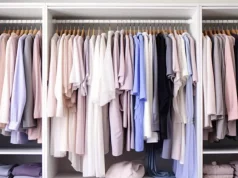
Color is one of the most underused tools in building a polished wardrobe, and it’s almost entirely free to employ. The visual logic is straightforward: a monochromatic or tonal outfit where everything exists in the same color family or along a coherent spectrum reads as deliberate. It looks curated. The eye travels smoothly across the whole silhouette instead of catching on clashing contrasts.
Think of how understated a head-to-toe camel looks in autumn. Or all-navy. Or varying shades of gray. There’s a reason so many truly well-dressed people gravitate toward capsule wardrobes built around neutral anchor tones. It’s not conservatism it’s strategy.
That said, color contrast done intentionally is equally powerful. The key word is intentional. A single pop of deep burgundy against charcoal, a white shirt under an olive coat these work because they feel considered. What doesn’t work is the visual noise of five competing colors that each arrived from a different decision on a different morning.
Fabric Reveals Everything You’re Trying to Hide
Fabric is where the gap between “looks fine” and “looks expensive” really lives. And this is the one area where spending money does matter but you don’t need to spend a lot if you know where to look.
Synthetic fabrics have a way of catching light wrong. Polyester under fluorescent lighting develops a faint plastic sheen. Acrylic knitwear pills within weeks. Cheap cotton loses its structure after a handful of washes and starts to hang like a rag. None of these failures are catastrophic on their own but they accumulate, and the cumulative effect is that your clothes start looking worn even when they’re relatively new.
Natural fibers wool, cotton, linen, silk, cashmere behave differently. They drape with weight. They age gracefully. A good linen shirt wrinkles in a way that looks lived-in rather than neglected. A heavy wool coat doesn’t lose its shape after a season. The investment in a few quality natural-fiber pieces, bought on sale or secondhand, consistently outperforms a closet full of fast fashion that was never going to look expensive no matter what you paid.
Thrift stores and resale apps like Poshmark or TheRealReal have quietly democratized access to quality fabrics. A cashmere turtleneck from a heritage brand bought secondhand for $35 beats a brand-new fast fashion equivalent at any price.
The Invisible Details Nobody Talks About
Grooming and accessories exist in a weird blind spot in most style conversations people talk about clothes endlessly and barely mention the things that frame them. But a great outfit sitting above unpolished shoes is a non-starter. Shoes carry enormous visual weight; they’re often the first and last thing people notice. Clean, well-maintained shoes even inexpensive ones communicate care in a way that elevates everything above them.
Nails, hair, the condition of a bag, the state of a watch strap these are all signals. Not because anyone is consciously auditing your accessories, but because the human eye is wired to detect inconsistency. When everything in a person’s presentation is at roughly the same level of quality and care, the overall impression coheres. When one element breaks that coherence, the whole thing slightly unravels.
The goal isn’t perfection. It’s consistency.
Restraint as Aesthetic Philosophy
There is a reason the most influential wardrobes of the past century Steve Jobs in black turtlenecks, Katharine Hepburn in high-waisted trousers, the perpetual minimalism of Giorgio Armani’s personal style are so consistently discussed. They made a decision and committed to it. The decision itself wasn’t remarkable. The commitment was.
Restraint is harder than it looks because it requires resisting the impulse to add. More accessories, another color, a louder print. Each addition feels like enhancement and occasionally is but more often it’s noise. The most powerful pieces of clothing let the person wearing them lead. They support rather than perform.
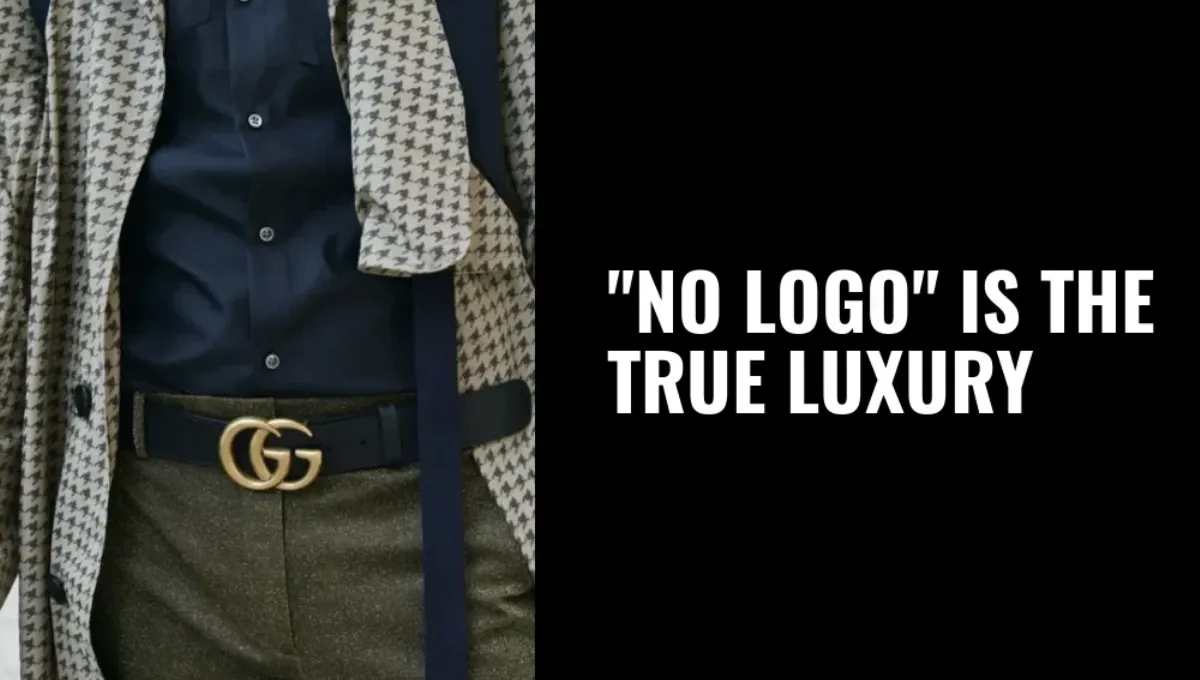
This is ultimately what separates a logo-heavy look from one that reads as effortlessly refined. The logo announces the brand because the brand needs announcing either to signal status or to fill the visual space that intentional design would otherwise occupy. Removing the logo is an act of confidence. It says: what I’m wearing doesn’t need a signature because the whole picture speaks clearly enough on its own.
That picture fit, fabric, color coherence, maintained details, deliberate restraint is one that anyone can build over time, piece by piece, without a single ostentatious label in sight.
The most expensive thing you can wear is the sense that you already know exactly who you are.