
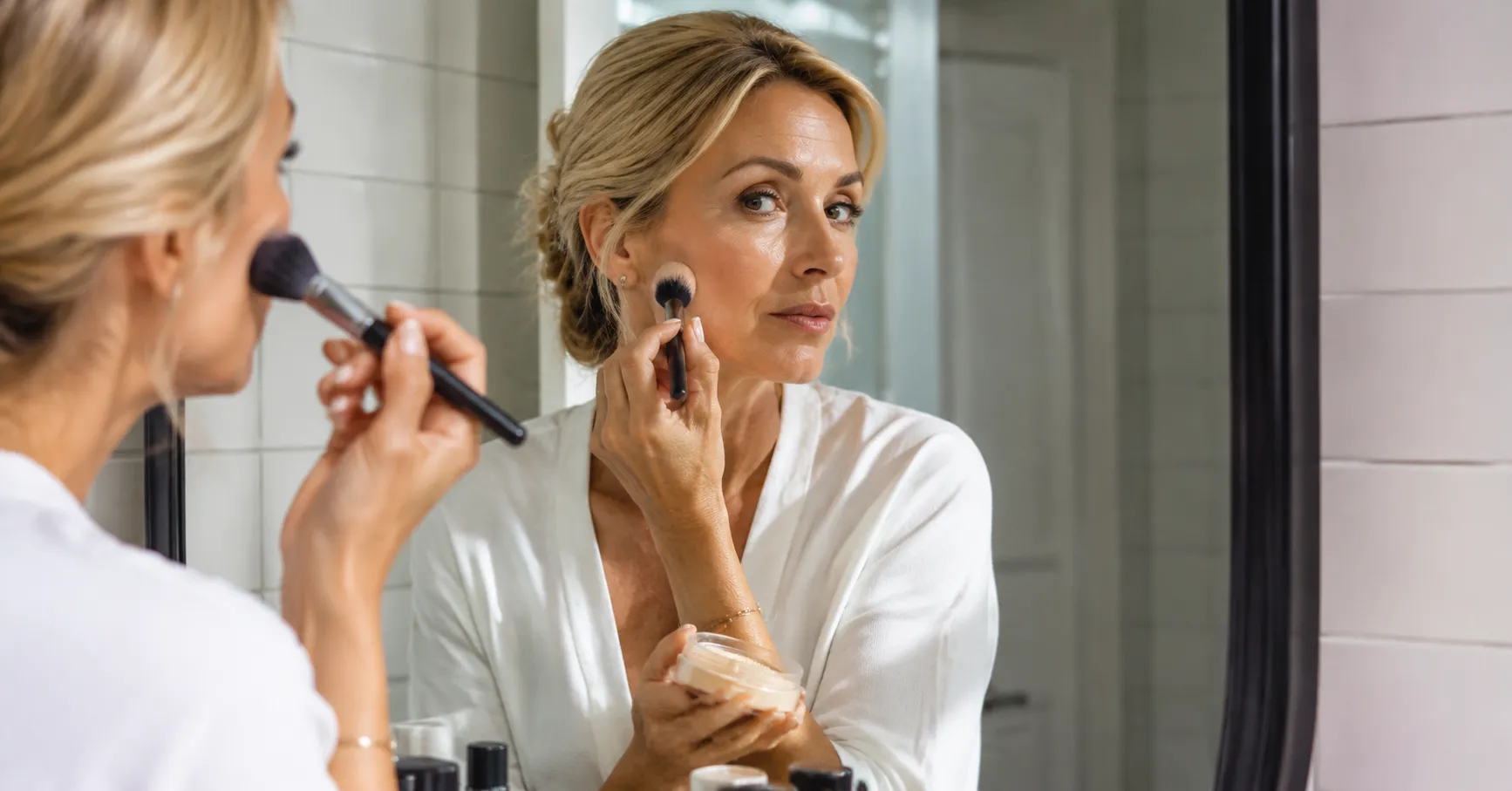
There’s a particular kind of makeup mistake that’s almost invisible in the moment you’re standing in your bathroom under flattering light, your face looks smooth and matte, and you feel put-together. Then you step outside, or you catch a glimpse of yourself in a car mirror, and something looks off. You look older. Not dramatically, not in a way you can immediately pinpoint, but the light catches your face differently and suddenly you look tired, drawn, a little powdery. Like you’re wearing a mask rather than a face.
Setting powder is often the culprit. And the frustrating part is that most people are applying it exactly the way they were taught to which is precisely the problem.
The Myth of the Full-Face Set
For decades, the standard advice was simple: after foundation, dust setting powder all over your face to lock everything in place. The logic made sense on a surface level. More coverage, longer wear, no shine anywhere. Beautycounters sold it. Tutorials reinforced it. And for a long time, nobody really questioned whether “matte everywhere” was actually flattering.
Here’s what that advice never accounted for: as skin matures and this starts happening earlier than most people think, sometimes in the late twenties it loses moisture, elasticity, and the natural luminosity that comes with both. Fine lines become more visible not because they’ve suddenly deepened overnight, but because dry texture catches light differently than plump, hydrated skin does. Setting powder, which works by absorbing oil and creating a flat matte finish, essentially amplifies that effect. It sits in fine lines. It settles into textured areas. It makes the surface of the face look less like skin and more like a painted surface.
The real issue isn’t the powder itself. It’s where it goes.
Understanding How Light Reads the Face
Before changing your powder application, it helps to understand what you’re actually trying to achieve and what you’re accidentally doing when you apply powder in the wrong places.
Light and shadow are how we read dimension on a face. Areas that catch light appear to come forward; areas in shadow appear to recede. This is the entire foundation of contouring, highlighting, and every other technique that attempts to sculpt the face using makeup. When you apply matte setting powder uniformly across your face, you’re essentially flattening that dimension. Every zone gets the same finish. Nothing advances, nothing recedes. The face reads as a single flat plane.
Now add fine lines or dryness to that flat plane, and the problem compounds. Powder sitting in the creases around the eyes, along the nasolabial folds, across the forehead it catches in those grooves and makes them appear deeper than they actually are. The zones that most benefit from a little luminosity, the high points of the cheekbones, the bow of the upper lip, the center of the forehead, are stripped of any light-reflective quality.
This is why the same product can look completely different depending on placement. Powder isn’t inherently aging. Blanket application is.
The Zones That Actually Need Setting
The practical shift here is less complicated than it sounds. Instead of treating setting powder as something that goes everywhere, start treating it as a targeted tool useful in specific places and genuinely counterproductive in others.
The T-zone is the area that most people actually need to set. The forehead, the nose, and the chin tend to produce more oil than the rest of the face, which means these are the zones where foundation will actually break down and where shine becomes noticeable throughout the day. Applying powder here makes sense. These are also areas with fewer fine lines in most people, and the skin tends to be more resilient and less prone to that dried-out, settled-powder look.
The under-eye area is where most people over-powder and where it does the most visible damage. The skin beneath the eyes is thin, often dry regardless of your overall skin type, and prone to fine lines even in younger people. Setting powder applied here tends to settle into those lines within a few hours and create a creasing effect that no amount of blending can undo. For this area, many makeup artists have shifted toward using finely-milled translucent powder only for baking and sometimes skipping it altogether in favor of a hydrating concealer that doesn’t require a powder finish.
The outer corners of the eyes, the area between the nose and lips, the sides of the nose these are all spots where powder tends to look cakey before the day is even halfway through. Skipping these areas, or going over them with only the faintest dusting, makes a noticeable difference.
What to Use Differently
The type of powder matters as much as where you put it. Loose translucent powders, particularly those with light-diffusing or blurring properties, tend to be more forgiving than pressed powders or those with heavy coverage. They sit on top of the skin rather than pressing into it, and many formulas now include ingredients designed to reflect light subtly rather than simply absorb it.
HD powders, originally developed for broadcast television where every pore and texture is visible under unforgiving lighting, have become popular for this reason they scatter light rather than block it, which means fine lines don’t catch the same way. The difference in real life isn’t dramatic, but it’s real.
Some people have found success with a damp beauty sponge technique: applying a small amount of loose powder to a slightly dampened sponge rather than a dry brush. The moisture changes the way the powder adheres, creating a finish that’s more skin-like and less flat. It also presses the powder in rather than depositing it on top of the surface, which reduces the risk of it settling into lines.
Setting sprays, used after powder, can also help dissolve that dry powdery layer and give the overall finish a more natural quality. They don’t erase the foundational problem of over-application, but they soften the effect enough to be worth keeping in the routine.
The Skin Preparation Nobody Talks About
Here’s the part that most powder placement guides skip: what you do before foundation affects how powder behaves more than almost anything else. Powder on hydrated, well-primed skin looks different from powder applied on a dry, unprepped surface. If the skin underneath is already dry, no amount of strategic placement will fully compensate.
A hydrating primer or a few drops of facial oil mixed into foundation changes the base layer in a way that makes the entire top layer powder included sit differently. It gives the skin a kind of resilience, a slight plumpness, that prevents powder from sinking into the surface texture. Skincare that focuses on moisture retention hyaluronic acid, ceramides, ingredients that support the skin barrier creates that same effect over time.
The placement strategy and the skincare foundation aren’t separate conversations. They work together, or they work against each other. Someone with genuinely well-hydrated skin can often apply more powder than you’d expect without looking older, because the skin’s own texture doesn’t allow it to settle in the same way. Someone with compromised moisture levels will see that aging effect with even a light application.
There’s something almost counterintuitive about the whole thing: the pursuit of a perfect, polished, long-lasting finish can end up being the very thing that makes you look less like yourself. And the fix isn’t buying something new or overhauling your entire routine. Sometimes it’s just knowing where to stop.