
The Problem Nobody Talks About Honestly
Dry skin and long-wear makeup have always had a complicated relationship. The products designed to stay put the setting sprays with industrial-strength hold, the matte foundations built for oily skin, the powders that set everything into a ceramic-like finish are often the exact formulas that will turn on you by noon. A flake of skin catches the light wrong. Foundation pools into fine lines. The look you spent forty minutes building starts to crack at the corners of your mouth like old plaster.
Most advice skips over the real friction here. You’ll hear “just moisturize more” or “use a hydrating foundation,” as if the issue were simply one ingredient shy of perfection. But the problem isn’t hydration in isolation it’s architecture. The way layers interact, the order in which they’re applied, the invisible chemistry between skincare and pigment. Getting a transfer-resistant finish on dry skin isn’t about finding a single holy-grail product. It’s about understanding what’s actually happening on the surface of your skin.
Skin Prep Is Where Most People Quietly Lose
Before any foundation touches your face, the canvas is either working for you or against you. Dry skin has a compromised barrier function by nature the lipid layer that keeps moisture locked in is thinner, which means the surface texture is uneven and more reactive to the ingredients sitting on top of it.
Exfoliation matters here, but timing matters more. Exfoliating the night before not the morning of gives skin time to recover and plump back up. Fresh exfoliation on the morning of makeup application can leave skin overly sensitized, and that sensitivity shows up as uneven absorption. Your foundation won’t sit evenly on skin that’s still processing physical or chemical exfoliation.
Moisturizer choice is where things get genuinely technical. Humectants like hyaluronic acid draw moisture from the environment into the skin, but without an occlusive layer to seal it in, they can actually pull moisture out of deeper skin layers on dry days. For dry skin specifically, you want a moisturizer that contains both humectants and emollients ceramides, squalane, shea butter. Let it fully absorb before moving forward. That means waiting. Not five seconds. Closer to five minutes.
Primer is not optional for dry skin, but the wrong primer is worse than no primer at all. Silicone-based primers the kind that blur pores and create that smooth camera-ready finish can sit on top of dry skin rather than bonding with it, leading to the sliding, transferring look that becomes obvious by mid-afternoon. Look for primers that are hydrating but not slick. Milk-based or water-gel formulas tend to play nicer with dry skin because they absorb rather than coat.
Choosing Foundation That Actually Stays Without Cracking
The conventional wisdom says dry skin and long-wear formulas don’t mix. That’s mostly true in the context of matte, full-coverage foundations with a high alcohol content or aggressive film-forming technology. But long-wear and dry-skin-friendly are not mutually exclusive you just need to be more selective about what “long-wear” actually means in the formula.
Foundations with a satin or natural finish tend to last well on dry skin because they contain enough slip to move with the skin rather than sitting rigidly on top of it. A completely dewy foundation, while comfortable, is often too emollient to resist transfer. The sweet spot is somewhere between the two enough luminosity to avoid looking flat, but enough structure to hold up through a full day.
Skin tint layering is a technique worth adopting. Instead of one heavy layer of foundation, apply a skin tint first to even out the complexion, let it set for a minute, then build with a second thin layer of your main foundation only where you need more coverage. This layering method creates more resilient makeup because each layer has the chance to begin setting before the next goes on. Single thick layers are more prone to cracking and transferring because the product doesn’t cure evenly.
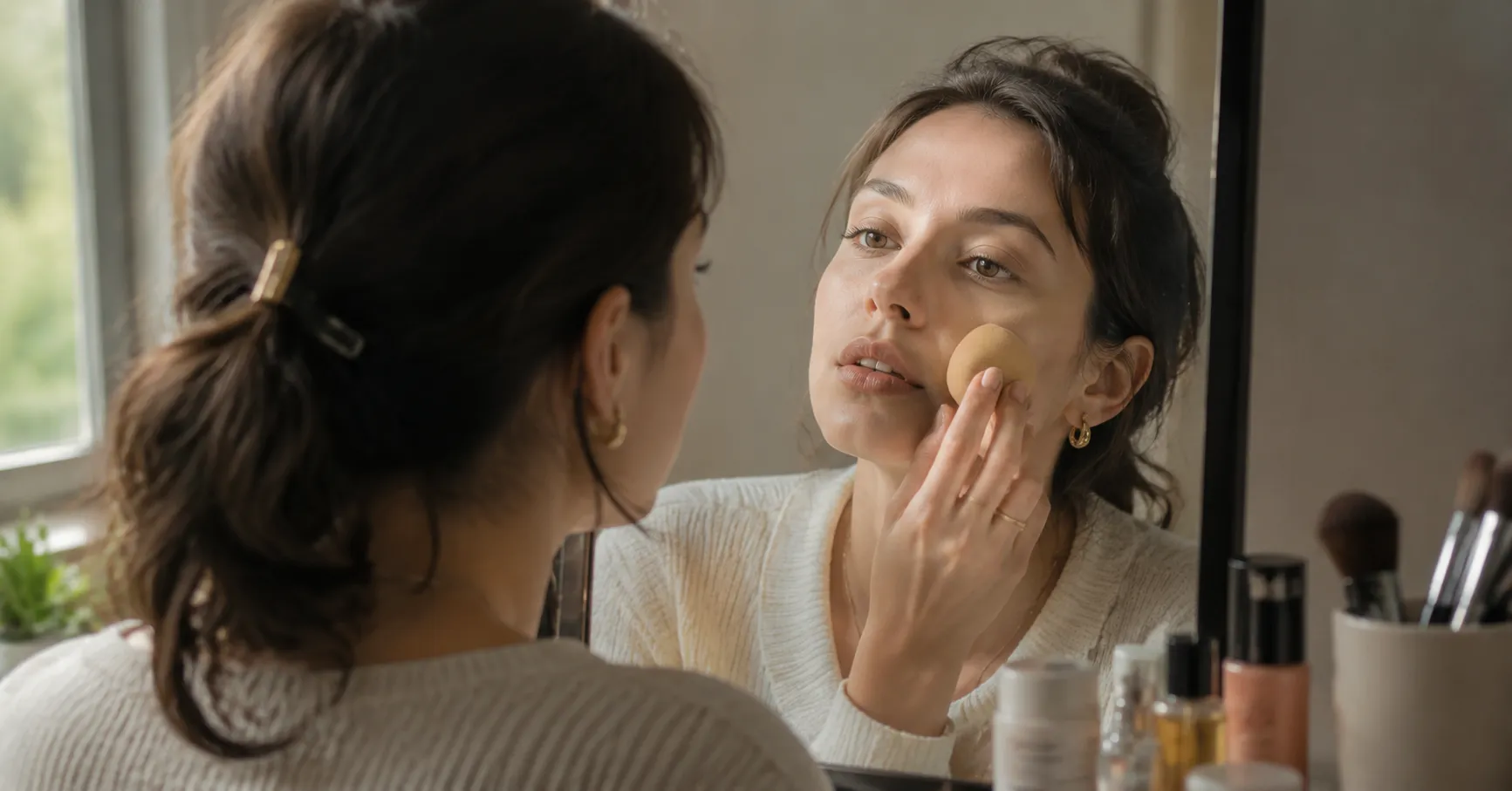
Application method also plays a role. A damp beauty sponge is the go-to recommendation for dry skin, and it’s good advice but the dampness level matters. Overly wet sponges dilute foundation more than they blend it. Wring the sponge out thoroughly until it’s just slightly damp, then use pressing motions rather than dragging. Dragging disrupts the layers you’ve already laid down.
Setting Without the Chalkboard Effect
Setting powder is where dry skin gets abandoned by most tutorials. The standard advice dust translucent powder all over exists for oily and combination skin. For dry skin, all-over powder sets the foundation but also amplifies texture, grabs onto dry patches, and drains luminosity from the skin until the face looks like a photocopy of itself.
The more considered approach is zone setting. You only powder the areas where transfer is actually a problem: the center of the forehead, the nose bridge, the corners of the mouth, and the chin. The rest of the face can be left with a slightly more natural finish. Use the smallest amount of powder possible tap your brush firmly on the back of your hand before applying to remove excess. The goal is to absorb surface oils and sebum without creating a matte film over the entire face.
Finely-milled setting powders are significantly more flattering on dry skin than traditional loose powders. Brands sometimes market these as “blurring” or “HD” powders the particle size is smaller, so they catch light differently and don’t accumulate in texture the way heavier formulas do. If you can feel the powder visibly sitting on your skin in natural light, it’s too heavy.
A setting spray applied after powder can paradoxically prevent the powdery look by melding all the layers together. Choose one that emphasizes hydration over hold. A light mist held at least eight inches from the face is enough. Two heavycoats of setting spray will just move everything around.
The Transfer Problem, Specifically
Transfer-resistance comes down to one thing: how well the foundation bonds to the skin versus how easily it bonds to whatever touches it. Skin that’s adequately moisturized but not over-saturated with product creates a better surface for foundation to adhere to. Over-moisturized skin the kind where you’ve layered five skincare products and your face still feels slightly slick gives foundation very little to grip. It sits on top of oils and serums, and when fabric or another surface makes contact, it takes the foundation with it.
This is why people with dry skin sometimes get better transfer resistance by slightly scaling back their skincare rather than intensifying it. One good moisturizer, fully absorbed, is more effective as a makeup base than three layered products that haven’t fully set into the skin.
The other transfer culprit that rarely gets addressed is touching your face. Even a brief chin-rest or the habit of pressing your phone against your cheek will lift makeup regardless of how well you’ve set it. This is less about chemistry and more about pressure no setting spray or powder can survive sustained direct contact. Awareness of this habit is genuinely more protective than any product.
When the Day Goes Long
The midday check-in is where dry skin makeup tends to show its age. Rather than reaching for a powder compact to touch up, consider keeping a hydrating facial mist in your bag. A light mist over the face, followed by gently pressing with a clean fingertip or a dry beauty sponge, can revive the look without adding more product on top of what’s already there. More powder over deteriorating makeup creates layers that look and feel heavy.
Spot concealing is better than full-face touch-ups. If coverage has worn in a specific area typically around the nose or chin applying a small amount of concealer and pressing it in with a fingertip resets that zone without disturbing the rest of the face.
There’s something almost counterintuitive about perfecting makeup on dry skin: the less product you use overall, the longer everything lasts. It goes against the instinct to layer, to fix, to add more where something feels lacking. But dry skin rewards restraint. A foundation that can breathe will outlast one that can’t, every time.