
The Air Up There Is Working Against You
Somewhere over the Pacific, around hour nine of a fourteen-hour flight, something shifts. Not the altitude, not the turbulence your face. The tight, papery sensation creeping across your cheeks isn’t just discomfort. It’s your skin responding to one of the most hostile environments it ever encounters: a pressurized metal tube cruising at 35,000 feet, circulating air with humidity levels that hover between 10 and 20 percent. For context, the Sahara Desert averages around 25 percent. You are, quite literally, flying through conditions drier than a desert.
This isn’t a vanity problem. Chronic moisture loss at that rate triggers a cascade: your skin’s barrier function weakens, oil production can paradoxically spike as the skin tries to compensate, and by the time you land, the puffiness from recycled air and sodium-heavy airplane meals has settled in like an uninvited houseguest. Jetlag compounds everything cortisol rhythms get thrown off, and elevated stress hormones are notorious for accelerating inflammation and dulling the complexion.
Understanding what’s actually happening is the first step to fighting back intelligently, rather than just throwing a sheet mask on somewhere over the international date line and hoping for the best.
What You Pack Matters More Than What You Do On the Plane
The instinct is to overpack. A rolling carry-on stuffed with serums, a separate pouch for SPF, a mini everything. But experienced travelers and aestheticians who’ve treated the skin of people who fly weekly for work will tell you the opposite is closer to the truth. A focused, intentional kit consistently outperforms a scattered arsenal.
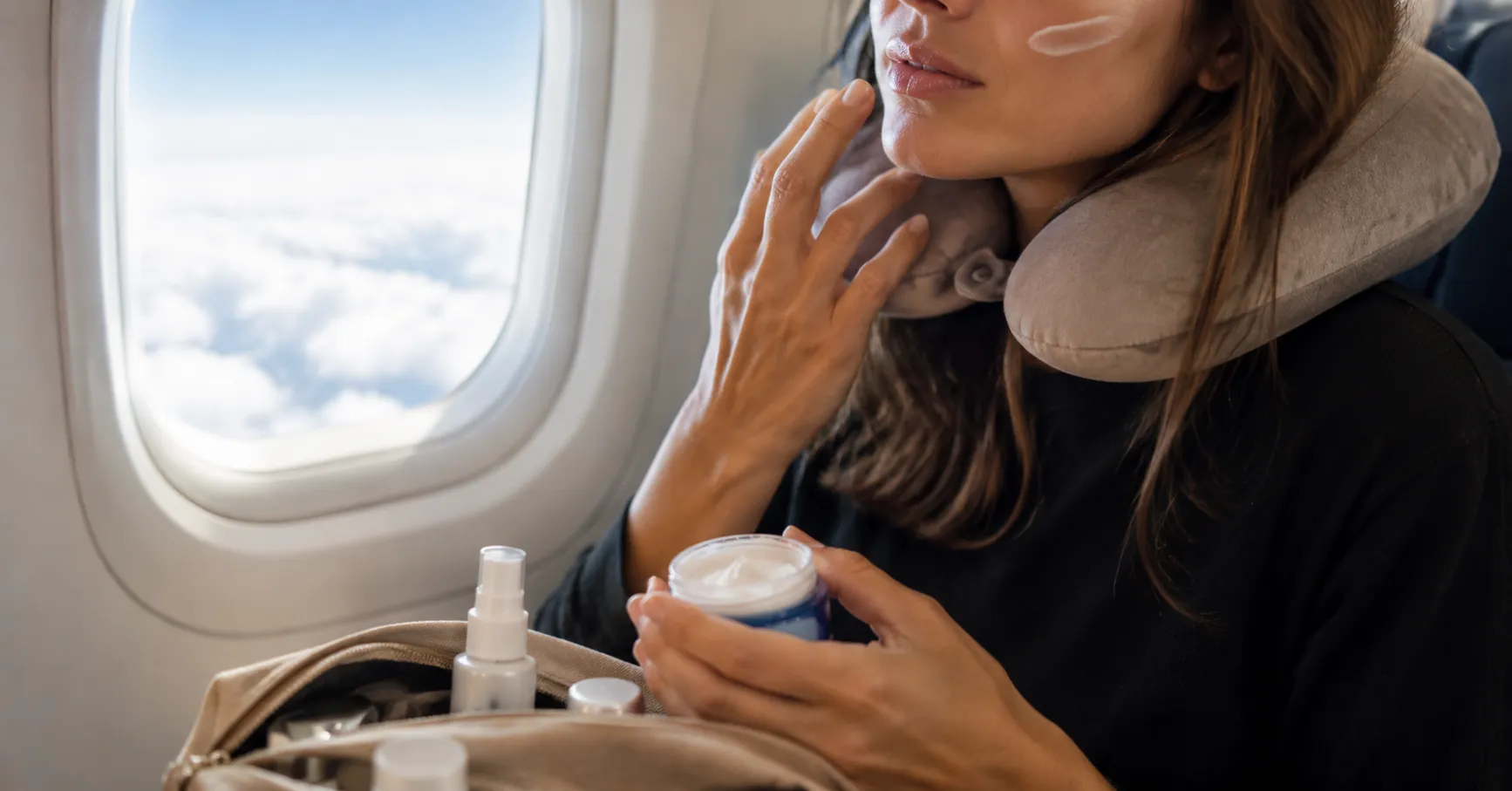
The foundation of any travel skin routine is occlusives. Not the thin, watery moisturizers that feel elegant at your vanity at home actual barrier-sealing, lipid-rich formulas. Think thick creams with ceramides, shea butter, or squalane. These don’t just hydrate; they lock moisture in against the aggressive dehydrating pull of pressurized air. A small pot of something like a rich overnight cream, worn mid-flight, will do more for your skin than three layers of lightweight serum that evaporates before it can absorb.
Hyaluronic acid serums deserve a particular mention here, though perhaps not in the way beauty marketing typically presents them. Hyaluronic acid is a humectant it draws moisture from its environment. On the ground, that environment is the air around you. On a plane, where that air has almost no moisture to offer, a humectant applied alone can actually draw water up from the deeper layers of your skin toward the surface, where it promptly evaporates. The lesson isn’t to avoidHA entirely; it’s to seal it immediately with an occlusive on top. Applied in layers, the combination works well. Applied solo, it can backfire.
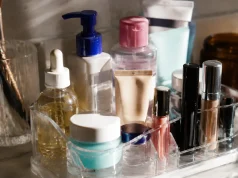
A balm-style lip treatment, a travel-size facial mist with calming actives like centella or rose water, and a small bottle of facial oil round out the essentials without requiring you to sacrifice precious carry-on space.
The Timing of Your Routine Is Half the Strategy
Most people think about doing a skin routine on the plane. Fewer think about what they do before they even board. That window the night before departure and the morning of is genuinely underused.
The night before a long-haul flight is the ideal moment for a heavier treatment: a slugging layer (a thin coat of petrolatum or a balm over your regular moisturizer), a peptide-rich product if you use one, or a ceramide-focused barrier repair cream. You’re building reserves. Think of it like carb-loading before a race. The skin you board with is the skin you’re working with for the next twelve-plus hours, so arriving at the gate already deeply moisturized gives you a significant head start.
On the plane itself, timing matters more than frequency. Spritzing a mist every hour feels productive but can actually contribute to evaporation if not followed by an occlusive. A better approach: apply your rich cream at takeoff, use a light mist around the midpoint of the flight followed immediately by another layer of balm or oil, and do a brief cleanse-and-reapply routine about two hours before landing. This last step serves a dual purpose it addresses any buildup from recycled air and sets you up to look reasonably human when you walk off the plane.
Eyes, Puffiness, and the Problem With Salt
The eyes always betray a long flight first. They’re surrounded by the thinnest, most delicate skin on the face, and they take on fluid like a sponge when you’re horizontal in a reclined seat with your lymphatic system idling. Add the sodium content of even a modest airplane meal and the dehydration that accumulates across hours of poor-quality sleep, and you have the perfect storm for that specific kind of under-eye puffiness that makes people ask if you’re okay before you’ve even claimed your luggage.
An eye cream with caffeine is worth its weight in gold here. Caffeine is a vasoconstrictor it temporarily tightens blood vessels and reduces the appearance of puffiness. Applied about an hour before landing, it can noticeably shift how awake you look on arrival. Chilled spoons or a jade roller stored in the seatback pocket (or wrapped in a napkin from the galley’s ice supply, if you’re resourceful) work on the same principle: cold constricts, drainage improves.
The dietary angle is less glamorous but arguably more effective. Hydrating consistently throughout the flight not with alcohol or even too much coffee, which are both diuretic and actively avoiding the salty snack packs makes a visible difference. It’s the kind of advice that sounds obvious until you’re seven hours into a flight and the flight attendant is offering pretzels and you realize you’ve been reaching for them automatically since hour two.
Jetlag Is a Skin Condition, Too
Landing is not the end of the story. Jetlag doesn’t just make you groggy it disrupts circadian rhythms that govern everything from how well your skin repairs itself overnight to how consistently it produces collagen. The skin’s peak repair activity happens in the late-night hours, and when your internal clock is scrambled, that repair window gets compressed or misfires entirely.
People who travel across multiple time zones frequently often report dullness, increased breakouts, and a vague flatness to their complexion that lingers for days. This isn’t coincidental. When cortisol spikes from jet lag stress, it suppresses skin cell turnover and can trigger inflammatory responses the same mechanism behind stress breakouts. Add disrupted sleep quality to the mix and you’re essentially asking your skin to regenerate on a broken schedule.
The most practicalcountermeasure is to anchor your skincare routine to local time as aggressively as you anchor your sleep schedule. This means doing your full PM routine at local night, even if your body insists it’s afternoon, and making sure you’re getting some form of a gentle brightening or antioxidant product into your morning routine vitamin C, niacinamide, or a green tea extract to help counteract the oxidative stress accumulated from altitude and recycled air.
Light exposure plays a role here too. Getting outside in natural morning light on arrival day, even for twenty minutes, isn’t just good for resetting your circadian rhythm. It’s a kind of systems-level reboot that your skin benefits from as much as your brain does.
The Long Game on Short Trips
There’s a certain traveler who arrives looking inexplicably good composed, clear-skinned, visibly rested and it’s tempting to attribute it to genetics or a higher budget for first-class seats. But what you’re more often observing is the result of consistent, intelligent habits compounded over many trips. The choices made in the days before departure, the disciplined hydration at35,000 feet, the routine anchored to local time on arrival.
None of it requires a medicine cabinet worth of products or a complicated multiStep routine performed in a plane bathroom barely large enough to turn around in. It requires understanding what’s happening to your skin and responding to it with a few very well-chosen tools. The rest, as they say, is just packing light.