

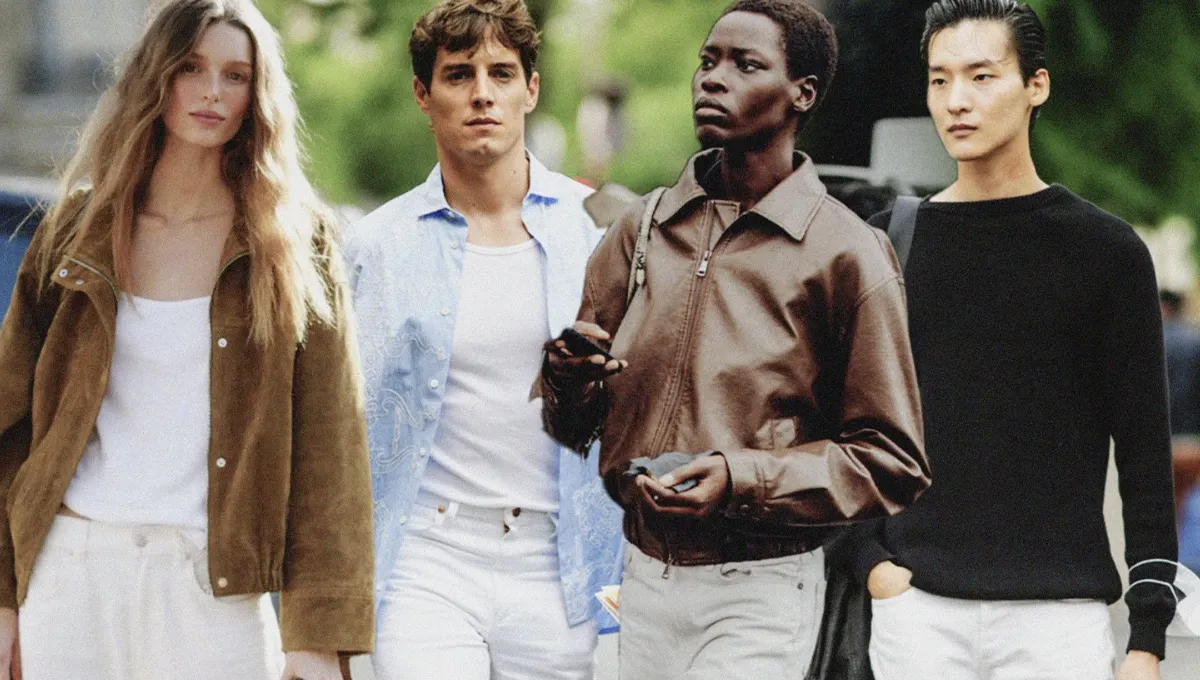
The Myth of “Trying Too Hard”
There’s a particular kind of woman you’ve spotted at a farmers market, a coffee shop, maybe just crossing the street she looks completely put-together, but not in the way that signals effort. Her outfit feels like it grew on her. Nothing is aggressively coordinated. Nothing announces itself. And yet you can’t stop looking. That quality, that elusive sense of ease, is what most people mean when they say “effortless style” and almost nobody talks honestly about what it actually takes to get there.
Here’s the uncomfortable truth: effortless style is never truly effortless. It is, instead, the product of internalized taste. The difference between looking like you tried and looking like you didn’t is not the absence of thought it’s the depth of it. People who dress beautifully without appearing to have agonized over it have simply done theagonizing so many times before that it’s become invisible. Which means the path to that kind of ease is available to anyone willing to do the work upfront.
Understanding Your Actual Aesthetic, Not the One You Think You Have
Most people’s wardrobes are a graveyard of aspirational identities. The leather jacket bought for the edgy version of yourself that never quite materialized. The flowy linen dress purchased for a bohemian summer that ended up being mostly errands. The blazer from the period you were convinced you were becoming a “clean girl.”
None of those purchases were mistakes, exactly they were data. The problem is that most people don’t read the data. They just feel vaguely guilty about the unworn items and keep shopping with the same half-formed image of who they’re dressing.
A more honest approach starts with what you already reach for without thinking. Not what hangs in your closet in pristine condition, but what you grab when you’re running late and not second-guessing yourself. That’s your real aesthetic talking. Pay attention to the silhouettes, the fabrics, the color temperature. Is it always something oversized? Always a heel, even a small one? Always a neutral with one unexpected element? Those patterns tell you more about your genuine style than any Pinterest board ever will.
The Foundation Pieces That Actually Deserve That Name
The concept of “wardrobe basics” has been so thoroughly colonized by marketing that it’s nearly useless. Brands will sell you a $200 white t-shirt and call it a foundation piece. What actually matters is understanding what a foundation piece means for your specific wardrobe which is not the same for everyone.
A foundation piece, correctly understood, is something that works in at least five distinct combinations you’d actually wear. Not theoretical combinations. Real ones, with real items you own. If you can’t build five outfits around it, it’s not functioning as a foundation it’s functioning as an accent, which is fine, but it’s a different investment.
For someone who lives in wide-leg trousers, a collection of interesting tops becomes foundational. For someone who rotates through casual dresses, the footwear is doing the heavy lifting. The point is that the load-bearing elements of a wardrobe are personal. Generic lists of “must-haves” are a starting point, not a prescription.
What French Style Actually Teaches Us (Beyond the Clichés)
The French girl aesthetic has been covered so aggressively that the phrase now triggers mild eye-rolls in certain circles. Understandable. But strip away the stereotype the beret, the baguette, the performative nonchalance and there’s a genuinely useful philosophy underneath.
It’s essentially an argument for quality over quantity and personal over perfect. French dressing culture, at its core, is not about having a specific set of items. It’s about treating clothes as something that belongs to you, not something you perform for others. The slightly undone collar, the scarf tied imperfectly, the bag that’s been carried so long it’s developed a patina these aren’t accidents. They’re evidence of use, of ownership, of a person who has integrated her clothes into her actual life rather than staging her life around her clothes.
The transferable lesson isn’t “buy a Breton stripe.” It’s “stop treating your wardrobe like a costume and start treating it like a language you’re fluent in.”
Color and Pattern: Working With Your Eye, Not Against It
Color theory as it’s taught in fashion content is often either too rigid or too vague. You get either “find your season” (helpful but incomplete) or “wear what you love” (sweet but useless). The more practical truth lives somewhere in between.
What works, for most people, is identifying the two or three colors that reliably photograph well on them, make them look awake rather than washed out, and feel genuinely comfortable rather than borrowed. Those become the anchors. Everything else patterns, prints, accent tones gets evaluated against whether it works with those anchors, not whether it works in isolation.
Mixing patterns is less mysterious than it’s made to sound. The rule that actually holds up is scale contrast: if the patterns differ significantly in scale, they tend to play well together. A small floral with a wide stripe, a micro-check with a large abstract print. What creates visual chaos is similar-scale patterns competing for the same space. That’s the actual grammar of it once you understand that, experimentation becomes intuitive rather than terrifying.
Dressing for Your Life, Not Your Hypothetical Life
This is where a lot of style advice quietly fails people. The inspiration is almost always aspirational: resort wear, gallery openings, rooftop dinners. And for the vast majority of people, those contexts represent maybe 3% of their actual dressing situations.
The other 97% is grocery runs and work calls and picking kids up from school and going to lunch with people who’ve known you for twenty years. Effortless style in real life means looking good in those situations not just having a plan for the exceptional ones.
That requires taking your actual routine seriously as a design problem. If you spend most of your days moving between a home office and casual social situations, your wardrobe should be optimized for exactly that. Not for a life of commutes and conference rooms, even if that’s what most “professional wardrobe” content assumes. Clothes that work for your real context will always look more natural and more you than clothes bought for a context you only inhabit occasionally.
Shopping as Editing, Not as Accumulating
The shift that tends to change everything for people who’ve struggled with their style for years is reconceiving shopping as an editorial act rather than an acquisitive one. Instead of asking “do I like this?” which almost anything can pass the question becomes “does this make what I already own better?”
That framing is clarifying in ways that feel almost chemical. You stop being seduced by the item in isolation and start evaluating it as part of a working system. Suddenly, three-quarters of what you would have bought stops being interesting. Not because it isn’t beautiful or well-made, but because it doesn’t do anything for the wardrobe you’re actually building.
This is also, incidentally, better for your budget and the environment though that’s a side effect, not the primary argument. The primary argument is purely selfish: a wardrobe that functions as a coherent system is dramatically easier to dress from than a collection of unrelated interesting things. Getting dressed stops being a decision and starts being a reflex.
The people who make it look effortless aren’t lucky. They’ve just built the system, quietly, over time, and now it runs itself.