

There’s a particular kind of frustration that comes with doing everything right and still watching your skin get worse. You’ve invested in the serums, you’ve read the ingredient lists, you’ve committed to morning and night. And yet breakouts persist, your complexion looks dull, or that patch of irritation on your cheek just won’t go away. Most people blame their skin. The more honest answer is usually the routine.
The skincare industry is built on a simple premise: more is better, and anything that tingles must be working. Both ideas are wrong, and they quietly cause more damage than neglect ever could.
The Overload Problem Nobody Talks About
Skin has a barrier the stratum corneum and its entire job is to keep the outside world out. Moisture in, irritants out. It’s not glamorous work, but it’s the foundation of everything we associate with healthy skin: evenness, glow, resilience. The moment that barrier gets compromised, all the expensive actives in the world stop working the way they’re supposed to, because they’re no longer landing on healthy skin they’re landing on a wound.
What compromises the barrier? Ironically, most of the steps people add to fix their skin. Over-cleansing strips the natural oils that maintain the acid mantle. Exfoliating acids used too frequently essentially sand away the protection you actually need. Even layering too many products without understanding how they interact can create a kind of chemical chaos on the surface not dramatic enough to feel like a reaction, but persistent enough to keep your skin in a low-grade state of inflammation.
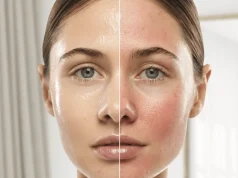
That inflammation doesn’t always announce itself as redness or burning. Sometimes it just looks like skin that won’t cooperate perpetually congested, slow to heal, sensitive to things that never used to bother it. Dermatologists have a term for this: sensitized skin. Not a skin type you were born with. A condition your routine created.
The Actives Arms Race
Retinol. Vitamin C. Glycolic acid. Niacinamide. BHAs. PHAs. AHAs. If you’ve been following skincare content for more than six months, you’ve probably been told you need all of them. Influencer culture and brand marketing have turned ingredient knowledge into a kind of competitive sport, where the person with the most complex routine wins and anyone with a simple one is missing out.
Here’s what that narrative leaves out: most of these ingredients are effective precisely because they’re potent. Retinol accelerates cell turnover, which is genuinely valuable, but it also makes skin significantly more sensitive to UV damage during that transition period. Vitamin C oxidizes when exposed to light and air, and poorly formulated versions can actually cause the kind of oxidative stress they’re marketed to prevent. Glycolic acid at the wrong concentration or pH doesn’t just exfoliate it disrupts. And using two or three of these on the same night, in the wrong order, creates interactions that no single ingredient was designed for.
There’s a concept in pharmacology called drug-drug interaction. We take it seriously in medicine. In skincare, the equivalent ingredient-ingredient interaction barely gets mentioned. The result is that people are running clinical-grade chemistry experiments on their faces every night with no real understanding of the variables.
When “Natural” Becomes Its Own Problem
The clean beauty movement created an understandable counter-narrative: if synthetic ingredients are harsh, then natural ones must be gentle. This logic collapses quickly under any real scrutiny.
Essential oils are among the most common contact allergens in skincare. Citrus extracts are photosensitizers they make skin more reactive to sunlight, not less. Witch hazel, beloved for its “pore-minimizing” reputation, is primarily alcohol-based and reliably strips the moisture barrier with consistent use. The fact that something comes from a plant does not make it inert. Poison ivy comes from a plant.
The cleaner-ingredients movement has done some genuinely useful work in pushing back against unnecessary additives. But it also created a generation of consumers who feel safer with products that are, in some cases, more reactive than the conventional versions they replaced.
The Sun Protection Miscalculation
Of all the ways a skincare routine can quietly cause harm, this one carries the highest long-term cost: most people are either using sunscreen incorrectly or skipping it entirely on overcast days and for indoor time.
UV-A radiation the kind responsible for collagen breakdown, hyperpigmentation, and a significant portion of skin cancer risk passes through clouds and glass with barely any reduction. The concept of a “UV day” is a myth. If light is reaching you, UV-A is part of it. People who sit near windows, who commute in cars, who work near skylights they’re accumulating UV exposure that a morning application of SPF 30 they applied three hours ago no longer covers.
Beyond the application window, quantity matters enormously. Studies consistently show that people apply roughly25 to 50 percent of the amount needed to achieve the SPF number on the label. The sunscreen is there, in a technical sense. The protection is not.
Meanwhile, people are using retinoids, exfoliating acids, and Vitamin C all of which increase photosensitivity and then underdoing the one step that makes the entire routine safer. The actives do their job. The damage does its job too.
What Hydration Actually Means
There’s a widespread confusion between hydrating the skin and moisturizing it, and it leads to routines that feel intensive while delivering almost nothing.
Hydration refers to water content in the skin cells. Moisturization refers to sealing that water in. A hyaluronic acid serum, applied to dry skin in a low-humidity environment, will actually pull moisture out of the deeper layers of the skin to compensate leaving the surface temporarily plump but the underlying tissue more dehydrated than before. This is well-documented. It’s also almost never mentioned in the marketing copy.
The correct approach is to apply hydrating ingredients to damp skin, then layer an occlusive or emollient over the top to trap that moisture in place. It sounds simple. It’s consistently underestimated, in part because it requires fewer products, not more and the skincare industry’s revenue model doesn’t benefit from simplicity.
The Frequency Trap
Somewhere along the way, skincare became a twice-daily obligation at minimum, with “slugging” at night, multi-step mornings, and weekly masks sitting on top of that baseline. The idea that more frequent application means more results seems logical. Biology doesn’t work that way.
Skin regenerates on its own schedule roughly every 28 days in younger skin, slower with age. Products that claim to accelerate that process are, in a literal sense, stressing the skin into behaving differently. Done carefully, with appropriate recovery time, that can produce real benefits. Done constantly, without pause, it keeps the skin in a perpetual state of playing catch-up.
Some dermatologists now recommend routine cycling periods of minimal product use that allow the barrier to fully restore itself. The concept is almost heretical in a culture that treats skipping a step as neglect. But the skin that emerges from a week of just cleanser and moisturizer often looks better than the skin that’s been processed twice a day for months.
It says something, that the skin sometimes heals not when you add another product, but when you finally put everything down.