
How to Use a Beauty Blender Like a Pro (Even If It’s Your First Time)
There’s a specific kind of frustration that comes with spending twenty minutes trying to blend foundation only to end up looking like you’ve patched drywall. If you’ve ever pressed a beauty blender against your cheek and dragged it across your skin wincing at the streaky results you’re not alone, and more importantly, you’re not doing anything wrong. You just haven’t been taught the right way yet.
The beauty blender, for all its deceptive simplicity, is one of those tools that rewards technique far more than most people expect. It looks like a sponge. It acts like a sponge. But treat it like one and you’ll waste half a tube of foundation in a single sitting.
Why the Shape Isn’t Just a Gimmick
Before touching your face, it helps to understand what you’re actually holding. That teardrop silhouette isn’t arbitrary. The rounded base is built for large, flat surfaces your cheeks, forehead, the broad stretch of skin below your eyes. The pointed tip exists for precision: the corners of your nose, the inner corners of your eyes, the bow of your upper lip. Most first-timers use only the round end for everything, which is why their concealer always looks slightly off.
Each curve has a purpose. Rotate the sponge intentionally as you move from zone to zone, and you’ll start to notice that the foundation behaves differently more controlled, more deposit where you actually want it.
The Dampening Step Nobody Takes Seriously Enough
Here’s the part that separates a streaky mess from a second-skin finish: the sponge must be wet before it touches your face. Not a little damp. Saturated.
Run it under cold water until it’s fully swollen it nearly doubles in size then squeeze out the excess with a clean towel. What you’re left with is a sponge that’s moist throughout but not dripping. This matters because a dry sponge absorbs product. A wet sponge deposits it. Every beauty professional who swears by this tool is working with a damp sponge, without exception.
Some people prefer to mist it with a setting spray instead of water, which gives the finish a slightly more luminous quality. If you have dry skin, this is worth experimenting with. But for beginners, plain cold water is both reliable and free.
Stippling vs. Dragging: The Motion That Changes Everything
If you’ve been swiping or rubbing the sponge across your skin, this is likely the root of your problem. The correct technique is a pressing, bouncing motion often called stippling. You’re not painting. You’re gently stamping product into the skin.
Think of how a printer deposits ink: repeated, controlled contact. Your hand bounces lightly, the sponge makes contact, lifts, moves an inch, makes contact again. The motion is quick and rhythmic once you get the feel for it. It looks almost like dabbing, but there’s a slight downward press involved, enough to push the product into skin texture rather than sitting on top of it.
This is especially important around the nose, where streaks tend to collect, and around the eyes, where any dragging will crease concealer in ways that age you by a decade. The stipple technique handles both of these zones with far more grace.
The Application Order That Most Tutorials Skip
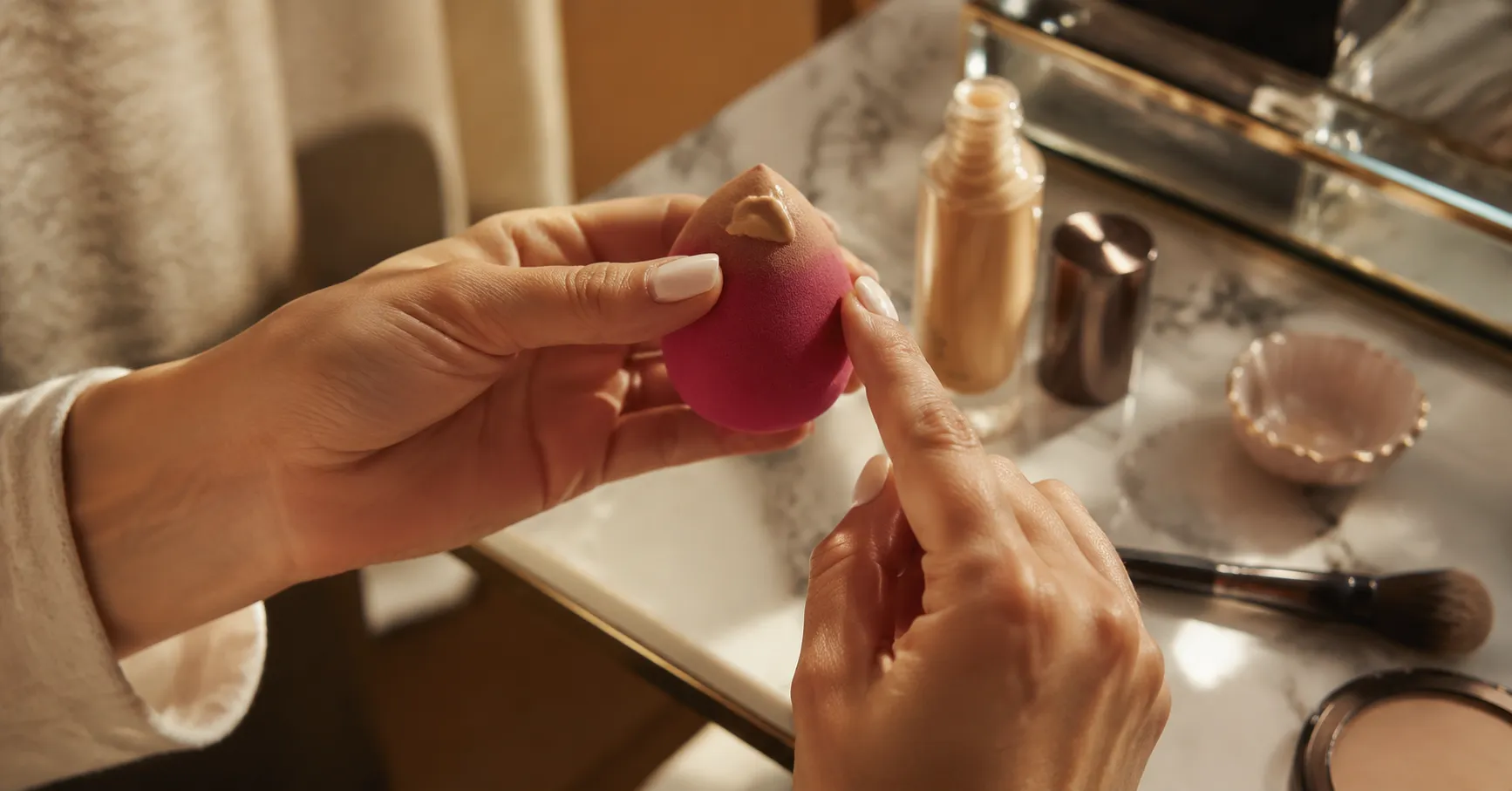
Most people apply foundation to their face and then chase it with the sponge. A more efficient method is to dot foundation directly onto the damp sponge itself, then work section by section. This gives you more control over how much product goes where less on areas that need coverage, more where you want it.
Start at the center of your face and work outward. This ensures the most product lands where most faces need the most help around the nose, on the chin, across the center of the forehead while the coverage naturally thins toward the hairline and jaw. Blending outward also reduces the risk of a harsh foundation line at the edge of your face, that telltale mask look that announces very clearly that you are wearing makeup.
For concealer, apply it directly under the eyes and on any spots you want to target, then use the pointed tip of the sponge to press it in. Don’t use a full circular motion here. Small, focused presses. You’re not blending so much as fusing the product to your skin.
Layering Without Looking Cakey
One of the real advantages of a damp beauty blender is its ability to build coverage without caking. Because the sponge deposits product rather than moving it around, you can press a second layer over the first without disturbing what’s already there. Let the first layer set for thirty seconds you can continue on another part of your face while you wait and then go back in.
This is genuinely how a lot of professional makeup artists build full-coverage looks for editorial work or weddings. What looks flawless in photographs is rarely applied in a single pass. It’s careful, patient layering, and the beauty blender makes that process accessible to anyone willing to slow down.
Powder, Blush, Contour: It Goes Beyond Foundation
Once you’ve got the foundation technique down, the sponge opens up as a more versatile tool than most people realize. You can tap a small amount of loose or pressed setting powder lightly over the face particularly the T-zone to lock everything in place. The key is a very light hand here, because pressed powder applied too densely undoes all the skin-like quality you just built.
For blush and contour, the sponge softens edges in a way that brushes sometimes can’t match. Powder blush applied with a brush gives you clear color deposit; applied with a barely-loaded damp sponge, it melts into the skin like a flush. Whether that’s the look you’re going for is a matter of preference, but it’s worth knowing the difference exists.
Cleaning It Without Destroying It
A dirty beauty blender is genuinely problematic not just aesthetically, but practically. Old product sitting in the sponge affects how it distributes new product, and bacteria buildup on a tool pressed daily against your skin is a concern worth taking seriously.
The most effective method: wet the sponge, apply a small amount of gentle soap or dedicated sponge cleanser, and work the product out by pressing and squeezing rather than twisting. Twisting tears the material over time. Rinse until the water runs clear, squeeze gently with a towel, and leave it to air dry in an open space never sealed in a bag while still wet.
How often? After every use is the gold standard. Once a week is the realistic minimum if your schedule doesn’t allow for daily washing.
When the Sponge Starts to Betray You
Even with perfect care, beauty blenders have a shelf life. When the surface starts to look pitted or torn, when small pieces begin to come away on your skin, when it no longer bounces back the way it used to that’s the signal to replace it. Holding onto a compromised sponge doesn’t save you money; it just gives you worse results while you spend more product compensating.
Most makeup artists replace theirs every three to four months with consistent use. Think of it less like a luxury purchase and more like a consumable supply.
The beauty blender doesn’t have a steep learning curve so much as it has a specific one. Master the damp sponge, the stipple motion, and the patience to build in layers, and what felt like a frustrating gadget becomes something you reach for first the kind of tool that quietly makes everything else in your routine look better without you quite being able to explain why.