
Style Isn’t Something You Find It’s Something You Remember
There’s a particular kind of frustration that hits when you’re standing in front of a full closet and feeling like you have nothing to wear. It’s not really about the clothes. It’s about not knowing, in that moment, who you are supposed to look like today. Style, in its truest form, isn’t a collection of items it’s a relationship between you and the version of yourself you want to project into the world. And like any relationship, it takes attention, a little courage, and the willingness to actually show up.
The good news? Inspiration isn’t some rare gift that arrives for fashion editors and runway devotees. It’s everywhere, and learning to pull from it is a skill one you can develop without spending a fortune or overhauling your entire wardrobe overnight.
Start With What Already Feels Like You
Most style advice tells you to look outward first. Browse Pinterest, follow influencers, study what’s trending. But the most sustainable personal style almost always starts by looking inward or more precisely, backward.
Go through old photos of yourself. Not the posed ones, but the candid shots: a birthday dinner five years ago, a random Tuesday afternoon, a trip where you weren’t thinking about what anyone thought. Notice what you were wearing in the moments where you look the most at ease. There’s real data in those images. You weren’t dressing for an algorithm or a trend cycle. You were just living in something that felt right.
What colors keep reappearing? What silhouettes? Are there recurring textures a lot of denim, a preference for soft knits, a lean toward structured blazers? Your past self has already been doing quiet research on your behalf. The trick is learning to read it.
Build a Visual Language Before You Buy Anything
Here’s where the practical work begins, and it doesn’t require a shopping cart.
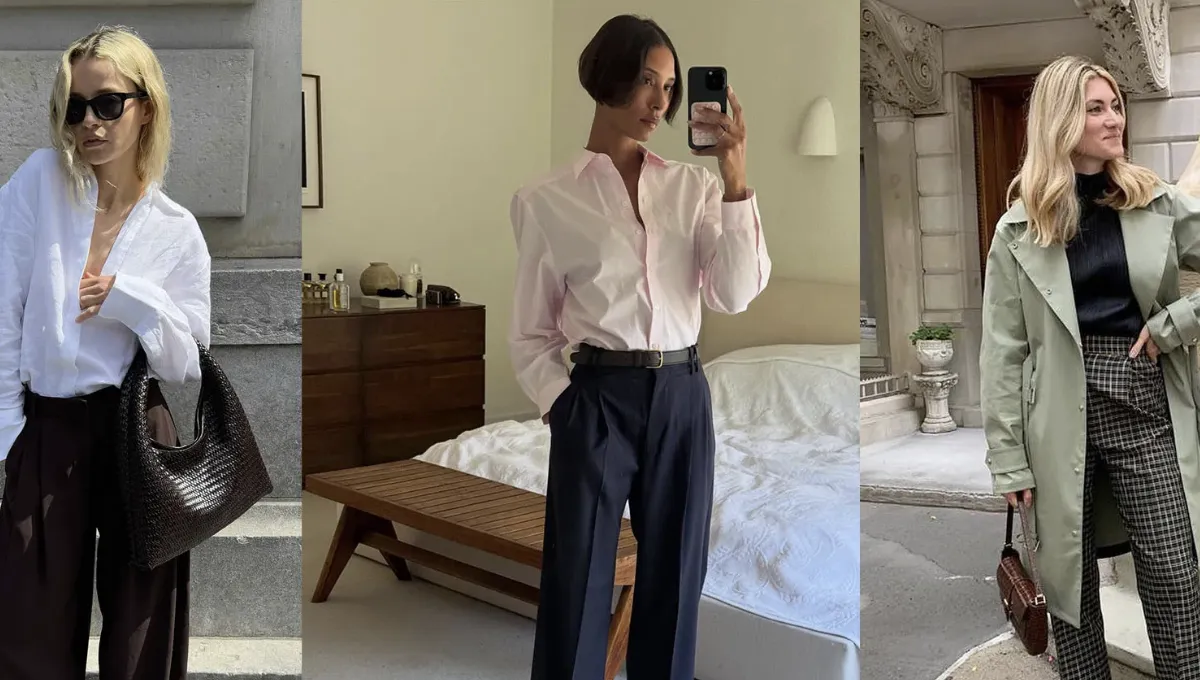
Create a private folder on your phone, a Pinterest board, a notes app, wherever feels frictionless and spend two weeks filling it only with images that make you feel something. Not images you think you should like, not looks you admire intellectually. Images that cause a physical reaction: a pull, a wanting, a recognition. That could be a street style photo, a still from a film, an editorial from1994, the way someone in a coffee shop put their outfit together.
After two weeks, look at what you’ve collected. Patterns will emerge that surprise you. Maybe you’ve saved twenty images of women in oversized coats and minimal footwear. Maybe everything involves some shade of terracotta or rust. Maybe you keep returning to a very specific era think early ’70s ease or late ’90s utilitarian without consciously intending to. That collection is the beginning of a visual language unique to you. It’s more honest than any style quiz, and more specific than any trend report.
Use Fiction as a Mirror
This one doesn’t get talked about enough: fictional characters are one of the most underrated sources of style inspiration, precisely because they aren’t real people performing for real audiences. Their wardrobes are intentional. Every costume decision is a deliberate choice made by a team of designers to communicate personality, status, internal life, evolution.
Think about the characters whose aesthetics have lingered with you. Not just the obvious fashion icons the obvious ones are, by definition, already absorbed by the mainstream. Think about the minor characters, the supporting roles, the ones whose look you registered without fully realizing it. Fran Kubelik in The Apartment. Tom Ripley in the Patricia Highsmith adaptations. The entire female ensemble of Broadcast News. These aren’t people selling you something. They’re just dressed.
What you’re drawn to in their wardrobes tells you something specific about your own instincts the proportion you find pleasing, the level of polish or deliberate carelessness that resonates, the relationship between clothing and personality that feels true to you.
Get Curious About Your Resistance
Style hacks almost always focus on what to add. Rarely do they ask about what you keep avoiding.
There are probably entire categories of clothing that you’ve dismissed for years without fully examining why. Maybe you never wear color. Maybe you avoid anything that reads as “dressed up.” Maybe you’ve decided you’re not a “dress person” or a “pattern person” without having tested that belief recently. These are the interesting edges of your style identity the places where something more than taste is operating.
Sometimes the resistance is practical and real. But sometimes it’s inherited: a comment someone made in high school, a narrative about what “people like you” wear, a fear of looking like you tried too hard or not hard enough. Getting honest about the difference between genuine preference and protective avoidance can open up surprising territory. You don’t have to rush in. Just notice.
The One-Item Experiment
Once you have some clarity about your direction, resist the urge to do a complete overhaul. The most effective way to develop personal style is through small, deliberate additions that require you to interact with your existing wardrobe rather than replace it.
Pick one item ideally something slightly outside your current comfort zone but clearly within the visual language you’ve been building and integrate it for a full month. Wear it in different combinations. See what it teaches you. Does it make other things in your closet feel more alive or more obsolete? Does getting dressed feel easier or harder? Are you reaching for it repeatedly, or does it sit untouched?
One item, genuinely worn and observed, tells you more than a seasonal haul. This isn’t minimalism as ideology. It’s just a more efficient form of research.
Steal Like a Stylist, Not Like a Shopper
The difference between style inspiration and style copying comes down to translation. A shopper sees a look and buys it. A stylist sees a look and asks: what is this actually doing? What’s the underlying principle?
When you see an outfit you love, try to break down its logic. Is it the contrast between something oversized and something fitted? The unexpected pairing of a formal piece with a casual one? The restraint the fact that only one element is doing the work while everything else recedes? Once you can articulate the principle, you can apply it with your own pieces, in your own context, for your own life.
That process of translation is what turns inspiration into personal style. Anyone can buy the same coat. Not everyone can understand why it works.
Let It Breathe
Personal style isn’t a destination you reach and then maintain. It shifts with where you live, who you spend time with, what you’re reading, how your body changes, what you’re moving toward and leaving behind. The most stylish people aren’t the ones who’ve locked something in. They’re the ones who stay curious about themselves.
What you’re wearing today is a sentence in a much longer conversation you’re having with yourself about who you are. Some days that sentence will feel precisely right. Other days it’ll feel like a rough draft. Both are fine. The point is to keep writing it.