
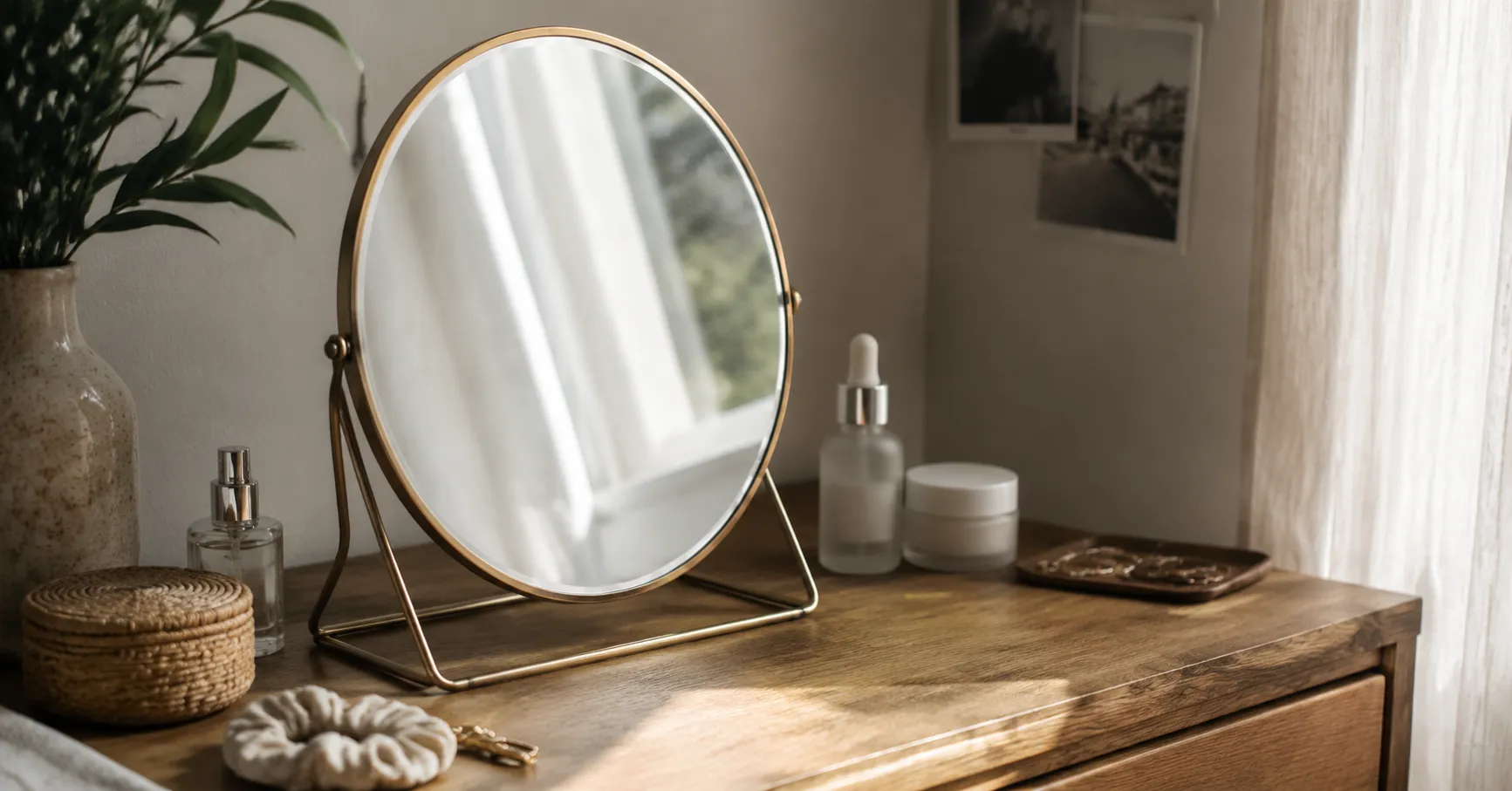
There’s a moment a lot of us know standing in front of the mirror in decent lighting, maybe the kind that streams in sideways on a Sunday morning, and noticing every pore, every bump, every patch where the texture isn’t smooth. For a second, the instinct is to reach for something to cover it. Foundation, filter, flattering angle. Anything to make the surface look different from what it actually is.
That instinct isn’t vanity. It’s the result of years of cultural conditioning, and it deserves to be examined rather than shamed.
The Skin We Were Sold vs. The Skin We Actually Have
For most of modern beauty advertising, “good skin” has meant one very specific thing: a poreless, uniform, matte-yet-dewy expanse that looks like it was rendered in Photoshop. Because for a long time, it was. Magazines airbrushed. Campaigns smoothed. Even actresses being photographed at red carpet events had their close-up shots retouched before publication.
What this did over decades was quietly train our eyes to see real skin as a flaw. Texture the thing every single human face has, because skin is a living organ, not a plastic surface started to feel like something that needed fixing.
The beauty industry profited enormously from that perception. Primers to blur. Heavy-coverage foundations to obliterate. Setting powders to flatten. Entire product categories were built on the idea that your skin, as-is, was the problem.
Then came high-definition cameras. Then came skincare TikTok. Then came a slow but meaningful pushback people showing their actual skin on camera, unfiltered, and discovering that the response wasn’t horror. It was relief.
Why Texture Is Not a Flaw (Even If It Feels Like One)
Skin texture encompasses everything from visible pores to fine lines, acne scars, hyperpigmentation, bumps along the jawline, rough patches near the nose. None of these are signs of neglect or bad health. Most of them are simply biology the way collagen arranges itself, how oil glands function, how skin repairs after a breakup or a bout of stress or just a Tuesday.
Pores exist because your skin needs to breathe and secrete sebum. You cannot shrink them out of existence, despite what approximately four hundred serums would like you to believe. Acne scars are records of inflammation. Fine lines are what skin does when it’s been stretched by two decades of smiling and squinting and living. These are not bugs in the system.
Knowing this doesn’t automatically make you feel confident. There’s a gap between intellectual understanding and visceral self-acceptance, and it’s worth being honest about that gap rather than pretending one TED talk closes it.
The Confidence That Comes From Familiarity, Not Approval
One pattern you notice with people who genuinely seem comfortable in their skin not performatively, not as a brand is that they’ve spent time with their own face. Not obsessively, not critically, but just looking. Getting familiar.
There’s a difference between scrutinizing and witnessing. Scrutiny is looking for problems. Witnessing is just… noticing. How your skin looks in morning light versus evening. How it shifts with your cycle or your sleep quality. How a certain texture that seemed like a flaw in one photo looks completely neutral in person, because in person, people aren’t zooming in on your pores they’re looking at your whole face, the animation of it, the expression.
When you stop treating your face as a problem to be solved and start treating it as something you simply live in, the relationship with it changes. This sounds abstract, but the practice is actually concrete: ditch the 10x magnifying mirror. Stop photographing yourself from two inches away and then spiraling. Give your face the viewing distance that another human would actually give it when talking to you.
Confidence, in this case, isn’t about convincing yourself that your skin is perfect. It’s about becoming comfortable enough with the reality that the imperfection stops feeling urgent.
What Other People Are Actually Noticing
Here’s something worth sitting with: when you walk into a room, no one is evaluating your skin texture. This isn’t a platitude it’s backed by what we know about how social attention actually works.
People remember how you made them feel, whether you seemed at ease or guarded, whether you were funny or warm or interesting. They remember if you made good eye contact, if you laughed genuinely, if you seemed present in the conversation. They almost never remember that your forehead had visible pores.
The exception is when someone is awkward about their own skin apologizing for it, constantly touching their face, turning away from light. In those cases, the attention they were trying to avoid gets drawn directly toward the thing they’re anxious about, not because the skin itself is noticeable, but because the anxiety is.
Ease is genuinely attractive. It creates the impression of health and confidence even when nothing about the surface has changed. This isn’t about faking ease you don’t feel it’s about understanding that the physical thing you’re worried about is rarely what’s actually registering with other people.
Skincare That Serves You, Not Insecurity
There’s a version of skincare that comes from a good place curiosity about skin health, the pleasure of a routine, genuine care for an organ that works hard every day. And there’s a version that’s driven entirely by the hope that the next product will finally make you acceptable.
The second version is exhausting. It also tends to worsen texture, because anxiety-driven routines often involve over-exfoliating, trying too many active ingredients at once, and stripping the skin barrier until it’s reactive and rough in new ways.
If you want to improve your skin’s texture, the most effective approach tends to be boring: consistent moisture, basic sun protection, gentle exfoliation maybe once or twice a week, and enough sleep. These are unsexy recommendations, but they work because they support skin function rather than fighting it.
The point isn’t that you should abandon all skincare or stop caring how you look. The point is to care from a place of maintenance rather than emergency. There’s a real difference in how that feels day to day.
Letting Yourself Be Seen
The deeper issue with skin confidence isn’t really about skin. It’s about the discomfort of being seen as you actually are texture, asymmetry, realness and all and the fear that the real version won’t be enough.
That fear is worth naming, because it’s not irrational. We live in a world where filtered images still dominate, where certain beauty standards still carry social currency, where women in particular are evaluated on appearance in ways that feel unfair because they are unfair. Rejecting that entirely requires a kind of counter-cultural conviction that takes time to build.
But it builds. Each time you show up without the heavy filter and nothing terrible happens each time someone finds you interesting or attractive or worth talking to while your skin is doing exactly what skin does the evidence accumulates. You start to build a different kind of record: one where your unedited face has been part of genuine connection, real conversation, actual life.
Confidence with your natural skin isn’t a mindset you arrive at once and keep forever. It’s something you practice in small acts of just showing up in good lighting and bad, on camera and off, in the morning when your skin looks tired and in the evening when you’ve forgotten to think about it at all.