
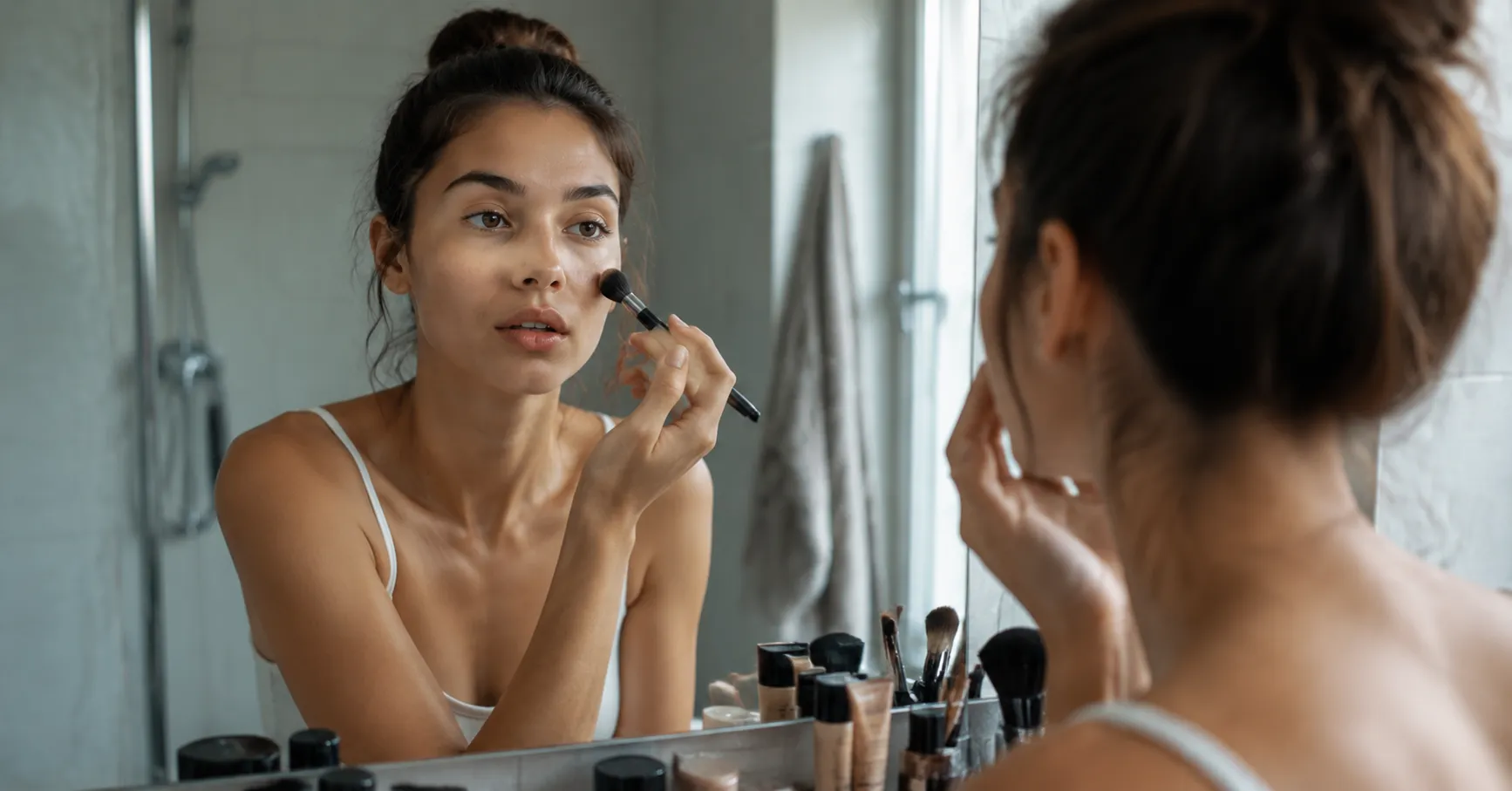
Nobody Tells You the Real Starting Point
Walk into any Sephora on a Saturday afternoon and you’ll see it the slightly overwhelmed look on someone’s face as they stand in front of a wall of foundations, holding two shades up to their jaw, squinting. Maybe that person is you. Maybe it was you, six months ago. The beauty industry has a strange way of making beginners feel like they missed a class everyone else attended. Like there’s a secret curriculum, and you’re already three chapters behind.
There isn’t. But there is one thing almost nobody says out loud at the start: the goal of makeup isn’t to look like someone else. It’s to look like the best, most intentional version of yourself. That distinction sounds small. It isn’t. Once you actually believe it, every purchase decision, every tutorial you watch, every product you reach for in the morning it all starts to make a different kind of sense.
Skin Is the Canvas, Not the Competition
Before you buy a single product, your skin deserves your attention not your judgment. This isn’t the part where you’re told to drink more water and sleep eight hours (though, fine, those things help). This is about actually looking at your face. What does your skin do by midday? Does it get shiny across your nose? Does it feel tight after you wash it? Are there areas that stay dry no matter what you do?
These aren’t flaws to correct. They’re information. Oily skin holds cream blush beautifully but can break down certain foundations by noon. Dry skin loves a dewy base but will cling to powder in ways that emphasize texture. Combination skin, the most common type, needs a little more thought sometimes treating different zones differently rather than applying one product wall-to-wall.
A lot of beginners skip this step entirely. They go straight to “what’s the best foundation” and then wonder why the product that works for their favorite YouTuber looks patchy or strange on them. Skin type isn’t a personality quiz. It’s practical data that will save you money, frustration, and the particular sadness of a product that looked incredible on screen and wrong on your face.
The Five Products That Actually Matter First
Forget the 15-step routines. Forget the color-correcting primers and the baking techniques and the cut-crease tutorials for now. When you’re starting out, there are really only five categories worth thinking about and even that might be more than you need.
A skin tint or light coverage foundation. Something that evens you out without making your face look like it’s wearing a mask. The best way to know if a shade works isn’t to swatch it on your hand the skin on your hand is a completely different color from your face. Test it on your jaw, in natural light, and check if it disappears.
Concealer. Not to cover everything, but to address the one or two spots where you actually want coverage. Under-eye circles, a blemish, some redness around your nose. One well-placed concealer does more than three layers of full-coverage foundation.
A blush. This is genuinely the most underrated beginner product. Nothing makes a face look more alive, more human, more awake than a little color on the cheeks. Cream blushes are more forgiving for beginners they blend with your fingers and sit into the skin rather than sitting on top of it.
A brow product. Brows are the frame. You don’t need to draw them in dramatically, but filling in sparse areas or defining the shape subtly changes how your entire face reads. A tinted brow gel is the easiest entry point it combs through, adds color, and takes about forty-five seconds.
A mascara. Nothing else opens the eyes quite the same way. Black or dark brown, a simple wand, nothing with too much drama. You can build from there.
That’s it. Those five things can take you from a completely bare face to something that feels polished and put-together in under ten minutes. Everything else the bronzer, the highlighter, the setting spray, the eyeshadow palettes is bonus territory. Learn the basics first, and you’ll have the judgment to navigate the extras without just buying whatever an algorithm shows you.
Technique Matters More Than Product
This is the part of the conversation that beauty marketing doesn’t profit from, which is probably why it’s so rarely emphasized. A $12 drugstore foundation blended well will almost always look better than a $60 department store foundation applied carelessly. Technique is the multiplier.
Blending is everything. Whether you’re using a brush, a sponge, or your fingers which are genuinely underrated, by the way the motion matters. Stippling (pressing and bouncing) builds coverage without streaking. Sweeping too hard just moves product around without placing it. For under-eye concealer specifically, tapping with a ring finger is often more effective than any tool because the gentle pressure melts the product into the skin.
Direction matters for blush. Most beginners apply it straight across the cheekbone, which can look flat or harsh. Bringing it slightly upward toward the temple, following the natural flush you’d get from a walk in cold air, looks more natural and lifts the face visually.
With mascara, wiggling the wand at the base of the lashes before sweeping upward coats the roots and creates the appearance of density something a lot of people don’t figure out until they’ve been doing their makeup for years and happen to see someone mention it in passing.
None of these techniques require talent. They require practice, which is a very different thing. Talent implies you either have it or you don’t. Practice is just doing something enough times that it stops feeling unfamiliar.
The Things Worth Unlearning
Some of the most persistent makeup myths are the ones that feel like rules because they’re repeated so often. More coverage means better coverage. Contouring is necessary. Makeup needs to last all day without touching up. Foundation should be invisible.
None of these are true in any absolute sense.
Heavy coverage can look intentional and beautiful on some people and occasions. It can also look heavy and uncomfortable if that’s not what you actually want. Contouring is a specific technique for specific goals it’s not a mandatory step in looking put-together. Touching up through the day is completely normal and doesn’t mean your technique is wrong. And foundation that has a slight sheen, a visible texture, a sense that there’s a person underneath it that’s not a failure. That’s often more interesting to look at than a face that’s been airbrushed into uniformity.
The goal was never to eliminate your face. It was to present it.
Color Is More Instinct Than Science
You’ll hear a lot about undertones warm, cool, neutral. And understanding yours does help with foundation and concealer matching. But when it comes to things like eyeshadow, blush, or lip color, the rules are far more flexible than the internet makes them seem.
The most reliable guide is often just your gut. A color you’re drawn to on the shelf, one you keep coming back to, one that made you stop scrolling that instinct isn’t arbitrary. We’re drawn to colors that do something for our particular combination of skin tone, eye color, and hair. Not because it’s mystical, but because we see ourselves every day and we’ve been processing that information our whole lives.
Try the color. If you like how it looks and how it makes you feel, that’s the only credential it needs.
What No Tutorial Can Teach You
Makeup is one of those skills that lives in the body more than in the mind. You can read every article, watch every tutorial, and still find that things click differently once you’re actually standing in front of your mirror, in your light, with your face, figuring out what works for you specifically.
The learning curve isn’t linear. Some days it comes together effortlessly. Other days the blush looks strange and the mascara smudges and you just wash your face and leave. Both of those days are part of it.
What changes over time isn’t really skill, or not only skill. It’s comfort. A familiarity with your own face, an ease with the tools, a quieter inner voice that used to say “this looks wrong” every time something wasn’t perfect. The people whose makeup always looks effortlessly good aren’t necessarily more talented they’re usually just more comfortable. With the process. With the imperfection. With themselves.
That’s not something a product can give you. But it does tend to arrive, slowly and without announcement, somewhere in the middle of all the practice.