
The Product You Trust Most Might Be the One Doing the Most Damage
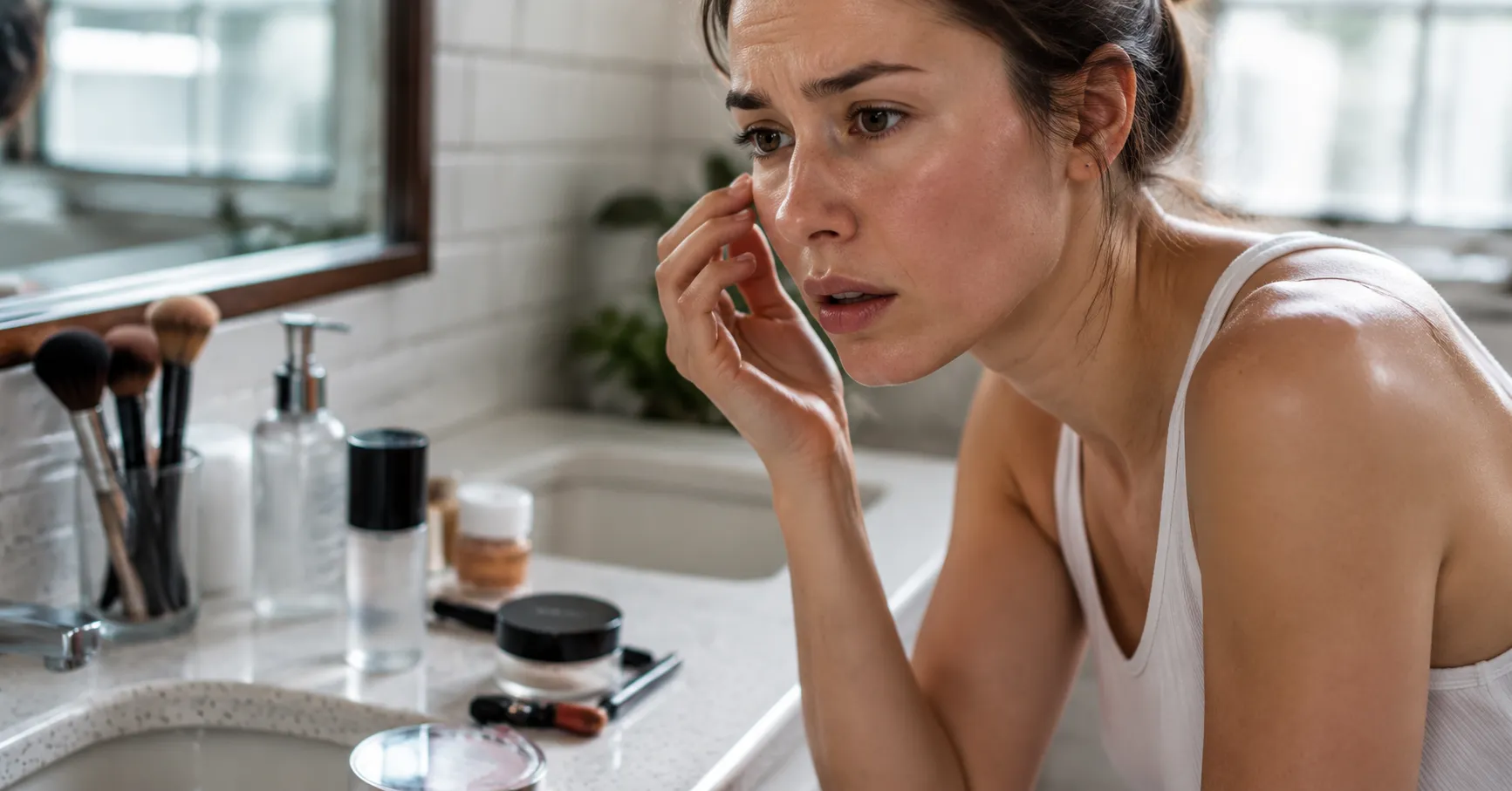
There’s a particular kind of betrayal that happens slowly. You don’t notice it the way you notice a bad haircut or a breakout. It sneaks up on you over months, sometimes years a gradual dimming of your complexion, a new heaviness around the eyes, a persistent dryness that your moisturizer never quite fixes. You keep adding products to solve the problem. What you don’t consider is that one of your existing products might be creating it.
Setting products sit in an interesting psychological blind spot. We think of them as the final, benign step the thing that just locks everything in. A spritz, a dusting, maybe a pressed powder over the T-zone. It feels passive, cosmetically speaking. It’s not doing anything, it’s just holding. But that framing is exactly why so many people overlook them as a source of skin trouble.
The truth is that setting products are some of the most misunderstood formulations in the entire beauty category. And because they’re applied at the end of every single routine, every single day, their cumulative effect on your skin is significant.
When “Matte” Becomes a Mask for Dehydration
Matte finish setting products have had an extraordinary run. For a solid decade, the goal was to look like you had no skin just a smooth, pore-less surface that photographed cleanly and didn’t budge. Products engineered for this effect became cult favorites, and with good reason. They worked, at least in the short term.
The issue is what sits inside many of them: high concentrations of silica, talc, and film-forming polymers. These ingredients are extraordinarily effective at absorbing oil and diffusing light. They’re also, when used daily over time, capable of disrupting the skin’s moisture equilibrium. Silica in particular is a moisture magnet which sounds beneficial until you realize it’s pulling hydration from your skin just as readily as it pulls it from sebum.
The people most affected tend to be those with combination or oily skin who reach for these products most aggressively. The irony is almost elegant: the more you fight the oil, the more you disrupt the barrier, and the more your skin overproduces oil to compensate. Meanwhile, the underlying skin is becoming progressively more dehydrated, which means fine lines become more visible, texture becomes more pronounced, and the skin just looks… tired.
If you’ve ever noticed that your skin looks somehow worse by the end of the day despite being set perfectly in the morning that slight sinking effect, the way lines seem deeper at6pm than they did at 8am this mechanism is often why.
The Alcohol Problem Nobody Talks About
Setting sprays occupy the more modern, “skin-friendly” end of the category. Marketed with words like “refreshing,” “hydrating,” and “dewy,” they’ve become the cooler, more sophisticated cousin to powder products. Some of them genuinely are excellent. Others are essentially glorified alcohol delivery systems.
Many setting sprays use denatured alcohol as a primary carrier it evaporates quickly, creates that tight, refreshing sensation, and helps the formula disperse evenly. The problem is that repeated daily exposure to alcohol-based mists accelerates the breakdown of your skin’s lipid barrier. You might not feel it immediately. The initial cooling sensation reads as refreshing. But lipid barrier damage accumulates, and a compromised barrier means faster moisture loss, increased sensitivity, more reactivity to other products, and a dullness that no amount of layering can correct.
The clue is often in the sensation. If your setting spray has a sharp, almost astringent quality when it hits your skin, or if your skin feels temporarily “tightened” after application in a way that feels satisfying but doesn’t last, that’s often alcohol speaking. Compare the ingredient list of your current spray against one formulated without alcohol brands have been moving in this direction, so there are real alternatives and the difference in how your skin behaves over weeks is often striking.
Fragrance: The Invisible Accelerant
Here’s a category of ingredient that ages skin in a way that’s particularly insidious because it’s so difficult to attribute. Fragrance both synthetic and, yes, natural essential oil-based fragrance is one of the most common causes of low-grade chronic skin inflammation. And low-grade chronic inflammation is, dermatologically speaking, one of the primary drivers of premature aging.
The skin doesn’t always mount a dramatic allergic response. It might not go red or itchy. Instead, it produces a quiet, persistent inflammatory response that, over time, accelerates collagen degradation, contributes to hyperpigmentation, and makes the skin progressively less resilient. You get to your late thirties or early forties and something seems off about how your skin is aging it looks older than it should, somehow and you genuinely cannot identify why because there was never a single dramatic incident to pin it to.
Setting products, because they’re worn all day against the skin, are a particularly high-risk vehicle for fragranced formulas. A fragrance in a rinse-off cleanser is genuinely low risk. A fragrance in a product that sits on your face for ten or twelve hours, every day, is a completely different proposition.
The Oxidation Factor in Powder Formulas
There’s a more granular problem specific to pressed and loose powder products that rarely makes it into mainstream conversations about skin aging: oxidation. Many powder setting products, particularly those with warm, peachy, or golden tones, contain iron oxides and other pigments that can oxidize on the skin throughout the day. This oxidation generates free radicals, and free radicals if you’ve spent any time learning about skincare chemistry are exactly what your antioxidant serums exist to fight.
The practical implication is that you might be layering a free radical-generating product on top of all that protective, expensive skincare. The antioxidants in your vitamin C serum are working against something being introduced by your setting powder. It’s not that the powder cancels everything out, but the logic of your routine becomes internally contradictory in a way worth examining.
This is also partly why some people find that their skin looks noticeably better on days they skip their powder, or when they swap to a translucent formula over a tinted one. The complexion looks fresher, more alive. They attribute it to letting skin “breathe” a phrase that isn’t technically accurate but points toward a real phenomenon they’re experiencing.
What to Actually Look For
None of this means setting products are inherently harmful or that you need to eliminate them. Some are genuinely excellent. The question is whether the one you’re using is working for you or against you, and that requires looking at it a little more critically than the packaging invites.
Check where alcohol (often listed as alcohol denat., ethanol, or SD alcohol) appears in your setting spray’s ingredient list. If it’s in the first five or six ingredients, it’s a meaningful concentration. Look for fragrance in your powders both as “fragrance” or “parfum” and as specific essential oils like lavender, citrus, or peppermint, which sound clean but carry real sensitization risk. Notice whether your setting products contain any form of sunscreen, because some do, and understanding how much UV protection you’re actually getting from them versus assuming you’re covered is a different and important calculation.
Pay attention, too, to how your skin behaves over a full day and in the days after you use a product consistently. Not in the mirror in bright morning light immediately after application, when everything looks controlled and finished. Later. Under different lighting. After a week or two of regular use.
Trusting the Evidence Over the Packaging
The beauty industry is extraordinarily good at making products feel like solutions. The vocabulary of setting products “locking in,” “protecting,” “perfecting” is inherently reassuring. It creates the impression of a final act of care.
But skin is a system, not a canvas. What goes on top of it, across years of daily application, participates in that system whether you’re thinking about it or not. The product that feels like it’s just finishing your look might, quietly, be rewriting it.
Look at your skin not as it appears in the first ten minutes after application, but as it appears overall its texture, its moisture levels, how it’s aging. If something feels off, if you’ve been diligently caring for your skin and the results don’t match the investment, the setting step is worth questioning. Not with suspicion exactly, but with the same critical attention you’d give anything else you’re putting on your face every single day.