
There’s a particular kind of confidence that comes from wearing an outfit nobody can fully decode. The coat looks expensive and it is. The shoes look like they cost a fortune and they didn’t. That gap, that deliberate ambiguity, is the quiet art at the heart of mixing high-end and affordable fashion. It isn’t about fooling anyone. It’s about knowing exactly what you’re doing and why.
Most people approach this the wrong way. They treat it like a math problem: spend here, save there, balance the budget. But the real logic is more psychological than financial. It’s about understanding how the eye moves, where attention lands, and which pieces carry the weight of an entire look.
The Investment Piece Principle
The concept of an “investment piece” gets thrown around a lot, usually as justification for an irresponsible purchase. But there’s genuine substance to it when you apply it correctly. The pieces worth spending on are the ones your eye gravitates to first and the ones that physically interact with your body the most.
A coat is the first thing anyone sees when you walk into a room. It frames your silhouette, it signals your aesthetic from twenty feet away, and it will likely be on your body for the next three to five years if you choose wisely. That’s where real money makes a real difference. The quality of wool behaves differently from synthetic blends. The structure of a well-cut lapel doesn’t collapse after a season. You feel it, others sense it.
Shoes follow the same logic. They ground an entire outfit, and they’re one of the first details a fashion-conscious person will clock. A pair of well-crafted leather loafers or clean leather boots elevates even the most basic outfit underneath. Conversely, a cheap shoe can quietly undermine an otherwise polished look in a way that’s hard to articulate but impossible to ignore.
Handbags occupy a similar tier not because of branding, but because a structured, quality bag communicates intentionality. It says you made a choice, not just a purchase.
Where Affordable Wins Without Apology
Here’s what the fashion industry doesn’t loudly advertise: basics are commodities. A white cotton T-shirt is a white cotton T-shirt. A simple crewneck, a pair of straight-leg jeans in a neutral wash, a ribbed tank top these are not the canvases for luxury spending. They’re the supporting architecture of an outfit, and the mass market has gotten genuinely good at producing them.
Zara, Uniqlo, ASOS, and even H&M’s more considered lines have raised the bar on fabrication for everyday staples over the last decade. Uniqlo in particular has built an almost cult following among stylish people who know that their cashmere and their Oxford shirts punch well above their price point. The key is being selective even within affordable brands choosing the cleaner, quieter options over trend-chasing pieces with obvious hardware, loud prints, or the kind of detailing that dates itself within a season.
Trend-driven pieces also belong in the affordable category by nature. If you’re buying something because it’s everywhere right now the micro-mini of the moment, the color of the season, the silhouette that’s splashed across every editorial don’t spend serious money on it. Its shelf life is exactly as long as its trend cycle. Buy it cheap, wear it well, let it go.
The Proportion Game
What separates someone who genuinely looks stylish from someone who just spent money is proportion and proportion costs nothing. It’s the decision to tuck one side of a shirt rather than both. It’s the instinct to cuff trousers just enough to reveal the ankle. It’s choosing to wear an oversized blazer over a slim silhouette underneath rather than doubling the volume top and bottom.
When you’re mixing price points, proportion becomes your most powerful tool because it creates visual harmony that has nothing to do with how much anything cost. A $40 ribbed midi skirt paired with a $600 cashmere sweater can look like a deliberate, considered outfit if the proportions are right. Throw that same sweater over a pair of ill-fitting trousers, and the sweater can’t save it.
This is also where fit alterations earn their reputation. A $30 pair of trousers that’s been tailored to your exact proportions will consistently outperform a $200 pair worn straight off the rack. A good tailor charges $20 to $40 for basic alterations. It’s the most underutilized tool in most people’s wardrobes.
Reading Quality Beyond the Label
One of the more liberating skills you can develop is learning to assess quality independently of branding. It untethers you from logo dependence and lets you shop across every price point with clarity.
Run the fabric through your fingers. Quality fabrics have weight and drape they move with intention. Cheap synthetics feel frictionless in an unpleasant way and often pill after a handful of wears. Check the seams on the inside of a garment. Reinforced stitching, French seams, or finished edges on the interior suggest that someone thought past the surface. Look at buttons they’re a reliable tell. Cheap buttons on an otherwise decent jacket communicate where corners were cut.
None of this requires a fashion degree. It requires slowing down and actually handling the clothes before buying them, which is harder in an era of one-click purchasing but more important than ever.
The Color and Texture Equation
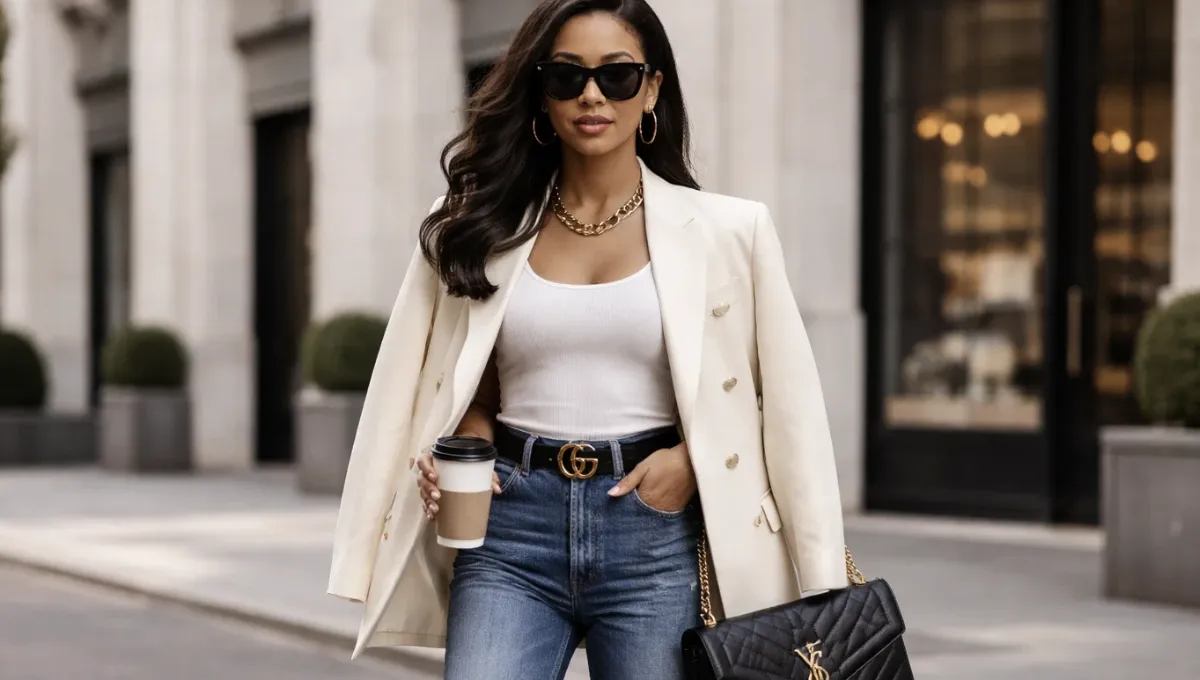
Here’s a practical mixing strategy that consistently works: let expensive pieces anchor your palette and affordable pieces add texture or layering interest. A neutral, well-cut blazer from a quality brand becomes the visual anchor. Underneath it, a $25 linen shirt from a fast-fashion brand in a complementary tone adds depth without demanding attention. The eye reads the blazer first. Everything else becomes context.
Texture mixing also obscures price disparity in a way that color-matching doesn’t. When you combine a chunky knit, a smooth leather bag, and a matte trouser, the visual richness of those different surfaces creates interest that draws attention away from individual price tags. It’s why so many stylish people look expensive even when they’re not: they’ve learned to think in textures, not price brackets.
The Quiet Luxury Trap
It’s worth addressing the aesthetic moment we’re in, because it’s influencing how people think about mixing price points right now. Quiet luxury the minimal logoless, neutral-toned aesthetic that has dominated editorial and social media over the past few years has a seductive quality. It photographs beautifully. It projects a certain ease.
But it’s also quietly expensive to replicate, because it removes all the distracting details and leaves only cut, fabric, and fit to do the work. The aesthetic is unforgiving of cheap fabrication. Buying into quiet luxury entirely from affordable sources tends to produce something that reads as beige rather than refined.
The smarter approach: take the ethos, not the price tag. Neutral palette, clean silhouettes, restrained accessories those principles work at every budget. But apply them selectively. Put real money into one or two pieces with genuine fabric and structure. Build everything around those anchors.
Fashion at its most interesting has always been democratic in spirit, even when it wasn’t in price. The people who navigate it best are the ones who’ve stopped thinking about clothes as status signals and started thinking about them as decisions intentional, considered, and entirely their own.