
The Problem Isn’t That You Don’t Care
Most people who struggle with their skin aren’t lazy. They’ve tried things. They’ve watched the tutorials, bought the products, followed the routines that worked for someone with800,000 followers. And still something’s off. The texture isn’t improving. The breakouts keep cycling. The glow everyone promises never quite arrives.
The real problem is that skincare has become a performance. Social media turned it into a ritual you display rather than a practice you actually understand. So before we talk about serums or SPF, it’s worth getting honest about something: a routine that works isn’t built from trend. It’s built from knowing your own skin.
Skin Is Not a Constant
Here’s something the beauty industry would rather you forget your skin changes. It changes with the seasons, with your stress levels, with your diet, with hormonal shifts, with where you live and what the air quality is like outside your window. The person who swears by a six-step routine in Seoul has different humidity levels, different UV exposure, and possibly a different genetic relationship with moisture barrier function than you do.
This matters because one of the most common mistakes people make is committing to someone else’s routine as though it were a prescription. You buy the same cleanser, the same toner, the same night cream. Six weeks in, you’re breaking out in new places or your skin feels tight in a way it never did before. So you blame your skin for being “difficult.” But your skin wasn’t wrong. The routine was just built for someone else.
The first step in building something that actually works is paying attention. Not to your phone. To your face.
What does your skin feel like two hours after washing it? Is there tightness around the cheeks but oiliness through the T-zone? Do you get dehydration lines even when you think you’ve been drinking enough water? These small observations, tracked over a few weeks, will tell you more than any skin quiz on a brand’s website.
Stripping Everything Back
If you’ve been using multiple products and can’t tell what’s helping or hurting, you need to reset. Not with a new product with subtraction.
Drop down to three things: a gentle cleanser, a basic moisturizer, and sunscreen. That’s it. Use them consistently for two to three weeks. This is the baseline test. You’re not treating anything during this phase. You’re learning what your skin does on its own when it isn’t being constantly bombarded.
For most people, the skin actually calms down considerably during this phase. Not because the fancy actives weren’t doing anything some of them were but because the cumulative irritation from layering too many products at once was causing inflammation that looked like a skin problem rather than what it actually was: a product problem.
A stripped-back routine isn’t a step backward. It’s diagnostic.
Cleanser: The One That’s Almost Always Wrong
The cleanser is the most underrated variable in any routine. People tend to spend their budget and attention on serums and treatments, then grab whatever cleanser is affordable or smells nice. This is backwards.
A cleanser that’s too harsh strips your skin’s acid mantle the slightly acidic protective layer that keeps bacteria out and moisture in. Once that’s disrupted, everything downstream in your routine becomes less effective. Your moisturizer has to work harder. Your actives may cause more sensitivity than they would on a healthy barrier.
What you’re looking for is something with a pH close to your skin’s natural range, around 4.5 to 6.5, and a formula that cleans without leaving that squeaky-clean sensation. That squeaky feeling isn’t cleanliness. It’s damage.
Gel cleansers tend to work well for oily and combination skin. Cream or milk cleansers generally suit drier types. For anyone dealing with sensitivity, fragrance-free is non-negotiable, regardless of how pleasant the scent is.
The Moisture Question Goes Deeper Than You Think
Moisturizing sounds simple until you realize that hydration and moisture are not the same thing, and confusing them explains why a lot of people with oily skin think they don’t need a moisturizer and then wonder why their skin overproduces oil.
Hydration refers to water content in the skin. Moisture refers to the oil that seals that water in. You can be oily and dehydrated simultaneously. In fact, when skin is chronically dehydrated, the sebaceous glands often compensate by producing more oil. So the shine isn’t excess it’s your skin trying to solve a problem you haven’t addressed.
A lightweight, gel-based moisturizer with ingredients like hyaluronic acid or glycerin addresses the hydration side. If your barrier is compromised, something with ceramides or squalane helps restore the lipid layer. These aren’t trends. They’re basic skin biology.
Actives Are Tools, Not the Foundation
Retinol, niacinamide, vitamin C, AHAs, BHAs this is where people get into trouble, and also where real, visible results come from once you know what you’re doing.
The key distinction is that actives are targeted interventions, not the core of a routine. You introduce them after you’ve established a stable baseline. Starting with actives before your barrier is healthy is like renovating a house with a cracked foundation the work won’t hold.
When you’re ready to add something in, pick one thing. If you’re dealing with uneven tone and early signs of aging, a low-percentage retinol used a few nights a week is a strong starting point. Give it six to eight weeks before evaluating. If you’re dealing with congestion and enlarged pores, a BHA like salicylic acid two or three times a week is worth trying. If dullness and hyperpigmentation are the primary concerns, vitamin C in the morning addresses both while also working synergistically with your SPF.
What you don’t do is start all three at once. You won’t know what’s working, and if your skin reacts, you won’t know what to stop.
Sunscreen Is Not Optional
If there is one hill worth dying on in any conversation about skincare, it’s this one. SPF is the single most evidence-backed intervention for preventing premature aging, hyperpigmentation, and skin cancer. Not retinol. Not any serum. Sunscreen.
The reason people skip it isn’t laziness it’s that the old formulas were terrible. Greasy, white-cast-heavy, pore-clogging. Modern sunscreen formulas have come a very long way. There are now mineral options that don’t leave a grey cast on deeper skin tones, chemical filters that feel like nothing on the skin, and hybrid formulas that double as lightweight moisturizers.
You don’t need to apply it only when it’s sunny. UV radiation penetrates clouds. It comes through windows. Daily application every morning, rain or shine is the habit that compounds over years into genuinely different-looking skin in your forties and fifties compared to people who skipped it.
On Patience and the Long Game
There’s a psychological trap in skincare that the industry actively cultivates: the belief that results should be visible quickly, and if they’re not, you need something new.
Real changes in skin texture, tone, and barrier health operate on timescales that don’t match our attention spans. Cell turnover takes roughly 28 days in younger skin, longer as you age. A retinol needs consistent use for at least three months before its full effects on collagen production and cell renewal are realized. Hyperpigmentation can take six months to fade meaningfully, even with targeted treatment.
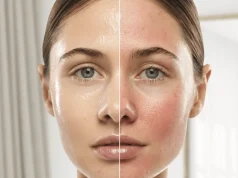
The brands know this, which is why they show you before-and-after photos from people whose results arrived in the optimal window, under optimal conditions, often with professional lighting adjustments. What they don’t show is the plateau in week four, the mild purge in week two, the quiet morning in week ten when you notice your skin just looks a little calmer and you can’t fully explain why.
That quietness is the routine working. It doesn’t announce itself. It just, eventually, becomes the baseline.