
Your skin has been trying to tell you something for months. Maybe years. Not with dramatic flares or obvious wounds, but in that quiet, persistent way the body has when something fundamental is going wrong the kind of signals that are easy to dismiss as just stress, just aging, just the weather changing.
The skin barrier, that outermost layer we rarely think about unless something goes visibly wrong, is one of the most underappreciated systems in the body. Technically, it’s called the stratum corneum a stack of dead skin cells held together by lipids, ceramides, and fatty acids, functioning less like a wall and more like a living, breathing membrane. It keeps moisture in. It keeps irritants, pathogens, and pollution out. When it works, you don’t notice it. When it breaks down, everything starts to feel slightly, persistently off.
The problem is that breakdown rarely happens overnight. It creeps. And most people mistake the early signs for ordinary skin complaints.
The Tightness That Never Quite Goes Away
That feeling after washing your face the pull, the stiffness, the sense that your skin is two sizes too small is not just dryness. Healthy skin, even dry skin, should recover within minutes of cleansing. When the barrier is compromised, transepidermal water loss accelerates. Your skin can’t hold onto moisture the way it should, and that tightness becomes baseline, not temporary.
A lot of people respond by layering on more moisturizer, which helps, but doesn’t address the structural problem underneath. The tightness keeps coming back because you’re managing symptoms, not restoring function.
Redness Without a Reason
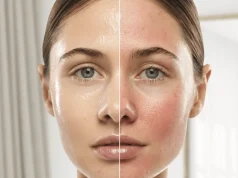
You’re not sunburned. You haven’t been crying. There’s no obvious trigger and yet there’s a low-grade flush sitting on your cheeks, your nose, your forehead. It comes and goes, or maybe it just stays, and you’ve started to think of it as just your complexion.
Unexplained, diffuse redness often signals that the skin’s immune response is in a kind of constant low-level activation. When barrier integrity is compromised, microscopic irritants and allergens slip through more easily. The skin mounts a response, not dramatically, but chronically. That baseline inflammation shows up as redness that feels unremarkable because it’s always there.
Your Old Products SuddenlySting
This is one of the more disorienting signs because it involves something changing rather than something being consistently wrong. The serum you’ve used for two years. The toner you bought in bulk. Now it stings, or tingles, or just feels uncomfortable in a way it never did before.
Fragrance sensitivity and stinging from otherwise benign ingredients niacinamide, vitamin C, even some forms of hyaluronic acid are classic signals of a barrier that’s lost its buffering capacity. A healthy barrier modulates what gets through and at what concentration. A damaged one lets actives penetrate in ways and at speeds that trigger nerve response.
The Inexplicable Itch
Not theitch of a bug bite or an allergic reaction. Something subtler. A restless, undirected itch that moves around the side of your jaw, your neck, the space between your eyebrows. You scratch, and it’s briefly satisfying, and then it migrates.
Itching without a visible cause is often neural in origin, driven by the release of inflammatory mediators that accumulate when barrier function is poor. Researchers have found that a compromised barrier triggers keratinocytes to release cytokines that directly stimulate itch-specific nerve fibers. It’s the skin’s alarm system, but the alarm is subtle enough that most people never trace it back to barrier dysfunction.
Texture Changes You Can’t Explain
Your skin used to be relatively smooth, and now it isn’t. Not rough in the sandpaper sense more like an unevenness, a slightly bumpy quality, a surface that catches light differently than it used to. You might notice it more when applying foundation or under harsh lighting.
Texture disruption at this level often reflects disrupted cell turnover and lipid disorganization in the outer layers. The orderly stacking of the stratum corneum gets erratic when it’s under chronic stress, and that erratic arrangement shows up as surface inconsistency.
Breakouts in Unusual Places
Adult acne tends to cluster hormonally jawline, chin, lower cheeks. Barrier-related breakouts can appear anywhere, and they often take the form of small, clustered, superficial bumps rather than deepcysts. Your forehead when it’s never been a problem area. Your cheeks in a pattern that doesn’t match your usual hormonal cycle.
When the barrier is disrupted, the skin microbiome is too. The delicate ecosystem of bacteria and fungi that normallycoexists in balance on your skin surface gets destabilized. Opportunistic organisms proliferate in the gaps, and inflammation follows. What looks like regular acne might actually be a microbiome response to structural damage.
Sensitivity to Temperature Changes
Walking into a heated building from the cold, or into air conditioning from summer heat, and your skin reacts flushing, tightening, prickling. Temperature-reactive skin isn’t just a vascular thing. The barrier plays a major role in thermoregulation and in moderating the nerve signals that respond to environmental shifts. When it’s intact, these transitions are seamless. When it’s not, the skin is less insulated and more reactive.
Products Stop Working
This one is particularly confusing because it implies that good skincare is somehow failing, when in fact the issue is that the foundation everything sits on has shifted. Your ceramide moisturizer used to last six or seven hours. Now you feel dry again by noon. Your retinol used to give you that slow, steady improvement. Now it just irritates.
A compromised barrier doesn’t absorb products efficiently or evenly. Some things penetrate too fast, in too high a concentration, causing irritation. Others sit on the surface and don’t absorb at all. The same product in the same formulation behaves differently on healthy skin versus damaged skin because the substrate has fundamentally changed.
That Feeling of Being Generally Reactive
Hard to name, harder to dismiss once you’ve experienced it. A kind of generalized sensitivity that extends beyond specific triggers. Wind bothers you. Certain fabrics. The water in a hotel. Everything that touches your face seems like a potential provocation.
This hyper-reactivity is the nervous system in the skin operating in a chronically primed state. Sensory neurons in the epidermis become sensitized through prolonged exposure to the inflammatory mediators that accumulate when the barrier isn’t functioning properly. The threshold for perceived irritation drops, and the world starts to feel like it’s designed to aggravate you.
Your Skin Looks Dull, and Moisturizer Doesn’t Fix It
Not tired dull. Not dehydrated dull in the obvious way. A flattened, slightly gray quality to the skin that doesn’t respond to hydration the way dehydration should. You drink more water, you sleep more, you apply serum, and the flatness persists.
Luminosity in skin comes partly from the optical properties of a healthy stratum corneum the way light interacts with well-organized, well-hydrated cells. When that layer is disrupted, the light-scattering quality changes. It’s less a surface that reflects and more one that absorbs. No amount of highlighter quite compensates for what’s happening at the structural level.
Where This Leaves You
Barrier repair isn’t glamorous. It doesn’t involve trendy ingredients or dramatic before-and-after transformations. It’s mostly subtraction removing the aggressive actives and harsh cleansers and over-exfoliating routines that created the damage and then waiting, patiently, while ceramides and cholesterol and fatty acids rebuild what was lost.
What makes barrier dysfunction so easy to overlook is that each symptom, taken individually, seems minor. Tightness, a little redness, some sensitivity these are the complaints that skin marketing is built on, each one solvable with a new product. But when you start to see them as a system, as a cluster of signals pointing at the same underlying structural problem, the picture changes. Your skin isn’t being difficult. It’s been trying to reach you. The question is whether you’ve been listening.