
There’s a moment from2017 that fashion historians will keep revisiting for a long time. Louis Vuitton the house that once dressed European royalty, that traded for decades on the language of old money and leather luggage and a certain studied remoteness from the street announced that Virgil Abloh would collaborate on a capsule collection. Abloh, who had started Off-White out of Chicago, who had grown up in the orbit of Kanye West and Supreme drops and the whole churning subculture of sneakerheads and skate kids, was now standing in the center of the most famous luxury house in the world. The announcement felt seismic. But looking back, it wasn’t a turning point. It was a confirmation. The takeover had already happened.
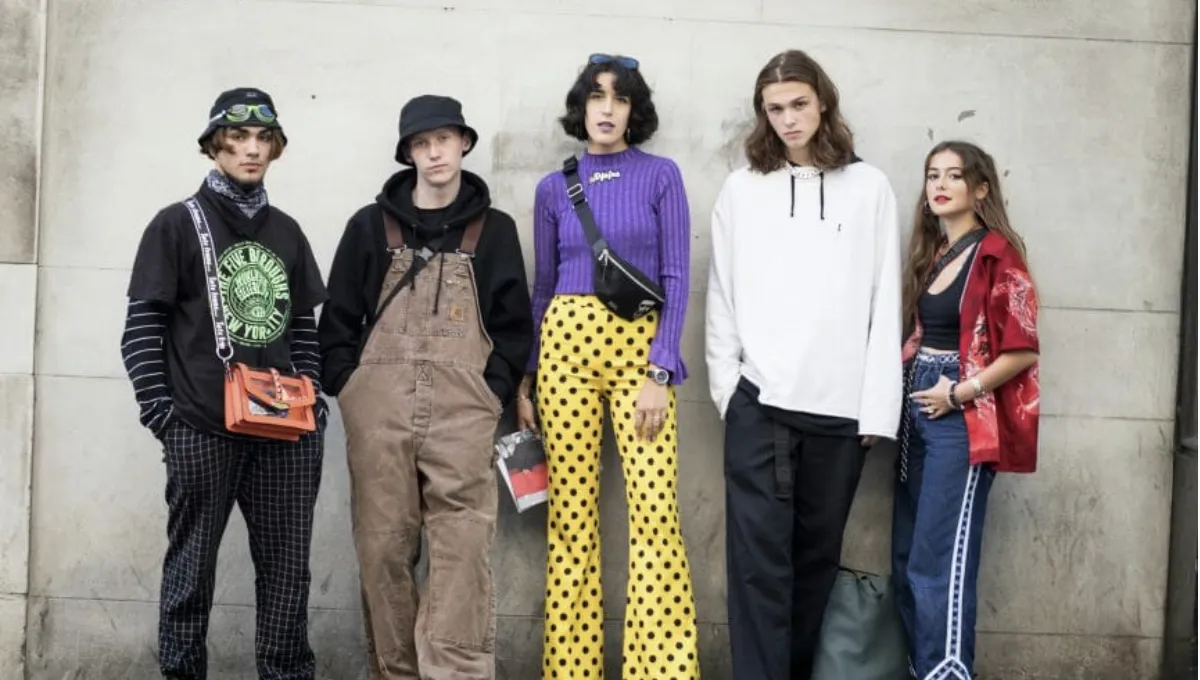
To understand how we got here, you have to resist the temptation to treat streetwear as a single, unified movement with a clear origin story. It didn’t emerge from one city or one scene. It grew in parallel across Los Angeles skate culture, New York hip-hop, Tokyo’s Harajuku district, and London’s grime underground each feeding the others through mixtapes and zines and early internet forums before the algorithm existed to flatten everything into one global aesthetic. What these scenes shared wasn’t a look, exactly. It was an attitude toward ownership. Toward authenticity. Toward the idea that what you wore was a signal, a declaration, a coded message to people who knew how to read it.
That last part matters enormously. High fashion had always operated on exclusivity, but its exclusivity was financial. You bought into it with money. Streetwear’s exclusivity was cultural you could have all the money in the world and still not understand why a particular colorway of a sneaker meant something, or why wearing a particular logo in a particular way read as sincere rather than desperate. This created a different kind of hierarchy, one that luxury brands had no real map for.
The Drop Model Changed Everything
One of the most consequential things streetwear did to fashion wasn’t aesthetic it was logistical. The drop model, pioneered at scale by Supreme in the 1990s, inverted the traditional retail relationship between brand and consumer. Instead of product sitting on shelves waiting to be discovered, limited quantities released on a fixed schedule created artificial scarcity and genuine anticipation. Lines formed at 4 a.m. Secondary markets formed by noon. The item itself almost became secondary to the experience of wanting it, pursuing it, getting it or not getting it.
Luxury fashion watched this with fascination and a little anxiety. Their model had always relied on scarcity too, but of a different kind the scarcity of price, of access to the right boutique, of knowing which salespeople to cultivate. Supreme’s version was democratically scarce in a strange way. Theoretically anyone could line up. The barriers weren’t financial, they were temporal and cultural. A fifteen-year-old with forty dollars and enough obsessive research could land a piece that a CEO with a black card couldn’t.
By the time luxury houses started experimenting with drops of their own limited sneaker releases, capsule collections with hyped streetwear brands, unexpected collaborations designed to break through cultural noise they were essentially admitting that Supreme and its descendants had invented something they hadn’t.
The Collaboration as Cultural Currency
The collaboration became the central art form of this new era. Not the staid licensing deal or the celebrity endorsement, but something more porous and genuinely transactional where two brand identities were placed in conversation and the tension between them was part of the point.
When Dior tapped Travis Scott for a capsule, or when Gucci and Palace produced their joint collection, or when Nike and Sacai started rethinking the architecture of the Air Waffle, something interesting happened. The luxury brand didn’t simply elevate the streetwear entity. The streetwear entity also conferred something on the luxury brand credibility with a younger demographic that had grown up treating traditional prestige markers with skepticism, sometimes outright contempt. The exchange was genuinely bilateral, even if the balance of financial power was not.
This bilateral quality is what made the cultural shift so durable. It wasn’t co-optation in the old sense, where a subculture’s aesthetics get strip-mined and sold back to it at a markup. The people who built streetwear into a global force were increasingly inside the rooms where these decisions were made. Kim Jones at Dior Men. Virgil Abloh at Vuitton. Jerry Lorenzo of Fear of God sitting at tables where those conversations happen. The absorption went both ways.
Why Luxury Needed Streetwear More Than It Admitted
There’s a version of this story that frames it as streetwear getting lucky right place, right time, the right demographics aging into money. That version is too convenient and ultimately wrong.
Traditional luxury fashion entered the 2010s facing a genuine relevance problem with anyone under forty. The aspirational language of heritage and craftsmanship and seasonal collections still functioned for an older customer base, but it wasn’t generating the kind of cultural heat that drives organic conversation. No one was camping outside Burberry’s flagship. No resale market was inflating the value of a classic Prada bag in real time the way it was for Jordan1s.
Streetwear didn’t just bring a new aesthetic. It brought a different relationship with desire. A more urgent, more communal, more performance-oriented relationship. Wearing the right thing at the right moment, in the right context, proved you were paying attention not to runway shows in Paris, but to the conversation happening on the street, in the DMs, in the comments sections of the accounts that actually moved culture. Luxury fashion needed access to that conversation desperately, and streetwear was holding the door.
There’s also something worth saying about the body. High fashion had long been primarily a visual medium clothes photographed well in editorial contexts, worn by particular bodies, consumed at a remove. Streetwear was always tactile and physical in a more immediate way. You wore it to the court, to the show, to the line outside the store. It lived on real bodies in motion. As fashion consumption moved toward social media and away from the glossy magazine page, this embodied quality became an asset rather than a limitation.
The Question Nobody Wants to Answer Cleanly
Here’s where it gets complicated. The same forces that drove streetwear’s ascent authenticity, community, the coded communication of in-group knowledge are under enormous pressure now that the aesthetic has become the dominant language of global luxury fashion. When Supreme sells to VF Corporation for $2.1 billion, when every major house has a hype-adjacent capsule in its pipeline, when the drop model is being used to sell everything from fast fashion to high-end watches, something changes in the cultural ecosystem.
The teenagers who shaped the original ethos of these scenes didn’t create them to become the dominant mode of global capitalism. They created them partly as a response to being excluded from it. The energy was always in some sense oppositional, even when it celebrated consumption. That opposition doesn’t disappear entirely when the culture gets absorbed but it does migrate, find new hosts, go underground again.
Which is probably the most honest thing you can say about where streetwear and high fashion currently stand. The merger happened, the paperwork is signed, the collaboration calendars are booked through next year. But somewhere, in some city, on some corner of the internet, a new vocabulary is forming. One that doesn’t look anything like what’s currently on the runway.
That’s always how it starts.