
High-End Results on a Drugstore Budget: It’s Easier Than You Think
The Myth That Good Skin Costs a Fortune
Walk into any department store beauty counter and you’ll encounter a kind of quiet theater. The lighting is perfect, the packaging is architectural, and the sales associate cool, polished, faintly intimidating will explain in careful detail why this serum, this moisturizer, this tiny pot of eye cream justifies its three-digit price tag. There’s a whole language built around it: bioavailable retinoids, peptide complexes, micro-encapsulated actives. And here’s the uncomfortable truth buried underneath all of it: a lot of it is marketing.
That’s not cynicism. It’s chemistry. The FDA regulates cosmetics as a separate category from drugs, which means that even the most aggressively positioned skincare product is still just sitting on the surface of your skin, doing its work in a fairly limited window. What matters is what’s actually in the formula the active ingredients, their concentrations, and whether the vehicle carrying them is stable and compatible with your skin. None of that requires a luxury price point.
The gap between what high-end products cost and what they actually contain is wide enough to drive a truck through. Brands charge for the experience the packaging, the brand story, the retail real estate, the influencer campaigns. The molecules themselves? Those are often identical to what you’ll find in a product sitting on the shelf at CVS.
Active Ingredients Don’t Know What They Cost
Niacinamide is a good example. It’s one of the most well-researched skincare ingredients available studies have shown it can minimize pores, improve uneven skin tone, reduce redness, and strengthen the skin barrier. A 10% niacinamide serum from a drugstore brand will run you about eight dollars. The same concentration shows up in serums from prestige lines at forty, sixty, sometimes ninety dollars. The molecule is the same. Niacinamide doesn’t develop brand loyalty.
Retinol works similarly. The ingredient itself vitamin A in its over-the-counter form has decades of clinical research behind it for cell turnover, collagen support, and the gradual smoothing of fine lines. You can get a well-formulated retinol at0.5% or 1% concentration from RoC, from Neutrogena, from a dozen other accessible brands, for under twenty dollars. The luxury brands sell it in smoked glass with a brushed gold cap, and the formulas are often not meaningfully different. What you’re paying extra for is theater.
This is where knowing a little about cosmetic chemistry starts paying dividends. You don’t need a degree just a basic understanding of what ingredients actually do, and how to read a label. When a product leads with water, glycerin, and niacinamide in the first five ingredients, that tells you something. When a product leads with water and then buries the active ingredient near the bottom between fragrance and preservatives, that tells you something too.
Where Drugstore Brands Actually Win
There are categories where mass-market products don’t just compete with high-end they outright dominate. Sunscreen is the clearest case. American consumers have spent years watching Korean and European sunscreens earn cult followings for their elegant textures and skin-feel, but the reality is that SPF is a regulated measurement. A drugstore SPF 50 with broad-spectrum protection is doing exactly what a luxury SPF 50 is doing. The only difference is the finish, and even there, brands like La Roche-Posay and Neutrogena have refined their formulas to a point where the texture is genuinely pleasant.
Cleansers are another area where overpaying rarely makes sense. A cleanser spends maybe thirty seconds on your face before going down the drain. It should do its job remove makeup, oil, and impurities without stripping your barrier. CeraVe’s foaming cleanser does this. Vanicream’s gentle cleanser does this. Neither will impress anyone at a dinner party, but your skin doesn’t care about dinner parties.
Lip care, body moisturizers, basic exfoliants the drugstore wins almost every time, not because the products are necessarily better but because the incremental improvement from a luxury version rarely justifies the price delta. There are genuinely hard problems in skincare that money does solve: prescription-strength retinoids, dermatologist-formulated treatments, procedures that go deeper than topicals can reach. But basic maintenance? Hydration? Broad-spectrum sun protection? The drugstore handles all of that without breaking a sweat.
Building a Routine That Actually Works
Here’s where people tend to go wrong: they spend money in the wrong places, or they build routines that are too complicated to be consistent with. A seven-step routine using mid-range products that you abandon after two weeks will always underperform a simple two-step routine you stick to every single day. Consistency is the active ingredient that no brand can bottle.
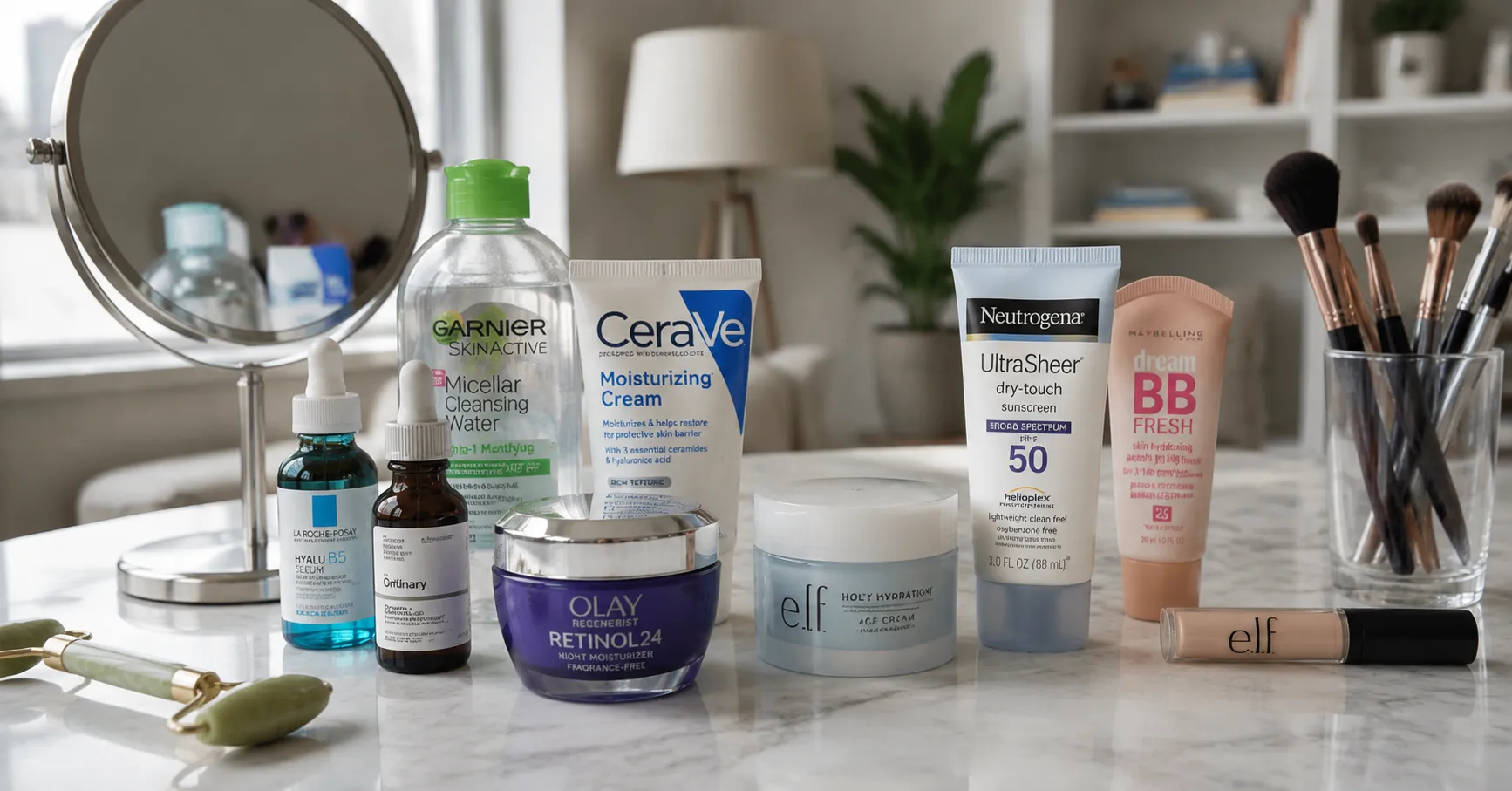
A foundational routine doesn’t need to be elaborate. A gentle cleanser, a niacinamide or hyaluronic acid serum depending on your concerns, a simple moisturizer with ceramides, and an SPF in the morning that’s it. That’s the skeleton that most dermatologists would recognize as sound. CeraVe, Cetaphil, Neutrogena, Vanicream, and The Ordinary are the names that come up again and again when dermatologists are asked what they’d recommend to their patients if cost were a factor. The fact that cost is always a factor for most people makes this worth saying clearly.
The Ordinary deserves its own mention because it changed the conversation. When they launched with single-ingredient serums at three and four dollar price points retinol, glycolic acid, vitamin C the collective reaction was suspicion. Could something that cheap actually work? The answer turned out to be yes, largely because they were transparent about formulation and didn’t charge for packaging that looked like it belonged in a museum. Their success forced the broader market to reckon with what customers were actually paying for.
When It Makes Sense to Spend More
None of this means every luxury product is a scam. Some high-end brands do meaningful R&D. Some formulas are genuinely more elegant better stability, less irritation potential, textures that make daily use feel like something rather than nothing. For people with sensitive or reactive skin, a carefully formulated product with minimal fragrance and a track record of tolerability might be worth a premium if the alternative is playing ingredient roulette.
Targeted treatments are another case where the calculus shifts. A well-researched serum with a specific, high-quality form of vitamin C like ascorbyl glucoside or L-ascorbic acid in a properly stabilized formula might be worth the extra cost if the drugstore alternatives are poorly formulated or unstable. Vitamin C oxidizes. A cheap, unstable formula is functionally useless. Here, you might be paying for actual chemistry, not just packaging.
The point isn’t to distrust anything expensive. It’s to ask, every time: what am I actually paying for here? If the answer is a genuinely superior formula, an ingredient at an effective concentration, a texture that makes you more likely to use it daily those are real reasons. If the answer is a heavy embossed box and a presence in the pages of a glossy magazine, that’s information too.
The Real Luxury Is Knowing the Difference
There’s a certain freedom that comes from understanding that your skin doesn’t read price tags. It responds to what you put on it the concentrations, the compatibility, the consistency. A twenty-dollar routine that you understand and trust and use every morning without thinking about it is doing more for you than a two-hundred-dollar collection sitting half-used on a shelf because you’re rationing it.
That knowledge doesn’t diminish the pleasure of a beautifully designed product or the ritual of something that feels genuinely elevated. Those things have their place. But they’re wants, not needs and knowing that distinction clearly means you’re spending on what actually moves the needle rather than on the story you’ve been told about what moving the needle should look like.