
The Skincare Industry Has a Complexity Problem
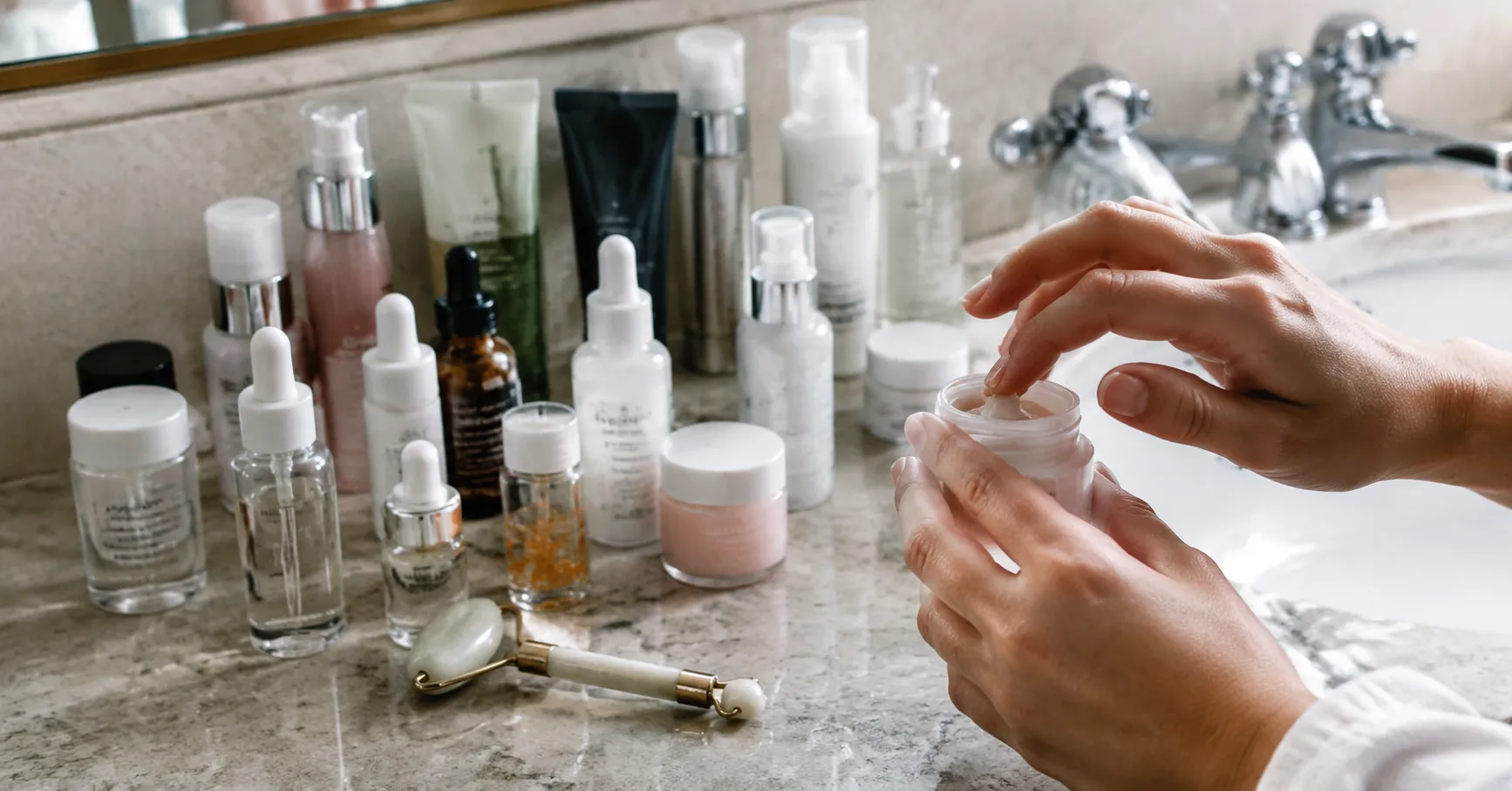
Walk into any beauty retailer and you’ll be met with an overwhelming wall of serums, essences, toners, ampoules, mists, and moisturizers each promising to do something slightly different, each insisting it belongs in your daily routine. The modern skincare ritual has quietly ballooned into something that resembles a chemistry lab more than a bathroom sink. Ten steps. Sometimes twelve. The kind of regimen that requires a spreadsheet to keep track of what goes on before what, which acids conflict with which actives, and whether you’re supposed to wait sixty seconds between each application.
It’s exhausting. And for a lot of people probably more than the beauty industry would like to admit it’s also completely unnecessary.
The five-minute face isn’t a compromise. It isn’t what you do when you’re running late or feeling lazy. It’s a philosophy rooted in something the skincare world has been slowly rediscovering: that the skin, a self-regulating organ, often performs better with less interference, not more. Strip away the noise, and what you’re left with is a routine that’s not only faster but, for many skin types, genuinely more effective.
Where the 10-Step Obsession Actually Came From
It’s worth understanding how we got here, because the ten-step routine didn’t emerge from dermatological science. It came from Korean beauty culture in the early 2010s, when Western beauty editors started documenting elaborate multi-step rituals and readers responded with fascination. The concept hit the internet at exactly the right moment just as Instagram was turning beauty routines into performance, and the idea of visible transformation through products felt both aspirational and achievable.
What got lost in translation was context. Many of the women those routines were attributed to had been using lightweight, water-based products their entire lives on skin conditioned over years. The steps weren’t heavy-handed interventions; they were layers of barely-there hydration. But the Western interpretation often stacked rich creams, potent actives, and multi-acid treatments on top of each other and called it the same thing. The result, for a lot of people, was sensitized, congested, or chronically irritated skin and a medicine cabinet full of half-used bottles.
The beauty industry, naturally, leaned into the complexity. More steps meant more products. More products meant more sales. The question of whether any individual person’s skin actually needed all of it rarely came up.
What Your Skin Actually Needs
Here’s the part that tends to surprise people: the foundational requirements of skin are genuinely simple. Clean it. Protect its moisture barrier. Shield it from UV radiation. That’s the core of it. Everything else is either targeted treatment for a specific concern or optimization at the margins.
A well-formulated cleanser, a moisturizer suited to your skin type, and a broad-spectrum SPF of at least 30 cover the essentials for morning. At night, swap the sunscreen for a slightly richer moisturizer if your skin runs dry, or a lighter one if it doesn’t. If you have a specific concern acne, hyperpigmentation, fine lines one well-chosen active, used consistently, will outperform five mediocre ones layered carelessly.
That’s the five-minute face. Cleanser, moisturizer, SPF in the morning. Cleanser, moisturizer at night. One targeted treatment if you need it. The whole routine, including the two minutes it takes for the moisturizer to absorb before you apply SPF, clocks in well under five minutes once you’ve done it a few times.
The Barrier Damage Nobody Talks About
One of the less glamorous conversations in skincare concerns what happens when you use too many actives at once. Retinol, glycolic acid, salicylic acid, vitamin C, niacinamide, benzoyl peroxide these are all legitimate ingredients with real evidence behind them. They’re also all capable of disrupting the skin’s natural barrier if used in excess, layered incompatibly, or introduced too aggressively.
A compromised skin barrier looks like a lot of things: persistent redness, tightness after cleansing, breakouts in people who never used to get them, a kind of dull and reactive complexion that no amount of product seems to fix. The cruel irony is that this is often the state people are trying to solve by adding more products, when what the skin actually needs is for them to stop and let it recover.
Stripping back to basics for even two or three weeks can produce dramatic results not because of anything the minimal routine is doing, but because of everything it isn’t doing. The skin, given space, is remarkably good at healing itself.
The Art of Choosing One Good Thing
Going minimal doesn’t mean going inert. The skill in a five-minute routine is in the selection. If you’re in your twenties and your only real concern is keeping your skin healthy and protected, a good SPF moisturizer that combines hydration and sun protection in a single step might be genuinely all you need in the morning. If you’re working on pigmentation, a vitamin C serum applied before your moisturizer adds a meaningful layer of antioxidant protection and brightening support without turning your bathroom into a chemistry experiment.
If texture and aging are your focus, a retinoid used three nights a week starting slow, building tolerance over months does more for long-term skin health than almost any other single ingredient in skincare. You don’t need a different eye cream, a neck cream, a hand cream, a pore minimizer, and a plumping serum alongside it. You need consistency and sunscreen.
The dermatologists who have been saying this for decades are not being dismissive of skincare. They’re pointing at something the industry finds commercially inconvenient: that the evidence-based approach to skin health is much shorter than a ten-step routine, and that most of the products occupying those extra steps exist because they can be sold, not because the skin requires them.
What You’re Actually Buying Back
There’s a version of this conversation that stays purely in the realm of efficacy and ingredients, but the real stakes are broader than that. Time, for one thing. A twenty-minute morning routine, done daily, adds up to roughly 120 hours a year. That’s five full days. Five days of standing at a bathroom counter applying layers of product in the correct order, waiting for each one to absorb, hoping the combination doesn’t trigger some kind of reaction.
There’s also the mental overhead the low-level anxiety of keeping track of it all, the guilt when you skip a step, the creeping sense that your skin is always a project in need of management rather than a body part that mostly takes care of itself. The five-minute face returns skin to something closer to its natural role in your daily life: background maintenance, not foreground obsession.
Some people genuinely love a longer routine. There’s pleasure in ritual, in the tactile experience of a carefully curated sequence of products, and that’s real and valid. But pleasure and necessity are different things. If you’re maintaining a complex routine because you feel like you have to, because the algorithm told you your skin needs twelve products, because stopping feels like giving up that’s worth examining.
Starting Simpler Than You Think You Should
The hardest part of cutting back is trusting that less will be enough. We’ve been conditioned, quite deliberately, to believe that our skin is always on the verge of catastrophe without intervention. That without the toning essence, the pores will spiral. That without the second serum, the glow will vanish.
It won’t. Start with the three things and nothing else. Give it a month. What you’ll likely find is that your skin calms down, evens out, and stops demanding constant attention because you’ve stopped demanding constant attention from it.
The five-minute face isn’t about settling for less. It’s about recognizing that you were probably never getting more in the first place.