
Why Your Bag Choice Matters More Than You Think
Picture this: you’re at a festival, the bass is thumping through your chest, the crowd is swaying in that collective rhythm that makes these moments feel almost sacred. And you’re stuck holding a tote bag in one hand, trying to fish out your phone with the other, nearly dropping your drink in the process. It’s a small frustration, but it chips away at something the full-body freedom that a festival is supposed to deliver.
That’s the quiet revolution behind the hands-free bag movement in festival fashion. It’s not just about convenience. It’s about reclaiming presence. When your bag disappears into your outfit slung across your back, wrapped around your waist, draped across your chest your hands are free to raise, your body is free to move, and your attention is free to be exactly where you want it.
The bags people carry to festivals have always said something about who they are and how they want to experience the day. Right now, they’re saying: I’m here, and I’m not about to let logistics slow me down.
The Crossbody: A Classic That Keeps Earning Its Place
If there’s one style that has survived every festival trend cycle without apology, it’s the crossbody. Long straps, body-skimming silhouette, just enough room for the essentials it’s a formula that works because it respects the physics of a festival day.
What makes a crossbody great in a festival context isn’t always the bag itself; it’s the strap. Adjustable, wide, and ideally woven or textured so it doesn’t slide off a bare shoulder every twenty minutes. Leather crossbodies hit differently when the light catches them right, but crocheted styles have a sun-soaked, effortless quality that pairs with linen sets and flowy dresses without trying too hard.
There’s also the question of closure. Zip-top crossbodies are the practical choice for festival-goers who’ve learned the hard way that open-top styles turn into liability the moment a crowd surges. But a magnetic snap on a structured flap bag can look genuinely elevated while still keeping your belongings secure.
Mini crossbodies barely bigger than a phone have become almost iconic in festival photography. They’re not for everyone. If you carry more than a card, a key, and a lip balm, you’ll feel constrained. But for someone who can genuinely travel light, there’s an elegance to the restraint. They communicate confidence. You’re not carrying backup plans; you’re fully committed to the moment.
Belt Bags: Still Here, Still Relevant
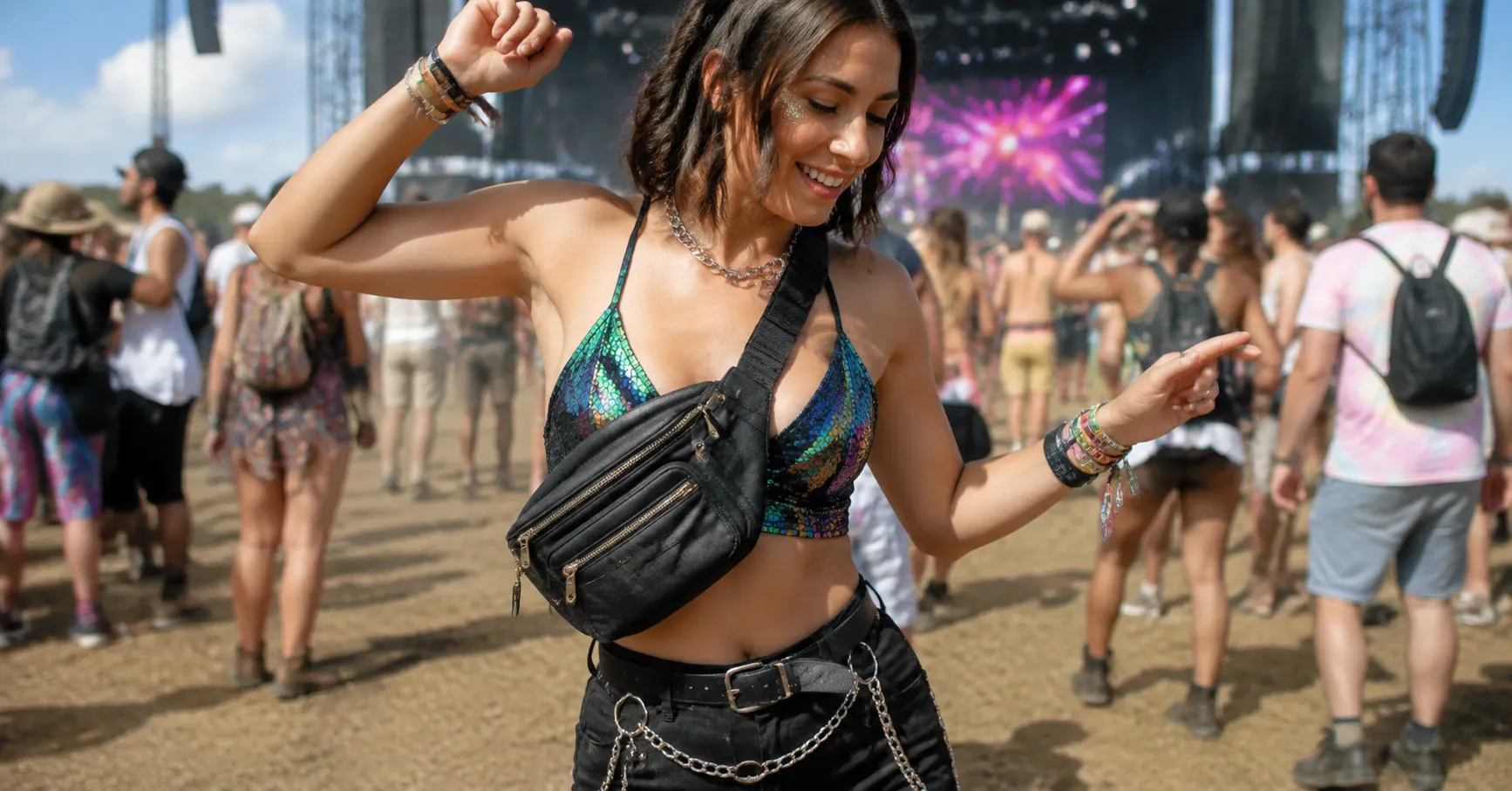
Let’s address the obvious: the belt bag has had a complicated reputation. It peaked somewhere around the early 2000s, disappeared under a cloud of irony, and then came back with such force that it never really left again. Today’s festival belt bag is not your father’s fanny pack. It’s structured neoprene or buttery suede, styled deliberately, worn high on the waist or draped casually across the hip.
What makes belt bags so persistent in festival fashion is the weight distribution. When you’re walking miles across a dusty field or dancing without stopping, having your belongings centered on your body rather than dragging from one shoulder is genuinely better. It doesn’t pull, it doesn’t slip, and it doesn’t bruise your ribs when you move quickly.
The styling possibilities have also expanded in ways that would surprise purists. A black leather belt bag worn under an open oversized blazer creates a whole editorial moment. A neon quilted style paired with neutral shorts says something completely different playful, self-aware, unbothered. Double-belting two smaller bags at different heights became a micro-trend at several major festivals, and while it sounds excessive on paper, in practice it looks intentional and oddly chic.
Bum bags with longer drop chains worn like crossbodies but with chain hardware occupy a fascinating middle ground between edgy and accessible. They photograph beautifully in golden hour and sit comfortably against the body throughout a long day. Festival wear is one of the few contexts where that kind of hybrid bag feels completely at home rather than confused about its own identity.
Backpacks: When You Need to Actually Carry Things
Not every festival allows you to leave your sunscreen, portable charger, and extra layers in a locker. Multi-day camping festivals especially demand a bag that can hold real volume without becoming a physical burden or a style compromise.
Mini backpacks have threaded the needle between function and fashion more successfully than their critics initially predicted. The key is proportion a structured mini backpack with clean lines and quality hardware can look sharp over a festival outfit in a way that a slouchy oversized version simply can’t. Think less hiking gear, more architectural statement.
Mesh backpacks, which gained traction partly because many festivals require clear bag policies, have been quietly elevated by designers and streetwear brands who understood that transparency didn’t have to mean disposable. Clear panels framed in black nylon or accented with bold hardware have genuine aesthetic merit. Some people have leaned into the clear bag as a kind of styling opportunity arranging what’s inside with intention, treating the contents as part of the look.
Embroidered canvas backpacks occupy a different register entirely: folkloric, textured, rich with detail. They work particularly well at festivals with bohemian or world-music programming, where the visual language of the event actually calls for something more artisanal. Pair one with a printedco-ord set and the result feels cohesive in a way that a sleek nylon pack wouldn’t.
Material and Color: Where the Real Decision Lives
Once you’ve settled on a silhouette, the true personality of a festival bag comes through in its material and color. And this is where most people play it too safe.
Neutral bags are easy. A tan leather crossbody or a black belt bag will match everything and offend no one. But festivals are one of the few social environments where going bigger with color carries essentially no downside. A cobalt blue woven bag in a sea of neutrals is a conversation starter. A fire-orange crocheted style reads warm and joyful against pale skin or deep tones alike.
Reflective materials holographic nylon, iridescent vinyl have consistent staying power in festival fashion specifically because of how they interact with both natural daylight and artificial stage lighting. They transform through the day. A bag that looks silver in the morning heat becomes something almost alive under moving lights at night.
Texture plays a psychological role too. Fluffy bucket bags and sherpa-lined pouches feel like a sensory experience in themselves tactile, unexpected, soft against the wrist. Beaded bags carry a handcraft quality that synthetic materials can’t quite replicate. Woven straw reads permanent summer, whatever the season.
Practicality as Aesthetics: The Underrated Design Principle
Here’s a perspective that doesn’t get enough credit: the best festival bags are beautiful precisely because they’re well-designed for actual use. Function and aesthetics aren’t in tension. They’re collaborative.
A bag with a hidden back zipper pocket, for instance, solves a real problem securing your essentials against pickpockets without compromising the bag’s exterior lines. An adjustable strap that can convert between crossbody and belt positioning doubles the styling options without adding visual clutter. Interior organization a few card slots, a clip for keys turns a beautiful bag into a reliable one.
When something works well, you carry it with ease. And carrying something with ease changes how you move through a space. Festival fashion at its best isn’t armor you wear; it’s an extension of how you want to feel in your own body. A bag that functions as it should lets you forget about it in the best possible way.
Somewhere between the dust and the crowd and the music, that’s actually the point to be so at home in what you’re wearing that the experience itself can take over completely.