

The Version of “Healthy” You Were Sold
There’s a particular image most people carry in their heads when they decide to “get fit.” It usually involves someone running at sunrise, a smoothie bowl with artfully placed berries, and abs that look like they were engineered rather than earned. Magazines built empires on it. Instagram refined it. And somewhere along the way, millions of people internalized that picture as the destination the proof that they’d finally done it right.
What nobody mentions is how thoroughly that image was designed to keep you spending money and feeling inadequate. The fitness and beauty industries don’t profit from people who feel good enough. They profit from the gap between where you are and where the image tells you that you should be. Understanding that isn’t cynicism. It’s the first genuinely useful thing you can learn before starting any real transformation.
Your Body Is Not a Before Photo
One of the quieter cruelties of wellness culture is how it treats the body you currently have the one getting you to work, digesting your breakfast, healing your minor cuts without a single conscious instruction from you as a problem to be solved. The “before” framing. Once you absorb that framing deeply enough, every mirror becomes a verdict rather than just a reflection.
The research on this is actually pretty clear: people who approach fitness from a place of body appreciation, rather than body punishment, show better long-term adherence, lower cortisol levels, and more sustainable results. That’s not a soft, feel-good observation. That’s physiology. Chronic stress, including the psychological stress of hating your body, elevates cortisol, which directly interferes with fat metabolism and sleep quality. You can’t hate yourself thin. The biology simply doesn’t cooperate.
This doesn’t mean you can’t want change. It means the emotional posture you bring to that change matters more than any specific workout program.
What “Radiant” Actually Means Under the Surface
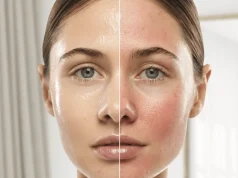
Skin is one of the most honest organs in the body. Not because it reveals everything, but because it reflects systemic health in ways that no topical product can fully fake. People spend extraordinary amounts on serums, treatments, and devices while largely ignoring the levers that genuinely move the needle: sleep, hydration, stress load, gut health, and the quality of their dietary fat intake.
Collagen, that structural protein responsible for skin’s firmness and elasticity, degrades from the inside out. UV exposure accelerates it. Poor sleep accelerates it faster. And a diet chronically low in antioxidants, omega-3 fatty acids, and vitamin C doesn’t give the body the raw materials to rebuild what time takes away. No retinol corrects a magnesium deficiency. No facial does what seven consistent hours of sleep does for skin inflammation and cellular repair.
The glow that people chase in skincare aisles is, at its core, a metabolic phenomenon. Which is inconvenient for the marketing of $200 moisturizers, but genuinely useful if you’re trying to understand why some people seem to age gracefully while doing very little, and others don’t despite doing everything on the list.
The Thing About Consistency That No One Frames Correctly
Every fitness coach says it. Consistency is everything. But the conversation usually stops there, as if saying the word is enough to make it happen. What’s rarely examined is why consistency fails and it almost never fails because people are lazy or lack willpower. It fails because the program doesn’t fit the actual life.
A 5a.m. lifting routine built for someone with no kids, a flexible schedule, and a gym three minutes from home will not translate intact to someone working variable shifts with two children and a 40-minute commute. That’s not a motivation problem. That’s a design problem. The program is wrong for the life, not the other way around.
Sustainable fitness is almost always the result of brutal honesty about the life you’re actually living, not the idealized version of it. Twenty minutes of movement you can do consistently beats a 90-minute program you abandon in week three. The body doesn’t give extra credit for ambition. It responds to what actually gets done.
There’s also something worth naming about novelty and boredom. The human brain habituates quickly. A workout that felt challenging and engaging at month one often becomes a chore by month four not because you’ve outgrown it physically, but because the psychological reward has diminished. Rotating modalities, training outdoors, joining a class, working with a partner these aren’t luxuries. For many people, they’re the difference between a decade of movement and a two-month streak.
Muscle Is the Metabolism Story You Weren’t Told
Somewhere in the cultural conversation about getting fit, cardio became synonymous with weight loss, and strength training got filed under “bulking up” a goal that a significant portion of women, in particular, were told they didn’t want. This was wrong in ways that genuinely cost people years of misdirected effort.
Muscle tissue is metabolically expensive. The body burns calories just maintaining it, even at rest. As people age, they naturally lose muscle mass a process called sarcopenia that begins in the thirties which is a significant reason why metabolism slows over decades. The standard response has been to eat less and do more cardio, which, without a resistance component, can actually accelerate muscle loss. You end up smaller, but not stronger. And the metabolic slowdown continues.
Progressive resistance training lifting weights, using resistance bands, doing bodyweight exercises that actually challenge the muscles is one of the most evidence-backed interventions for body composition, insulin sensitivity, bone density, and even mood. The antidepressant effects of strength training are well-documented at this point and appear to be dose-responsive. It also builds the kind of functional capacity that changes how you move through daily life: carrying groceries, climbing stairs, recovering from injury faster.
None of this requires a powerlifting program or a gym membership. But it does require a shift in how fitness is conceptualized away from burning calories as punishment and toward building a body that works well for a long time.
The Sleep Debt No One’s Accounting For
It would be difficult to overstate how much inadequate sleep undermines every other health effort. One well-cited study found that people on a calorie-restricted diet lost significantly more fat when they slept adequately and when sleep-deprived, the weight they lost shifted dramatically toward muscle rather than fat. The same diet, the same deficit, profoundly different outcomes based purely on sleep.
Hunger hormones are particularly sensitive to sleep duration. Ghrelin, which drives appetite, rises with sleep deprivation. Leptin, which signals satiety, drops. The result is a biological state that makes overeating feel almost involuntary not because of poor choices, but because the hormonal environment is actively pushing in that direction. Willpower runs against a current here. Better sleep removes the current.
There’s a broader point underneath all of this. The body isn’t a set of separate systems you can optimize independently. Skin, muscle, fat metabolism, mood, hunger, inflammation they’re all downstream of the same foundational inputs. Sleep. Movement that you enjoy enough to sustain. Food that’s mostly real and varied. Stress that’s managed, not simply suppressed. Relationships that feel nourishing rather than draining.
Getting fit and radiant isn’t a secret formula. It’s closer to the deliberate stacking of boring fundamentals over a long enough timeline that the results start to look like transformation. The industry just doesn’t have much to sell you inside that version of the story.