

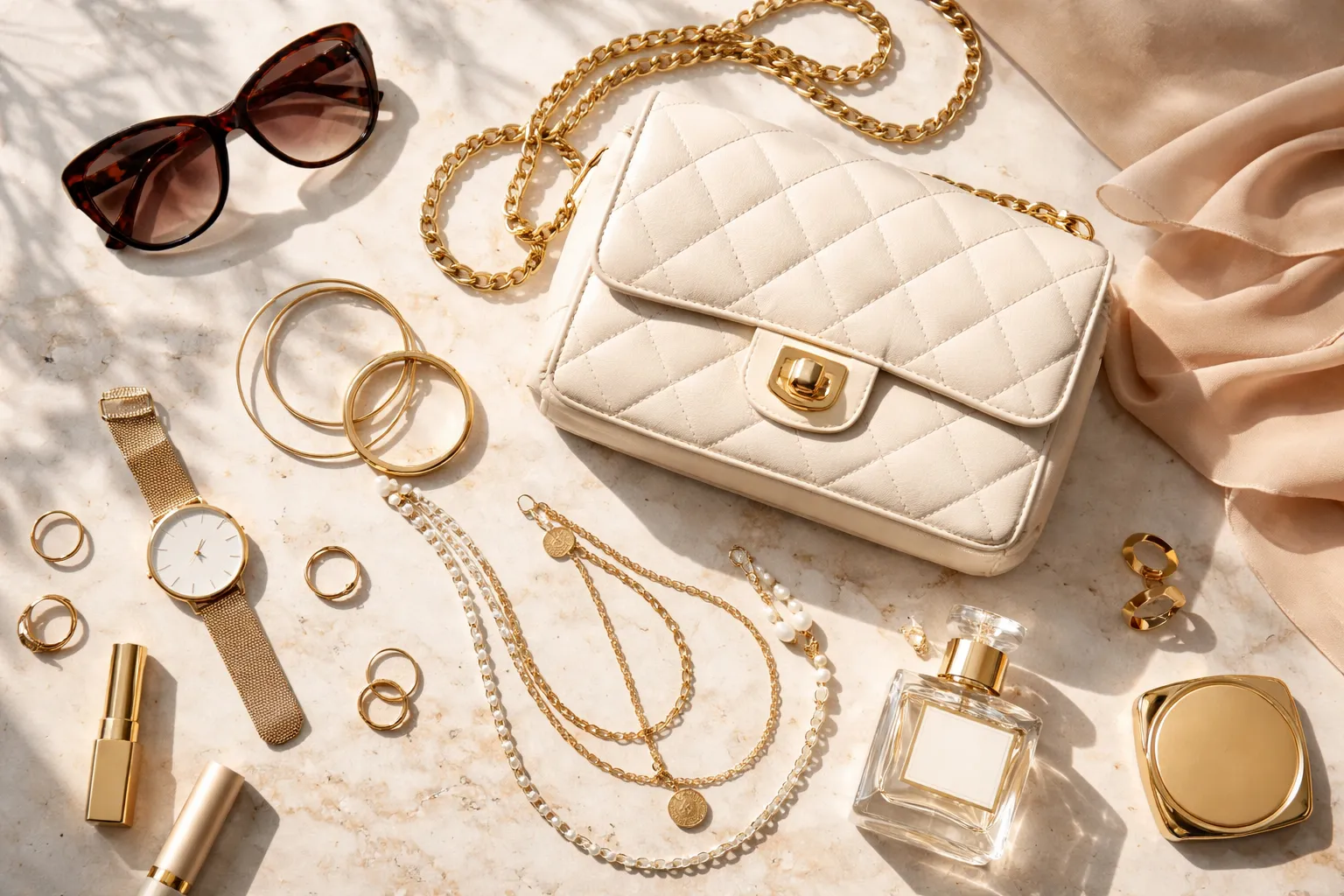
There’s a particular kind of person who walks into a room and seems effortlessly put together not because of what they’re wearing, exactly, but because of how they’re wearing it. You study them for a second longer than you mean to. The outfit isn’t complicated. It might even be simple. But something about it reads as expensive, considered, intentional. Nine times out of ten, the answer isn’t the clothes at all. It’s the accessories.
This is one of fashion’s most quietly democratic secrets: a well-chosen accessory can do more for a look than a designer dress. It doesn’t matter if the blouse came from a fast-fashion rack or the trousers are three years old and slightly out of trend. The right bag, the right watch, the right belt these things reframe everything around them. They signal taste in a way that price tags alone cannot buy.
The question, of course, is which accessories. Not every shiny object elevated a look. Some overcrowd, some cheapen, some simply confuse. The ones that work share a common language: restraint, quality of material, and a kind of quiet authority that never needs to announce itself.
The Belt: The Most Underestimated Tool in the Wardrobe
Most people treat a belt as a functional afterthought something to stop the trousers from falling. That’s a waste of one of the highest-leverage items you own. A well-made leather belt in black or rich cognac brown is capable of doing something genuinely architectural. It creates waist definition where there wasn’t any, transforms a loose blazer into something structured, and signals that the wearer paid attention to the whole picture rather than just the top half.
The details here matter enormously. A thin, flimsy belt with a gold-toned buckle that’s already losing its plating after six months tells a story you don’t want to tell. A substantial belt full-grain leather with a solid, simple buckle in a matte finish tells a completely different one. You’re not looking for ornamentation. You’re looking for integrity of material and simplicity of form. The best belts are the ones no one notices specifically but everyone registers subconsciously.
Patent leather and textured options like crocodile-embossed or pebbled leather add visual interest without demanding attention. And in a moment when quiet luxury has firmly displaced logomania as the aspirational aesthetic, a logo-free belt in real leather outperforms branded alternatives in almost every context outside a streetwear setting.
A Watch That Doesn’t Try Too Hard
There’s an entire philosophy embedded in the choice of a watch. More than almost any other accessory, a watch communicates worldview. The person who wears a dive watch with everything formal, casual, dressed up is making a statement about practicality and confidence. The person in a slim dress watch is communicating something else: precision, a certain old-world restraint. Neither is wrong. Both are deliberate.
What makes a watch “elevate” an outfit isn’t necessarily its cost, though quality of movement and dial finishing do read differently at close range. It’s proportion and appropriateness. A watch that’s too large looks costume-y on a slender wrist. A delicate gold-toned watch on someone in heavy workwear creates a jarring visual disconnect. The magic happens when the scale of the watch feels native to the body wearing it and the clothes surrounding it.
The case for a classic, uncluttered dial white or black with minimal indices, no complications crowding the face is strong regardless of budget. These watches photograph beautifully, age without going out of style, and carry a kind of restraint that communicates confidence. You don’t need the watch to do all the talking. The outfit is already speaking.
Sunglasses and the Power of the Right Frame
Sunglasses are one of the few accessories that can change the entire mood of a face. They also operate as a kind of shorthand for personal style in a way that’s more immediate and visible than almost anything else you notice someone’s sunglasses from across a street in a way you’d never notice their earrings or shoe hardware.
The classic frames have endured for a reason. A well-proportioned tortoiseshell acetate frame works with almost every skin tone and hair color. Black thin-frame sunglasses carry an effortless editorial quality. Vintage-leaning round frames in gold or silver metal soften angular faces and add a touch of bohemian intellectualism. These silhouettes recur every few seasons precisely because they transcend their moment.
What makes sunglasses look cheap isn’t usually the brand it’s the quality of the lens tint. A murky, uneven tint reads as budget regardless of the frame around it. Gradient lenses done well, or a clean solid smoke or brown tint with optical-grade clarity, communicates a level of intentionality that upgrades the entire look. Pair a crisp white linen shirt with good sunglasses and suddenly you look like you just stepped off a yacht. The linen didn’t change. The framing did.
The Bag as a Silent Biography
There’s a reason people study bags. A bag is, in a very literal sense, a container for your life and the one you choose to carry says something about how you want to present that life to the world. The structured tote that fits a laptop, a notebook, and still looks clean says: organized, professional, unhurried. The slouchy leather hobo in a worn cognac says: confidence, an ease with imperfection, a certain sensuality of material. The tiny cross-body says: unencumbered, intentional, going somewhere specific.
In terms of making an outfit look expensive, the rules converge around a few consistent principles. Structured silhouettes elevate more than slouchy ones. Hardware that matches all gold or all silver, not a confusing mix reads as considered. And the relationship between the bag’s color and the rest of the palette matters more than most people realize. A camel bag against a navy outfit is one of fashion’s quiet agreements. An olive green bag against earth tones creates depth. Matching your bag exactly to your shoes, once a strict rule, now reads as overly coordinated in a way that actually undermines the sense of ease that luxury conveys.
Real leather ages in a way that synthetic materials simply cannot replicate. The patina that develops on a quality leather bag over years of use is itself a signal it tells a story of longevity that fast fashion, by definition, can never accumulate. This is why a twenty-year-old leather bag from a quality maker can outperform something brand new and synthetic from a premium retailer.
Jewelry: The Case for Less
Fine jewelry and its convincing costume alternatives operate on the same principle: one strong piece, worn with confidence, beats six competing pieces every time. A single sculptural ring on an otherwise bare hand. A thin gold chain against bare skin. Classic pearl studs that simply do what they’ve always done add a point of luminescence near the face without demanding discussion.
The temptation to layer, to stack, to fill in all the negative space is understandable. It can work, and it can work beautifully when the pieces share a visual language. But for most people in most contexts, the version that looks most expensive is the edited one. What you leave off is as much a decision as what you put on.
Gold tones tend to warm skin; silver tones tend to sharpen. Neither is inherently superior, but consistency within a look not mixing metals randomly is a discipline that separates the assembled from the accidental. And there’s something worth noting about scale: large statement earrings make sense on their own, without necklaces fighting for the same territory. A boldcuff carries the wrist. A delicate ring lets the hand remain.
What all of this points toward isn’t a checklist or a capsule wardrobe prescription. It’s a way of seeing learning to look at an outfit the way a set designer looks at a scene, identifying what’s serving the composition and what’s just noise. The accessories that make things look expensive are really the ones that demonstrate that someone thought it through. That they knew when to add and when to stop. That’s not about money. It never really was.