
Most people buy sunglasses the way they buy impulse snacks they spot something that looks good, grab it, and deal with the consequences later. A pair catches the light just right in a store display, or an influencer makes a specific frame look effortlessly cool, and that’s the decision made. There’s nothing wrong with that kind of spontaneity, except when the sunglasses end up sitting in a drawer three weeks after purchase because they slide off your nose every time you look down, or because the tint turns a morning run into a visual guessing game.
Choosing sunglasses that actually work for your life is a more layered problem than it first appears. It touches on face geometry, light physics, the specific activities you do, and maybe more than anything the gap between who you are and who you imagine yourself to be when you’re standing in front of a mirror in a boutique.
The First Question Isn’t “What Looks Good?” It’s “What Do I Actually Do?”
Before anything else, be honest about your daily context. Not the aspirational version of your life, but the actual one.
If you commute in a car every morning, your primary enemy is glare off wet asphalt and other windshields. Polarized lenses become less of a luxury and more of a functional tool. The effect isn’t subtle polarized lenses cut horizontal light waves selectively, which is exactly the kind of reflective glare that bounces off flat surfaces. Non-polarized lenses just darken everything uniformly, which helps with brightness but does nothing specific for that blinding shimmer.
If you spend serious time outdoors hiking, running, cycling the conversation shifts toward lens category and coverage. European standards use a scale from Category 0 to Category 4 for light transmission. Category 0 is essentially clear. Category 4, used for glacier and high-altitude conditions, blocks up to 97% of visible light and is not suitable for driving. Most people doing outdoor sports land in Category 3, which handles strong sunlight well without turning the world into a cave.
If you work mostly indoors and wear sunglasses primarily for commuting or weekend use, you have more flexibility. But even here, the frame-to-activity fit matters more than most people realize.
What UV Protection Labels Actually Tell You (And What They Don’t)
“100% UV protection” has become something of a marketing mantra, and it’s worth knowing what it actually means before you trust it completely.
UV protection in lenses refers to blocking UVA and UVB rays the same spectrum that causes sunburn and long-term eye damage including cataracts. A lens can block 100% of UV radiation without being particularly dark. UV protection is a chemical property of the lens material or coating, not a function of tint darkness. A pale, lightly tinted lens with a proper UV coating outperforms a dark, dramatic lens without one. This is the single most common misconception in sunglass buying, and it costs people their eye health because they assume a darker lens is doing more work.
When shopping, look specifically for the phrase “100% UVA and UVB protection” or “UV400,” which means the lenses block all light up to 400 nanometers wavelength the full UV range. The American Optometric Association endorses UV400 as the standard worth meeting. Most reputable brands meet this bar. The risk zone is discount shelving, street markets, and anonymous online sellers where the coating may be cosmetic rather than functional.
The real issue isn’t that people don’t know UV protection matters. It’s that they assume any reasonable-looking pair of sunglasses from any reasonable-looking source probably covers it. That assumption is worth dropping.
Face Shape Is Real, But You’re Probably Overthinking It
There is genuine optical logic to the idea that certain frame shapes flatter certain face structures. Contrast creates visual interest angular frames on a rounder face, softer curves on a more angular one. This isn’t arbitrary aesthetic doctrine; it’s the same principle that guides portrait photography and graphic design. The eye is drawn toward contrast and difference, not sameness.
That said, most face shape guides online are written with a rigidity that doesn’t reflect how the actual human face works. Real faces don’t map neatly onto “oval,” “heart,” “square,” or “diamond.” They’re combinations. And personal style the way you carry yourself, what you wear, your hair overrides face geometry in practice.
The more useful question isn’t “what shape suits my face?” but “what frame size fits my head?” Fit is concrete and measurable. A frame that’s too wide will slide constantly. Lenses that sit too close to your face will create a fogged-up tunnel around the periphery. Temple arms that are too short will grip your skull in a way that becomes a headache after twenty minutes.
Look for millimeter measurements on frame bridges and lens widths many online retailers include them now. A general benchmark: the frame width should roughly match or slightly exceed the widest point of your face. Lens height matters too if you’re concerned about coverage; taller lenses offer more protection for the lower portion of your visual field, which matters for driving or anything involving bright reflected surfaces below eye level.
Lens Color Has Actual Consequences
This is where things get genuinely interesting, and where most casual buyers are completely flying blind.
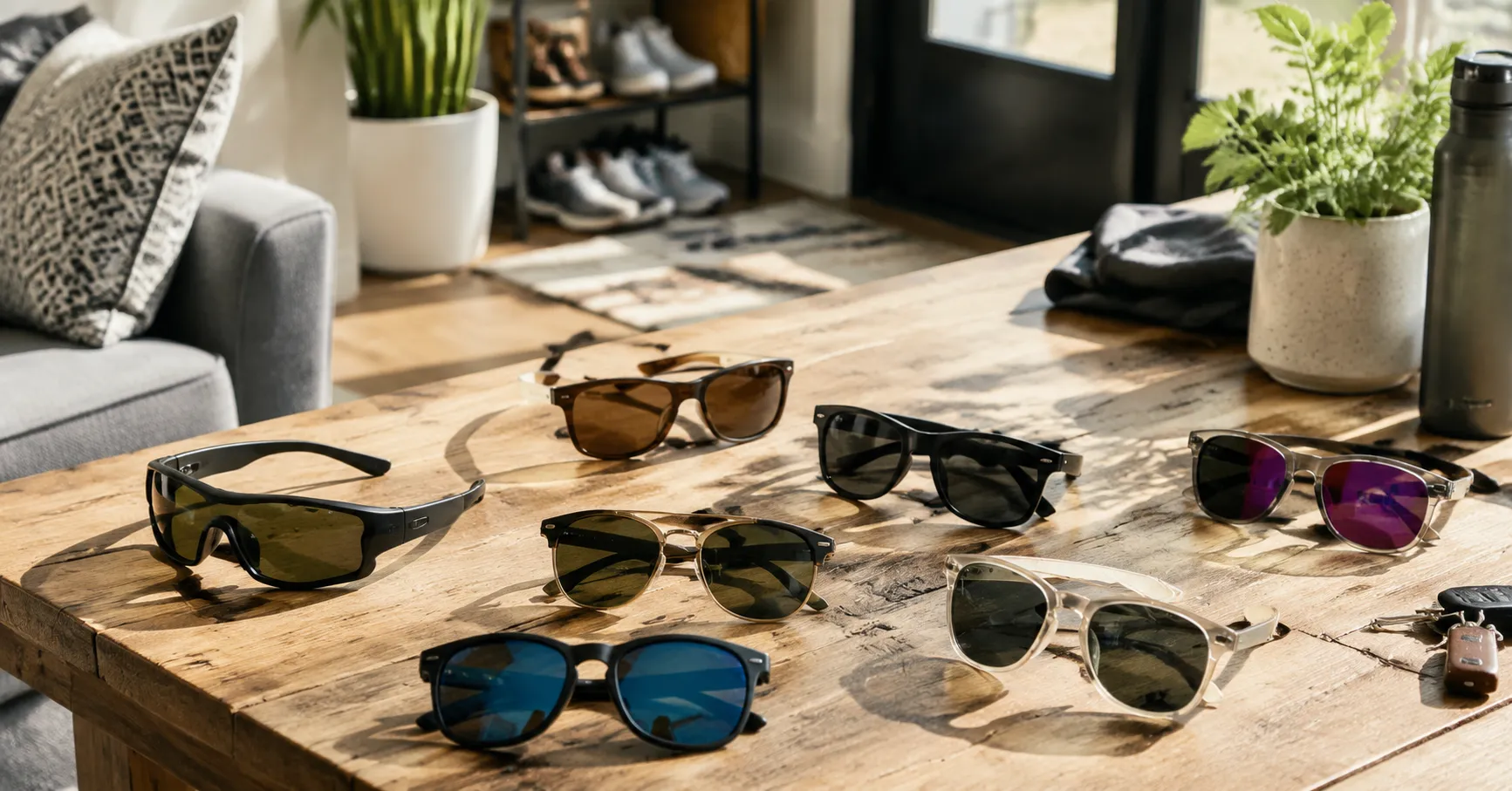
Different tint colors filter different parts of the light spectrum and enhance contrast in specific environments. Gray lenses are the closest to neutral they reduce brightness without shifting color perception significantly, which is why they’re standard for driving. You see the world as it is, just darker.
Brown and amber lenses enhance contrast in low-to-medium light. They’re particularly effective for activities where depth perception matters golf, cycling on varied terrain, fishing. The warm tone filters blue light, which sharpens edges and makes objects pop against backgrounds. Fishermen have known this for decades. The same lens that helps you track a fly on the water also makes that green hiking trail pop with definition.
Yellow and rose-tinted lenses are counterintuitive. They’re used in low-light or overcast conditions because they brighten the perceived environment by filtering blue-gray wavelengths. Ski goggles often use yellow or rose lenses for this reason flat light on a snow slope is genuinely dangerous because it eliminates depthcues, and a warm-tinted lens partially restores them.
Blue and mirrored lenses read as fashion-forward, but their functional application is more limited. Mirrored coatings reduce visible light transmission and can look flattering, but they don’t inherently improve contrast or UV protection beyond whatever the base lens offers. Blue tint can actually increase sensitivity to the wavelengths most associated with eye strain. This doesn’t make them wrong it just means you’re buying them for aesthetics, which is a perfectly legitimate reason, but a different one.
The Durability Question Nobody Asks Until It’s Too Late
Lens material rarely comes up in the store, and it should. The dominant options are glass, polycarbonate, and CR-39 plastic, each with real trade-offs.
Glass lenses offer the best optical clarity and scratch resistance of the three. They’re heavier and will shatter on impact. For casual urban wear, the weight is noticeable over a long day, and the shatter risk is non-trivial for sports or outdoor use.
Polycarbonate is the dominant material for sport and performance eyewear. It’s impact-resistant to a degree that glass cannot match, significantly lighter, and naturally filters some UV. The drawback is surface softness polycarbonate scratches more easily than glass, and without an anti-scratch coating, those lenses will look worn within a year of regular use.
CR-39 plastic sits between the two. Optically excellent, lighter than glass, more scratch-resistant than polycarbonate. It lacks the impact resistance that makes polycarbonate the choice for contact sports, but for most everyday applications, it’s the sweet spot.
Frame material matters too. Acetate frames are durable and adjustable but sensitive to heat leave them on a car dashboard in summer and they’ll warp. Metal frames are more stable but less forgiving on irregular face shapes. Nylon or TR90 frames dominate the sports market because they’re light, flexible, and essentially impervious to temperature changes.
The Lifestyle Fit Is the Final Filter
Here’s the thing nobody says clearly enough: the best sunglasses are the ones you’ll actually wear consistently. A technically superior pair that lives in a case because they feel awkward or don’t match your usual clothes provides zero benefit. Sunglasses accumulate UV exposure damage to your eyes the same way sunscreen protects skin the protection only works when it’s applied.
So the real criteria stack looks something like this: UV400 protection as the baseline non-negotiable, then lens category and tint suited to your primary use case, then fit and coverage appropriate to your face and the activities involved, and finally a frame style you’ll reach for without thinking twice.
The pair that meets all four is out there. You might find it in a sporting goods store, an optician’s office, or a well-reviewed online retailer with a clear return policy. What you probably won’t find it doing is grabbing the first thing that catches the light in a checkout display though stranger things have happened.