
This “Healthy” Habit Was Actually Aging My Skin
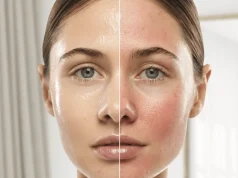
For years, I thought I was doing everything right. I was the person who read ingredient labels, who had a dedicated skincare routine, who actually wore SPF on cloudy days. My friends called me obsessive. I called it informed. And then, somewhere around my late twenties, I started noticing something I couldn’t explain a dullness that no serum seemed to fix, fine lines appearing faster than they should, a kind of tired texture that felt older than my age.
It took me an embarrassingly long time to trace it back to the one habit I was most proud of.
I was over-cleansing. Aggressively, religiously, enthusiastically over-cleansing. Twice a day, sometimes three times if I’d been to the gym. I was using a foaming cleanser that left my skin feeling and this is the word that should have been a red flag squeaky clean. I genuinely believed that tightness meant effectiveness. That stripped meant clean. That clean meant healthy.
It meant none of those things.
The Squeaky Clean Myth
The idea that your skin should feel taut after washing is one of the most pervasive and quietly destructive myths in skincare. It feels intuitive. Clean things feel clean, right? But skin isn’t a kitchen counter. It’s a living organ with its own ecosystem, and that ecosystem is far more delicate than most of us treat it.
Your skin’s surface is protected by something called the acid mantle a thin, slightly acidic film formed by sebum and sweat that acts as the first line of defense against bacteria, pollution, and moisture loss. Most foaming cleansers, particularly ones that produce a rich lather, contain surfactants that are specifically designed to strip oils. They do their job well. Too well. Every time I washed my face with that cleanser and felt that satisfying tightness, I was dismantling my acid mantle and leaving my skin functionally naked.
And here’s where the aging part comes in. A compromised skin barrier doesn’t just feel dry it loses its ability to retain moisture efficiently. Transepidermal water loss increases. Collagen-producing cells, called fibroblasts, are sensitive to their environment. When the barrier is chronically disrupted, the inflammation that follows even low-grade, invisible inflammation accelerates the kind of cellular breakdown that shows up as premature aging. Dermatologists have a term for this: inflammaging. It’s not dramatic. It doesn’t announce itself. It just quietly compounds over years.
I was creating the conditions for it every single morning and every single night.
When Healthy Habits Become Harmful Rituals
What makes over-cleansing so insidious is the feedback loop it creates. Strip your skin’s oils, and your sebaceous glands respond by producing more oil to compensate. Now your skin feels oilier than it did before you started your diligent cleansing routine. So you cleanse more. The problem gets worse. You cleanse more aggressively. Somewhere in this cycle, you convince yourself that you just have oily, problematic skin when actually, you’ve trained it to behave that way.
I went through this exact loop for the better part of three years. I even upgraded to a stronger cleanser at one point, reasoning that my skin clearly needed something more powerful. It needed the opposite.
This pattern where the cure perpetuates the condition shows up in a lot of skincare habits that have been culturally coded as virtuous. The daily exfoliation that was supposed to reveal glowing skin but instead left a raw, reactive surface. The alcohol-based toner used to “control” shine that was actually dehydrating the deeper layers. The more-is-more philosophy applied to an organ that tends to thrive on consistency and gentleness rather than intensity.
We’ve been taught to treat skincare like effort has a direct correlation with results. It doesn’t. The skin doesn’t reward aggression.
What the Research Actually Says About Cleansing Frequency
There’s genuine science here, and it’s somewhat humbling for those of us who considered our multi-step routines a mark of sophistication.
A study published in the Journal of Investigative Dermatology found that the skin microbiome the community of bacteria, fungi, and other microorganisms living on your skin plays a crucial role in skin health, immune function, and barrier integrity. Frequent washing with antibacterial or high-surfactant cleansers significantly disrupts this microbiome. And like gut health, skin microbiome disruption has cascading effects that aren’t immediately visible but show up over time.
Separate research has looked at the relationship between chronic barrier dysfunction and collagen degradation. The short version: when your skin is in a persistent state of repair, it ages faster. The resources it would normally spend on maintenance get redirected to emergency patching. That tightness I was interpreting as cleanliness? It was my skin in triage mode.
Dermatologists now broadly recommend that most people even those with oily or acne-prone skin only need to cleanse once a day, in the evening, to remove sunscreen, makeup, and the day’s pollution. A morning rinse with water, or at most a very gentle, pH-balanced cleanser, is sufficient. The skin does its own cleaning work overnight. We’re interrupting it.
The Ingredient I Was Ignoring
Once I started digging into what was actually in my beloved cleanser, I found sodium lauryl sulfate near the top of the ingredient list. SLS is one of the most effective cleansing surfactants in cosmetic chemistry it’s what creates that voluminous foam, that sensation of deep cleaning. It’s also one of the most well-documented skin irritants, with research linking it to disruption of the skin’s lipid barrier even at relatively low concentrations.
The irony is that SLS-containing cleansers are often marketed as the virtuous choice the “deep clean,” the “pore-purifying” option. They show up in “clean girl” skincare routines on social media. They’re recommended for oily skin. They’re positioned as the serious, no-nonsense option for people who actually care about their pores.
Swapping to a low-foam, pH-balanced cleanser felt almost laughably uneventful at first. There was no satisfying lather. No tightness afterward. It felt, honestly, like not doing enough. But within about six weeks, something shifted. The texture of my skin changed. Not dramatically there was no overnight transformation but the dullness I’d normalized started to lift. The reactivity I’d accepted as my skin type settled down. The fine lines around my eyes, which I’d been attributing to stress and screen time, looked softer.
I hadn’t added anything new. I’d stopped removing something essential.
Rethinking What “Taking Care” Actually Means
What I keep coming back to is how much of what we consider self-care is actually self-interference dressed up in the language of wellness. The skincare industry profits enormously from the idea that your skin is a problem to be solved, a surface to be optimized, a system that needs constant intervention. And we motivated by very real desires to feel good, look after ourselves, age gracefully absorb that framework without questioning it.
But skin, left to a reasonable baseline of care, is remarkably capable. It’s been doing this for a few hundred thousand years without glycolic acid and double-cleansing. What it actually needs is protection from genuine stressors UV radiation, pollution, chronic stress, poor sleep not a daily chemical reset that treats the skin’s own biology as the enemy.
There’s something almost counterintuitive in learning that the most aging thing I was doing was the thing I was most convinced was healthy. It’s made me reconsider the other habits I’ve never questioned the ones I perform with total confidence because they feel virtuous, thorough, diligent.
The squeaky clean sensation is gone from my mornings now. What replaced it is quieter, less satisfying in that immediate, ritual way. But my skin has stopped trying to tell me something is wrong.
Maybe that’s what healthy actually sounds like.