
There’s a moment most people recognize standing in front of a mirror under unforgiving light, suddenly aware that the skin looking back at them doesn’t quite match how they feel inside. It might happen at thirty, or fifty, or twenty-two after a brutal stretch of bad sleep and worse eating. Skin has a way of keeping score.
The good news is that it also has a remarkable capacity to recover. Not to be frozen in time, not to be artificially inflated back to some teenage baseline, but to genuinely thrive at whatever age you happen to be. That distinction matters more than most skincare marketing will ever admit.
Why “Glowing Skin” Means Something Different Depending on Your Decade
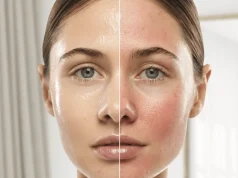
The concept of a glow gets thrown around so casually it’s almost lost its meaning. But physiologically, what we’re really talking about is light reflection the way healthy, well-hydrated skin with an intact surface barrier bounces light back rather than absorbing it flatly. Dull skin isn’t just aesthetically less interesting; it’s usually a signal. Dehydration, compromised barrier function, accumulated dead cells, sluggish circulation these all show up in the same way: a kind of visual heaviness, a lack of depth.
At twenty, the main culprits are usually oil imbalance, inconsistent habits, and inflammation from stress or diet. The skin cell turnover rate is still fast roughly every25 to 28 days which means recovery happens quickly when you give it the right conditions. The mistake most people make at this age is overcorrecting. Stripping the skin with harsh cleansers, layering on actives before the barrier is ready, chasing trends instead of fundamentals. Ironically, more aggressive routines at this stage can create the exact dullness they’re meant to fix.
By the mid-thirties, the biology quietly shifts. Collagen production begins declining by about one percent per year. Cell turnover slows. Estrogen fluctuations whether from stress, perimenopause, or hormonal birth control start showing up in skin texture and hydration levels in ways that feel sudden but have actually been building for years. This is the stage where consistency starts paying dividends in ways that no single miracle product ever will.
Past fifty, the skin’s lipid barrier thins, sensitivity increases, and the old rules about what products work simply stop applying. What was a perfectly fine retinol routine at forty can become genuinely irritating at fifty-five. The focus shifts from aggressive intervention to intelligent support.
The Foundation That Actually Works Across All Ages
Before diving into serums, actives, and everything the skincare industry wants you to believe you desperately need, there are a few non-negotiable foundations that determine whether any topical product can even do its job.
Sleep is the unglamorous one that nobody wants to hear about. During deep sleep, the body’s cortisol levels drop and growth hormone surges this is when cellular repair actually happens. Skin barriers regenerate. Collagen synthesis peaks. No moisturizer on earth can replicate what six to eight quality hours of sleep does on a biochemical level. This is not a wellnesscliché; it’s just physiology.
Water intake and diet follow closely behind. Skin is roughly 64% water, and systemic dehydration shows up on the face before you might notice it anywhere else. But beyond raw hydration, the inflammation picture matters enormously. Diets high in refined sugar and processed oils trigger a process called glycation glucose molecules literally binding to collagen fibers and making them stiff and brittle. You can layer on all the antioxidant serum you want; if the glycation is happening from inside, you’re working against yourself.
Sun protection is the single most evidence-backed intervention in all of skincare. Not because of vanity, but because up to 80% of visible skin aging the lines, the uneven pigmentation, the loss of elasticity is attributable to cumulative UV exposure rather than chronological age. Daily SPF 30 or higher, every morning, whether you’re going outside or sitting near a window. This one habit, started at any age, will do more for long-term skin quality than any other step in any routine.
Understanding Your Skin Barrier Before You Do Anything Else
The skin barrier technically the stratum corneum is a thin but extraordinarily sophisticated layer of cells and lipids that sits between your body and the outside world. It keeps moisture in and pathogens, pollutants, and irritants out. When it’s functioning well, skin looks plump, calm, and there it is glowing. When it’s compromised, everything falls apart simultaneously: productssting, redness appears, moisture evaporates no matter how much you apply.
A huge portion of skincare frustration comes from not recognizing barrier compromise. Redness, tightness, sudden sensitivity to products that used to work fine these are almost always the barrier signaling distress. The solution is almost always simpler than people want it to be: strip the routine back, introduce a ceramide-rich moisturizer, stop using anything with fragrance or alcohol, and give the skin two to four weeks to rebuild itself.
This is where minimalism wins over complexity. A compromised barrier cannot effectively absorb active ingredients. Layering a vitamin C serum, a retinol, and an exfoliating toner onto inflamed skin doesn’t accelerate results it guarantees inflammation and stalls everything.
The Ingredients That Have Actually Earned Their Reputation
Not every skincare ingredient with a loyal following deserves it. But a handful have genuinely substantial bodies of evidence behind them.
Retinoids the umbrella term covering both prescription tretinoin and over-the-counter retinol remain the most well-researched topical anti-aging compounds in existence. They accelerate cell turnover, stimulate collagen synthesis, and address hyperpigmentation simultaneously. The catch is that they require patience and a slow introduction. Starting too fast, too high a concentration, causes retinoid dermatitis the flaking, burning irritation that makes people quit before they ever see results. Starting at a low concentration two nights per week and building gradually over months is not timidity; it’s the approach that actually leads somewhere.
Vitamin C in a stable, well-formulated serum works as both an antioxidant (neutralizing free radical damage from UV exposure and pollution) and a cofactor in collagen synthesis. The challenge is formulation vitamin C oxidizes easily, and an oxidized vitamin C product is not just ineffective but potentially counterproductive. If your serum has turned orange or brown, it has already lost most of its potency.
Niacinamide, hyaluronic acid, and peptides round out what most people actually need. Niacinamide addresses pore appearance, oil regulation, and barrier support simultaneously, with almost no irritation potential making it genuinely universally useful. Hyaluronic acid draws water into the skin from the environment (a caveat: in very dry climates, it needs to be sealed in with a moisturizer or it can pull moisture from deeper skin layers instead). Peptides support collagen architecture over time, quietly, without drama.
The running theme is that none of these are quick fixes. They work through consistency and compounding each week of faithful use building on the last.
What Nobody Tells You About Aging and Skin
There’s a version of the skincare conversation that treats aging as the enemy, as if the goal is to halt the clock entirely. This framing is not only unrealistic but actively unhelpful, because it creates a standard against which nothing you do will ever feel like enough.
The more honest framing is health. Skin that is well-nourished, protected, and cared for looks vital regardless of the decade it belongs to. The lines on a sixty-year-old’s face that come from genuine sun damage and chronic dehydration look different categorically different from the lines on a sixty-year-old who has spent years protecting and supporting their skin. The goal was never to look thirty. The goal is to look like the healthiest, most alive version of yourself at whatever age you currently occupy.
That shift in framing changes the relationship with skincare entirely. It stops being about fighting something and starts being about tending to something. And that, oddly, is when the results you were originally chasing tend to show up.
Skin is patient. It responds to attention with a kind of quiet generosity not overnight, not dramatically, but steadily. The glow people spend so much money chasing is often just what the skin looks like when it’s finally being listened to.