

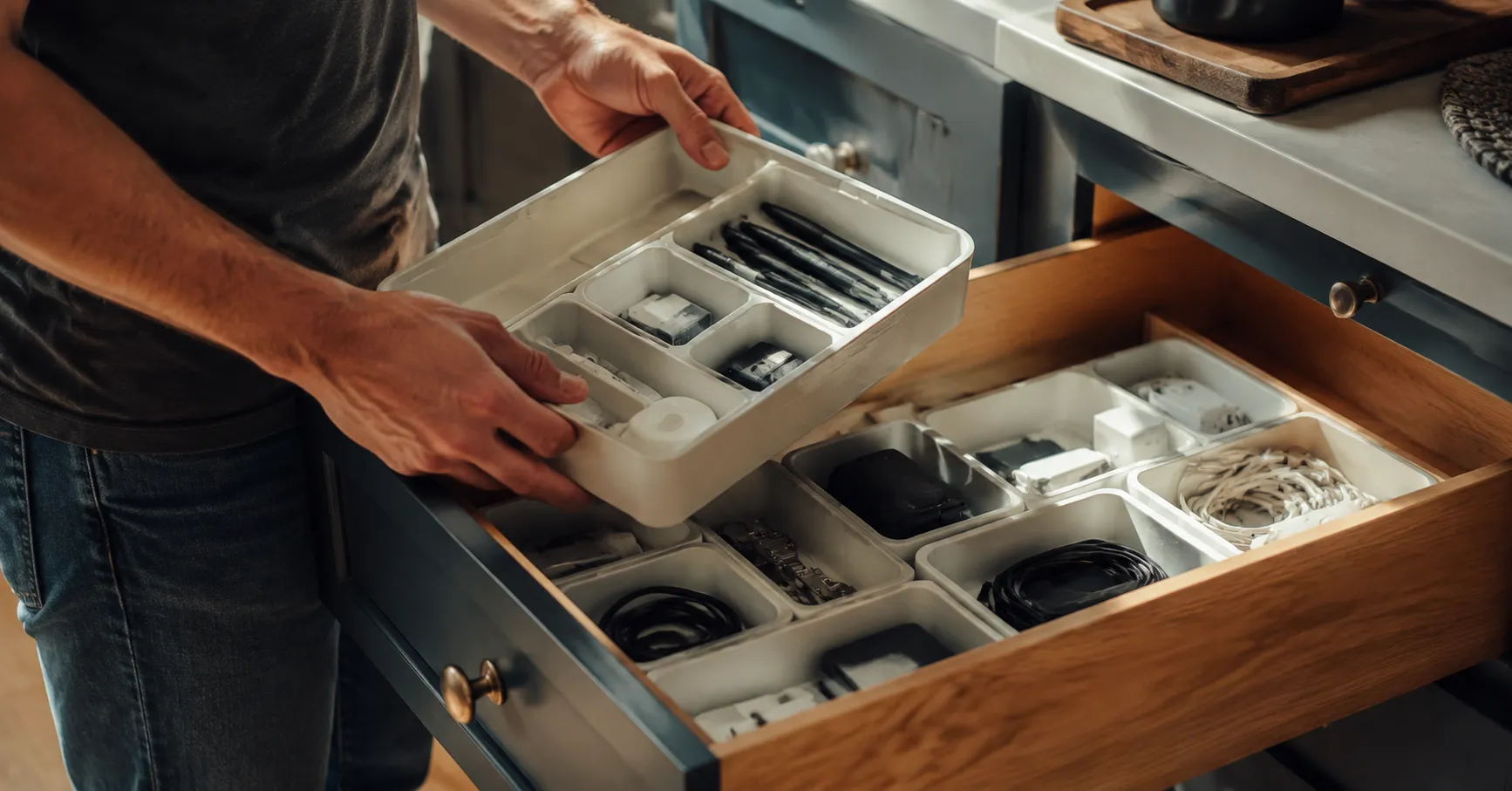
There’s a particular kind of satisfaction that comes from sliding a perfectly fitted insert into a drawer and watching chaos collapse into order. Every pen in its slot. Every cablecoiled and contained. For about forty-eight hours, it feels like you’ve solved something fundamental about yourself.
Then life happens.
The question of whether organizer inserts are actually worth buying or making, or obsessing over is messier than it first appears. It touches on how we think about productivity, the psychology of tidiness, and whether the solutions we pay for genuinely change behavior or just rearrange the problem into a more photogenic format.
The Promise vs. the Reality
Walk into any Container Store or scroll through a few minutes of organization content on social media, and you’ll encounter a vision of domestic serenity. Bamboo drawer dividers. Velvet-lined jewelry trays. Acrylic organizers for makeup that look better than most retail displays. The implicit argument being made is that the right system, installed correctly, will fundamentally transform how you move through your space.
That’s not nothing. Visual clarity does reduce cognitive load. When you’re getting ready in the morning and you don’t have to excavate your drawer to find the right eyeliner or the right pen, that’s a real, if modest, improvement. Behavioral economists have documented how much mental bandwidth we waste on small, repeated decisions and a well-organized drawer quietly eliminates several of them.
But the gap between the promise and the reality usually lives in one place: customization. Most off-the-shelf inserts are designed for an imagined average person with an imagined average collection of things. Your actual drawer the specific depth, the specific mix of oddly shaped items you’ve accumulated over years rarely matches what the product assumed. So you end up with a grid of perfect little compartments, three of which are useful, and four of which become the new junk receptacles.
When Inserts Actually Earn Their Place
The strongest case for organizer inserts isn’t the junk drawer. It’s any context where the contents are relatively stable and the activity has a rhythm.
Kitchen utensil drawers, for instance. If you cook regularly, you reach for the same handful of tools every day. A good bamboo or plastic insert that fits your drawer correctly creates a kind of muscle memory you stop looking and start grabbing. Same principle applies to bathroom vanity drawers, if your skincare routine is consistent. Or a home office drawer where the same pens, tape, and scissors come out every week.
The pattern that distinguishes worthwhile inserts from decorative clutter is this: they work best when the category of contents is clear and the volume is manageable. If you already know what belongs in a space and roughly how much of it there is, an insert gives that knowledge a physical shape. It doesn’t create organization it enforces what you’ve already decided.
Children’s art supply drawers are another good example. Kids are capable of understanding assigned spots for markers, scissors, and glue sticks, and the visual compartmentalization makes it easier for them to actually put things back. Here the insert is doing genuine behavioral work, not just aesthetic work.
The Hidden Costs People Don’t Factor In
Here’s what the before-and-after photos never show: what happens when your collection changes.
You buy a seven-slot makeup organizer perfectly fitted to your current lipstick collection. Six months later you’ve purged three shades and added a setting spray that doesn’t fit anywhere. The insert, designed for a static inventory, becomes subtly inconvenient. You start leaving the setting spray on the counter. The drawer starts feeling half-organized, which is its own specific kind of irritation.
This is the rigidity problem. Fixed inserts especially the acrylic modular systems that look beautiful in flat lays tend to ossify whatever organizational logic you had at the moment of purchase. If your possessions are in a period of flux, or if you’re still figuring out what you actually use, you’re essentially locking in a half-formed system and hoping it still fits in a year.
There’s also the measurement tax. Any insert worth having needs to be measured for. Drawer depth, especially, is something most people eyeball and get wrong. Too shallow and items poke out above the insert, defeating its visual purpose. Too deep and the insert slides around because there’s nothing holding it in place. These are solvable problems, but they require a level of deliberate effort that most people underestimate when they’re impulse-buying organizational products.
And then there’s the financial reality check. A full set of acrylic drawer organizers for a bathroom can easily run sixty to a hundred dollars. For a kitchen, more. If those inserts genuinely get used, genuinely change how you move through your space every day, that’s a reasonable investment. If they get installed, used enthusiastically for a month, and then quietly abandoned as life resumes its natural entropy that’s just expensive clutter with better aesthetics.
DIY Alternatives and When They Make More Sense
There’s a fairly strong argument that for many drawers, a $3box of repurposed shipping boxes and cardboard dividers outperforms a $45 acrylic set at least initially.
The logic is about sequencing. Before you commit to a fixed organizational system, you need to actually live with a rough version of it long enough to learn what works. How many of those pens do you actually use? Where does your hand naturally reach first? What gets pulled out and left on the counter anyway? Cardboard lets you run that experiment cheaply. Acrylic locks you into whatever theory you had before the experiment.
Once you’ve lived with a rough system for a few months and confirmed it works that the logic is sound, the categories hold, the quantities are stable then upgrading to a nicer material is worth it. You’re not buying organization at that point. You’re buying a more pleasant version of something that already works.
The Aesthetics Question
It would be dishonest to ignore the fact that for a lot of people, organizer inserts are purchased at least partly for how they look. There’s nothing wrong with this, but it’s worth being honest about it, because “this makes my drawer look nice when I open it” is a different value proposition than “this makes my life more functional.”
Both are legitimate. Feeling like your space is cared for has real psychological benefits there’s research suggesting that visual order reduces anxiety and increases focus. If a set of matching bamboo dividers makes you feel better about your home and yourself, that is a return on investment, even if it’s not strictly a productivity one.
The problem is when people buy for aesthetics but evaluate for function, and then feel vaguely disappointed when the beautiful system doesn’t change their behavior in the ways they hoped. Organizing products are excellent at creating the feeling of control. They are only intermittently good at creating actual control. Knowing which one you’re buying for helps you shop more honestly and feel better about what you get.
Some drawers are just genuinely improved by a well-fitted insert. Others are reorganized theater satisfying to install, photographable, and ultimately neutral in their effect on your daily life. The honest accounting depends entirely on which drawer you’re talking about, how stable its contents are, and whether you’re solving a real friction or just trying to feel like someone who has their life together.
The insert itself is never the answer. But sometimes it’s a very good piece of the answer.