
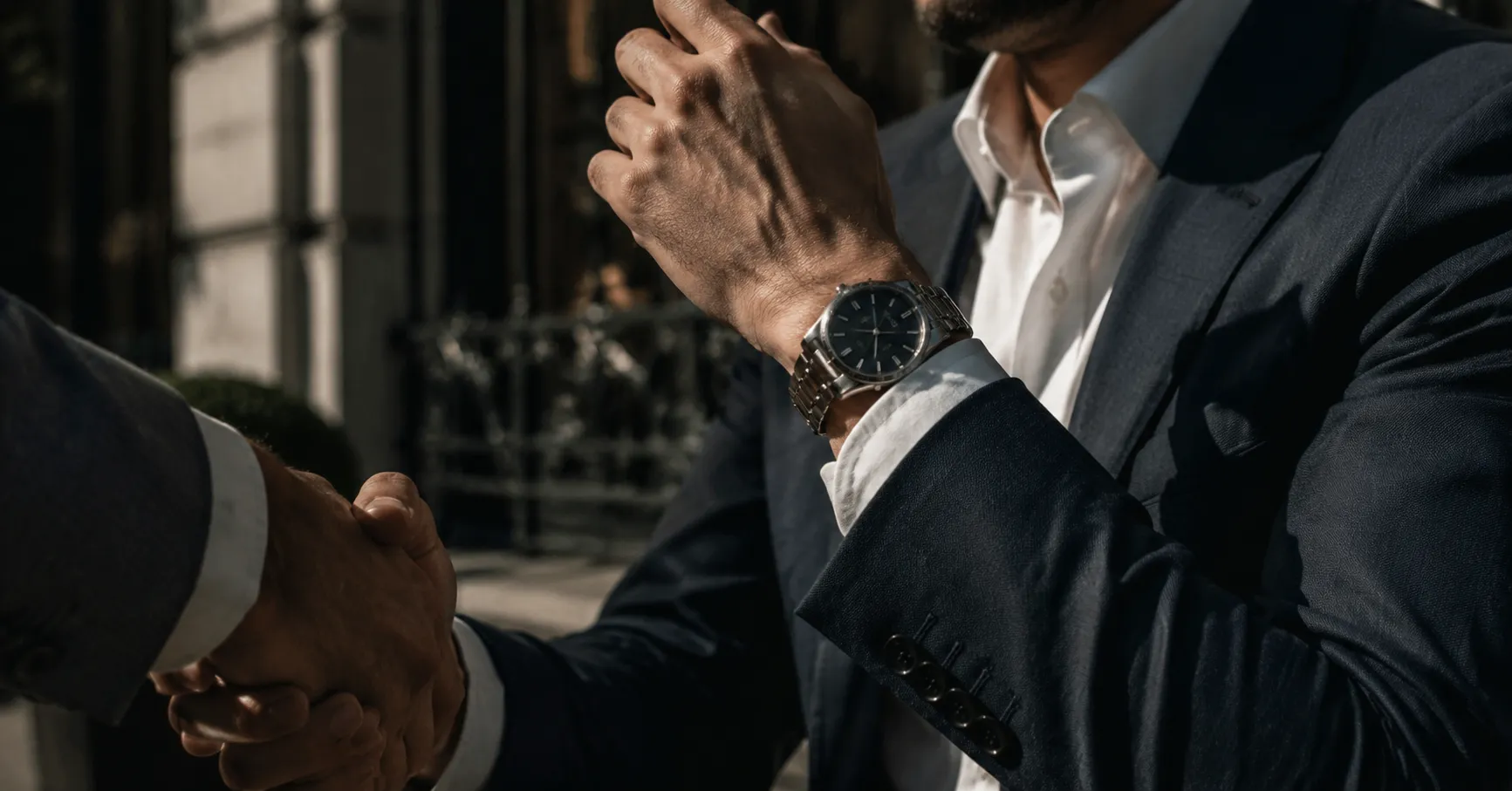
There’s a moment and most watch wearers have experienced it when someone glances at your wrist before they’ve quite finished shaking your hand. It lasts less than a second. But something has already been communicated, processed, filed away. You said nothing. Your watch did the talking.
We live in an era obsessed with personal branding, with the curated self, with the deliberate signal. Yet the watch remains one of the few objects people underestimate as a communicator. A handbag gets analyzed. Shoes get scrutinized. But the watch is treated as functional, almost neutral which is precisely why the signals it sends tend to land harder than the wearer ever intended.
The Wrist as a Billboard Nobody Admits to Reading
Horology has always been entangled with status. The pocket watches of the 18th century were portable proof of wealth in an era when accurate timekeeping was genuinely expensive. When wristwatches democratized in the 20th century, the game didn’t end it got more layered. Suddenly the question wasn’t just whether you owned a watch, but which one, and why.
What’s interesting is how much interpretive labor other people do on your behalf, without your knowledge or consent.
A stainless steel Rolex Submariner reads differently depending on who’s looking. In a Manhattan boardroom, it signals success that’s restrained enough not to be garish the wearer knows how to play the room. At a dive bar in Austin, it reads as trying too hard. At a tech startup in San Francisco, it might actually register as quaint, almost ironically traditional. The object is identical. The room does the rest.
This is the first hidden signal most people miss: your watch doesn’t just signal who you are. It signals who you think you’re talking to, and how well you’ve read them.
The Minimalism Tell
Over the last decade, a quiet revolution happened on the wrists of a very particular type of professional. The ultra-thin dress watch a clean dial, no date window, no complications became the accessory of choice for people who wanted to project effortless refinement. Brands like A. Lange & Söhne, Vacheron Constantin, and even the more accessible Nomos Glashütte started appearing in settings where a Submariner would’ve looked out of place.
The signal isn’t just about taste. It’s about a specific performance of restraint.
The minimalist watch says: I don’t need to impress you with function. I’m not climbing anything. I’ve arrived. There’s a studied nonchalance to it, the same psychology behind wearing an obscure jazz album t-shirt or ordering the unlisted item at a restaurant. It signals fluency rather than enthusiasm, knowledge rather than acquisition.
But here’s where it gets interesting. That same performance of restraint can flip. When worn by someone who is actually still climbing who bought the watch as an aspiration rather than an arrival the signal backfires subtly. People who know watches can sense the incongruence, the way a piece of clothing can look “worn for the occasion” rather than simply worn.
The watch, in other words, is only as convincing as the ease with which you carry it.
The Tool Watch and What It Reveals About Risk Tolerance
There’s another category entirely: the person who wears a serious tool watch a dive watch, a pilot’s chronograph, a field watch not because they’re actually diving or flying, but because they like knowing they could. The Seiko Prospex crowd. The Tudor Black Bay enthusiast who has never been below fifteen feet of water.
This isn’t mere pretension. It reflects something genuinely revealing about how a person sees themselves in relation to capability and readiness.
The tool watch wearer tends to value function as an aesthetic in itself. They’re drawn to the idea that their possessions should be able to handle more than daily life actually demands. There’s often a pragmatism that extends beyond the watch these tend to be people who carry a multi-tool, who know how to change a tire, who find comfort in being prepared. The watch is one data point in a larger story about self-reliance.
What’s more telling is when someone wears a tool watch in a context that has no practical use for it whatsoever a black-tie dinner, a client presentation in a glass office tower. In that dissonance, there’s a statement being made: I’m not fully of this world. I have other modes. I’m not reducible to this room.
Whether that statement is charming or insufferable tends to depend entirely on execution.
The Vintage Signal: Nostalgia as Identity
Vintage watches have had a prolonged cultural moment, and the signals they send have grown increasingly complex. A 1970s Omega Seamaster, a beat-up Longines from an estate sale, a Seiko 5 that predates the wearer by thirty years these objects carry a specific cultural grammar.
At one level, the vintage watch signals taste that operates outside the marketing cycle. The person who wears vintage isn’t playing the current season’s game. They’ve opted out of the escalating retail theater of new releases, waitlists, and resale flippers. There’s a principled quality to it, or at least the appearance of one.
But the vintage signal is also, increasingly, a signal about how someone relates to time itself.
Younger wearers who choose vintage are often making a statement about continuity about wanting to hold something that existed before them and will exist after them. In a culture of subscriptions and streams and things that evaporate, a watch from1968 is quietly radical. It insists on its own physicality. It doesn’t update. It doesn’t require your data.
The collector who gravitates toward a specific era say, mid-century dress watches is often also drawn to the values they associate with that era: craftsmanship over efficiency, longevity over obsolescence. The watch becomes a small act of resistance against a world that keeps accelerating.
The Smart Watch Paradox
The Apple Watch, the Garmin, the Fitbit these sit in a genuinely strange position in the signaling landscape, because they collapse two entirely different things into one object. They are simultaneously a personal health monitor and a fashion accessory, a productivity tool and a status symbol. The result is a signal that’s harder to decode but no less meaningful.
What the smart watch most consistently communicates is an orientation toward optimization. The wearer is measuring, tracking, improving or at least committed to the idea of doing so. In professional contexts, this projects a certain kind of conscientiousness. In social contexts, it can read as an inability to fully arrive there’s always a notification pending, always a metric to check.
The person who keeps a smart watch alongside a mechanical watch in rotation is sending perhaps the most complex signal of all. They’re saying: I live in both worlds. I need to perform in the present tense and I want to be anchored in something older. I close my rings in the morning and wear my grandfather’s Omega to dinner.
That duality is genuinely modern, and more honest than either choice alone might be.
What You Never Meant to Say
None of this is fully conscious, which is what makes it so revealing. People rarely choose a watch the way they choose a press release with full awareness of every implication. They choose what they love, what they can afford, what feels like them. And precisely because the choice is instinctive, it tends to leak something true.
A watch can betray anxiety about status, or ease with it. It can signal membership in a community the wearer barely knows they’ve joined. It can reveal how someone relates to time, to money, to history, to the body. It can show whether someone needs to be taken seriously or has stopped needing to prove anything.
The next time you glance at someone’s wrist, you might notice you’re not just checking the hour. You’re reading. And somewhere across the room, someone is reading yours finding things you never consciously placed there, making inferences you’ll never hear, constructing a version of you from a dial and a case and a strap.
The watch doesn’t lie. It just speaks in a language most people have never formally studied, which means the fluent ones have an advantage you may not have accounted for.