

The Truth About Over-Exfoliation: What Dermatologists Don’t Say Enough
Your Skin Is Trying to Tell You Something
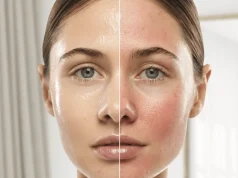
There’s a particular kind of frustration that comes with doing everything right and still watching your skin fall apart. You bought the acids your favorite beauty editor swore by. You added the exfoliating toner because the influencer with flawless skin said it transformed her complexion. Maybe you layered in a gentle scrub on the weekends because more is more, right? And now your face is red, tight, stinging when water hits it, and somehow breaking out worse than before.
This is over-exfoliation. And it’s far more common than the skincare industry wants to admit because the industry profits from you buying more products, not from you using fewer.
The Mythology of “Cell Turnover”
The marketing language around exfoliation is seductive precisely because it’s grounded in real science. Skin does renew itself. Dead cells do accumulate on the surface. Chemical exfoliants like AHAs and BHAs do help with everything from hyperpigmentation to clogged pores. None of that is fiction.
What gets quietly omitted is the timeline. Your skin’s natural cell turnover cycle runs roughly 28 days in younger adults and that number stretches longer as you age. The outermost layer you’re so eager to slough off isn’t just sitting there doing nothing. It’s the skin barrier: a carefully maintained ecosystem of lipids, proteins, and microbiota that keeps moisture in and pathogens out. When you exfoliate daily, or even every other day with multiple active products, you’re not accelerating renewal. You’re dismantling infrastructure faster than it can be rebuilt.
Dermatologists do mention this in clinical settings. What they don’t say loudly enough, consistently enough, or in the consumer-facing spaces where people actually make purchasing decisions, is how catastrophically easy it is to cross that line.
When Healthy Becomes Harm
The cruelest trick of over-exfoliation is that its early symptoms look like problems exfoliation is supposed to solve. Tiny breakouts appear, so you exfoliate more to clear them. Skin looks dull or congested, so you reach for the acid again. This feedback loop is how someone goes from a sensible twice-weekly routine to daily exfoliation without ever making a conscious decision to escalate.
What’s actually happening beneath the surface tells a different story. A compromised barrier triggers an inflammatory cascade. Your skin, now permeable to irritants it would normally deflect, reacts to everything your moisturizer, your sunscreen, the chlorine in your tap water. Transepidermal water loss increases, so skin feels simultaneously dehydrated and oily as sebaceous glands overcompensate. Redness and sensitivity become baseline, not exceptions.
Some people develop something called sensitized skin, which is distinct from naturally sensitive skin. You weren’t born with reactive skin. You created the condition, slowly, with products marketed to you as beneficial.
The Particular Problem With Combination Routines
Here’s where the conversation genuinely needs to go further. Most dermatology advice about over-exfoliation focuses on individual products. “Don’t use your glycolic acid every day.” Fair enough. But the real issue in2024 skincare culture isn’t single-product overuse it’s layering.
A cleanser with salicylic acid, followed by a BHA toner, followed by a Vitamin C serum, followed by a retinol at night adds up to a chemical assault that no individual product warning label acknowledges, because each product is formulated in isolation. The cleanser manufacturer doesn’t know you’re using four other actives. The toner brand isn’t accounting for the retinol you’ll apply six hours later. You’re essentially conducting an unsupervised chemistry experiment on living tissue, guided by the logic that if one good thing is good, several good things must be better.
They’re not. Acids lower your skin’s pH to work effectively. Retinoids accelerate cellular turnover. Vitamin C derivatives are inherently acidic. Pile them together and you get cumulative exfoliation that wildly exceeds what any of those products were designed to deliver.
What Recovery Actually Looks Like
If you recognize your skin in any of this, the path forward is probably more boring than you want it to be. Strip your routine down to a gentle non-stripping cleanser, an unfragranced moisturizer with ceramides or barrier-supporting ingredients, and a mineral sunscreen during the day. That’s it. No actives. No exfoliation of any kind. For weeks, possibly months, depending on how long the damage has been accumulating.
This is hard for people who have been conditioned to believe that doing more is caring more. The skincare industry has done a masterful job conflating effort with efficacy. A seven-step routine feels like devotion. A three-step routine feels like neglect, even when it’s the more sophisticated, evidence-based choice.
The healing phase is also not photogenic. Skin in recovery often goes through a period of looking worse before it levels out flaking as damaged surface cells finally shed naturally, temporary congestion as barrier function normalizes, uneven texture that resolves on its own timeline, not yours. Most people panic during this phase and reach for the acids again. This is exactly the wrong move, and it’s a cycle that can repeat for years.
The Trust Problem
There’s a systemic issue underneath all of this. Skincare consumers today are more educated than any generation before them they know what ceramides are, they can explain the difference between AHA and BHA, they track their skin pH. And yet rates of skin barrier dysfunction and self-reported sensitivity have climbed alongside that education, not declined.
Knowledge without context is just fuel for more purchasing. Knowing that glycolic acid exfoliates is not the same as understanding your barrier’s capacity for that exfoliation on a given day, or in a given season, or in combination with your current stress levels, hormonal fluctuations, and environmental conditions. The dermatological community provides that context in clinical appointments that most people never book. It gets diluted to near-meaninglessness by the time it filters through brand partnerships, affiliate links, and ten-second tutorials.
What would help is a more honest accounting of the fact that skincare is not uniformly additive. More products, more ingredients, more steps do not produce proportionally better outcomes. For a significant number of people, reduction is the intervention. The empty shelf is the prescription.
The Exfoliation Paradox
There’s something worth sitting with here. We live in a culture that has medicalized beauty to a degree where maintaining skin requires the vocabulary of a clinician and the discipline of a pharmacist. And the endpoint of that trajectory hyper-informed, product-saturated, maximum-effort skincare has produced an epidemic of damaged barriers and chronically sensitized skin.
The dermatologists who understand this best are often the ones recommending the least. They know the skin barrier is not a problem to be solved. It’s a system to be supported. Sometimes supporting it means doing almost nothing and trusting that biology, given enough room to operate, is competent.
That’s an anticlimactic answer in a market built on selling you the next thing. But it’s the one that actually holds up.