
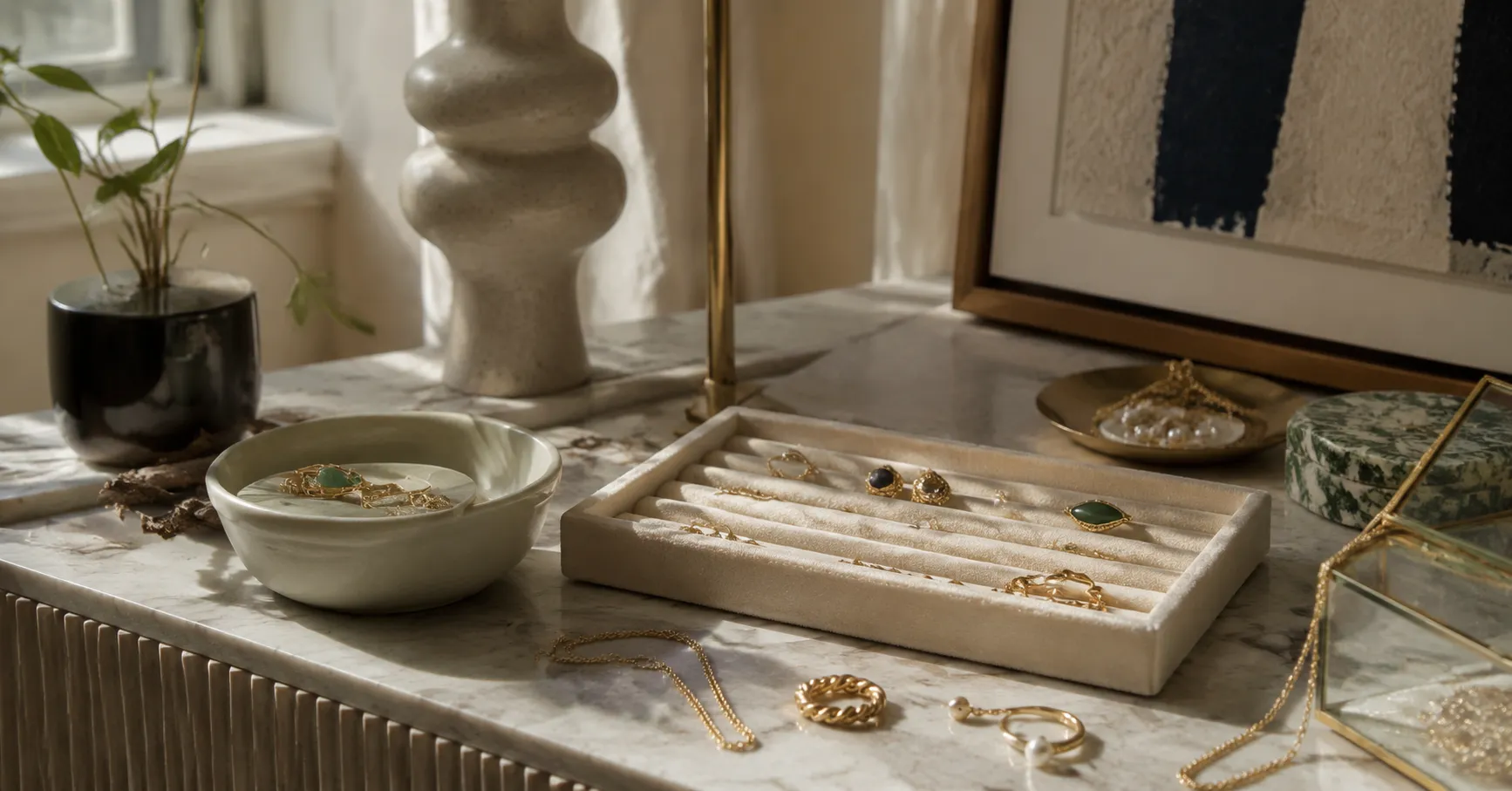
There’s a quiet revolution happening in jewelry right now and most people are missing it. While the internet stays fixated on chunky gold chains and minimalist studs that have been cycling through mood boards for the past five years, something far more interesting is unfolding in the spaces between trends. These are the pieces that don’t announce themselves loudly. They don’t need to.
If you’ve been feeling like your jewelry collection lacks a certain electricity, like everything feels borrowed from the same aesthetic moment, the answer probably isn’t another tennis bracelet. It’s time to look at what’s been simmering just beneath the surface.
The Return of Victorian Sentiment
Mourning jewelry sounds macabre until you hold a piece of it. Victorian-era sentiment jewelry lockets containing hair, rings engraved with forget-me-nots, brooches shaped like hands clasping is experiencing a genuine revival among collectors and younger wearers alike. The appeal isn’t morbid curiosity. It’s intimacy.
We live in an age of mass production and algorithmic aesthetics. Everything is scalable, everything is reproducible. Victorian sentimental jewelry is the opposite of that. It was made to encode a specific human relationship into an object. A lock of a child’s hair pressed behind glass. A lover’s initial worked into a seed pearl border. These pieces carry a kind of emotional specificity that no amount of personalization algorithms can replicate.
Contemporary jewelers have started drawing from this tradition without replicating it wholesale. You’re seeing enamel work that references mourning iconography weeping willows, urns, clasped hands reinterpreted in moodier palettes and scaled for modern silhouettes. It reads as romantic rather than funereal, heavy with meaning without explanation required.
Mismatched Earrings, But Make It Intentional
The mismatched earring trend arrived a few years ago and immediately got watered down. What started as a genuinely interesting statement became a commercial category “intentional mismatch sets” sold as pairs, which defeats the entire point. The real version of this trend is still underrated because it requires a level of personalcuration that most jewelry brands can’t bottle and sell.
Wearing one architectural drop and one simple hoop isn’t about asymmetry for its own sake. It’s about building tension within a single outfit, letting two objects carry different emotional weights. A hammered gold disc next to a pearl drop creates a conversation on your body. One references craft and texture, the other softness and formality. The ear that holds both becomes more interesting than either piece worn conventionally.
The underrated version of this isn’t buying a mismatched set from a fast fashion brand. It’s raiding your grandmother’s jewelry box, picking up single earrings at vintage markets, and developing an eye for which objects create interesting dialogue when placed in proximity.
Silver Getting Philosophical
Gold dominated the past decade so thoroughly that silver started to feel like a consolation prize. That’s changing, and the shift is more nuanced than silver simply coming back into fashion. It’s about which silver, and how it’s worn.
Oxidized silver darker, almost charcoal at its deepest is having a moment that the mainstream hasn’t fully caught up to. It photographs differently than polished silver, reads differently against skin, and pairs with an unexpected range of colors. Deep greens, rust, midnight blue. It doesn’t brighten an outfit the way gold does. It grounds it.
There’s also a material honesty to oxidized silver that resonates with where design culture is moving. It shows its process. The darkening is a chemical reaction, a visible record of how the metal responds to time and air. Wearing it feels less like an accessory choice and more like a small philosophical position on beauty.
Brooches Refusing to Be Vintage
The brooch’s reputation as something your aunt pinned to a blazer in 1987 is stubborn, but it’s been wrong for a while. Contemporary brooch design has become one of the most conceptually interesting categories in jewelry, precisely because it operates outside the hierarchy of rings, necklaces, and earrings that most people navigate by default.
Because brooches aren’t expected anymore, designers have more freedom with them. You’re seeing pieces that function almost as miniature sculptures abstract shapes in oxidized metals, ceramic elements fused with silver, textile-adjacent constructions in gold wire. Some of the most conceptually rigorous jewelers working today are brooch-focused, in part because the form allows for scale and three-dimensionality that other jewelry categories don’t.
Wearing a brooch well requires something most jewelry doesn’t demand: a decision about placement. On a lapel, it’s traditional. Pinned low on a coat, almost hip level, it’s something else entirely. Clustered with two or three others on a bagstrap, it becomes an installation. The brooch rewards people who think spatially about dressing.
Cord and Chain Together
The hybrid of textile and metal in necklaces is one of those trends that looks effortless until you understand how difficult it is to pull off. Silk cord threaded through a gold pendant, waxed linen knotted around a ceramic bead, leather with oxidized silver hardware these combinations collapse the distance between jewelry and craft in ways that feel genuinely contemporary.
Part of what makes this interesting is the tactile dissonance. Metal is cold, rigid, permanent. Textile is warm, flexible, subject to wear. Combining them creates an object with two different relationships to time. The cord will eventually fray or fade. The pendant may outlast you. There’s something quietly moving about wearing that.
It also solves a practical problem in unexpected ways. Cord necklaces sit differently on the body than chains. They move differently, rest differently against a collarbone. Some pendants that feel heavy or clunky on a delicate chain become right when suspended from something more substantial. The physical logic of the piece changes.
Rings Below the Knuckle Giving Way to Rings Above
Midi rings worn above the knuckle peaked around 2015 and then retreated into the category of trends that felt dated. They’re back, but not in the same register. The stacked-all-the-way-up finger of the mid-2010s is gone. What’s replacing it is more deliberate: one or two rings worn above the knuckle, chosen with the same care as any other piece, not as a volume move.
The interesting thing about an above-knuckle ring is how it redirects attention. Your hands become more active visual elements. Every gesture carries more weight. It’s a small choice with a disproportionate effect on how you read in a room.
The pieces working best in this space tend to be simple thin bands, small bezel-set stones, flat geometric shapes. Nothing that would compete with what’s worn below. The point is architecture, not accumulation.
The Jewel That Doesn’t Match
There’s a wider principle underneath all of these trends, and it isn’t really about any single category. It’s about jewelry that refuses to coordinate. The era of building a matching set same metal, same stone, same designer has given way to something more interesting: the practiced eye that can make three completely unrelated objects into something cohesive on a body.
It takes more confidence. It takes actual looking, at the pieces and at yourself. But that’s the point. The most interesting jewelry choices right now aren’t the ones that make sense immediately. They’re the ones that make you stop and figure out why they work.
Some things earn their elegance slowly.