

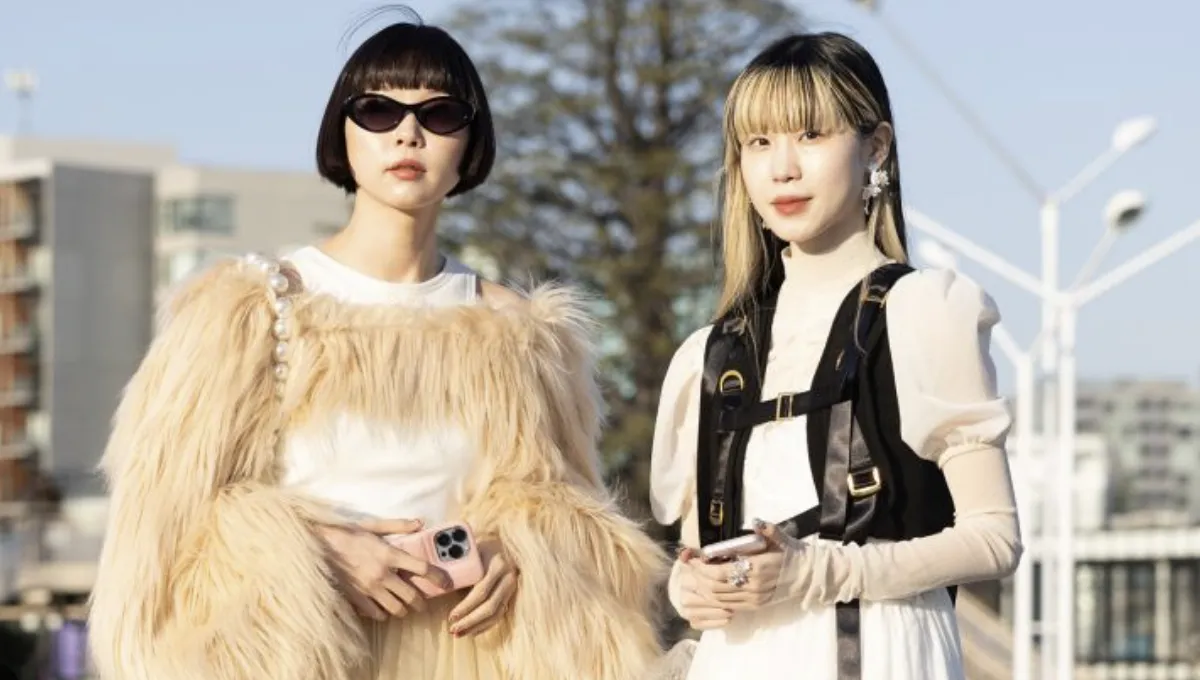
A City That Refuses to Dress Like Anyone Else
There’s a particular corner in Harajuku just past the crepe stands and before the narrow alleys open up into Takeshita Street where fashion stops being about clothing and starts being about something harder to name. Conviction, maybe. Or a very specific kind of freedom that has nothing to do with rebellion and everything to do with self-authorship. Standing there on any given weekend, you’ll see silhouettes that don’t exist anywhere else on earth. Proportions that defy the logic of commercial design. Colors layered with the deliberateness of a painter who has thought very carefully about chaos.
Tokyo’s streets have been a source of global fashion fascination for decades, but the relationship between this city and the wider industry has always been more complicated than the usual “street style inspires runway” narrative. What happens in Tokyo doesn’t trickle up in any predictable way. It seeps, quietly and persistently, until something that looked bizarre five years ago appears, slightly laundered, on a Paris catwalk or in a fast-fashion retailer’s capsule collection. The lag time is real. The debt rarely gets acknowledged.
The Architecture of Layering
One of the most globally consequential ideas to emerge from Tokyo street culture is the complete reimagining of layering. Western fashion has always understood layering as a practical matter coat over sweater over shirt with occasional aesthetic ambition attached. Tokyo changed the logic entirely. In subcultures like mori-kei and, later, in the broader avant-garde circles around Comme des Garçons and Yohji Yamamoto, layering became architectural. Garments weren’t worn on top of each other; they were placed in conversation with each other. A sheer fabric over a structured linen over something deliberately unfinished at the hem.
This sensibility has now fully migrated into global menswear and womenswear alike. The “deconstructed” aesthetic that dominated European luxury fashion through the late 2010s and into the 2020s owes a long, largely uncredited debt to Japanese designers and the street communities that informed them. When Demna Gvasalia was rearranging coat panels at Vetements, he was working in a tradition that had been refined on Tokyo streets for thirty years prior. The visual language the intentional asymmetry, the exposed seams, the hemlines that seem to ask a question rather than provide an answer all of it has roots in a city that decided technical perfection was less interesting than emotional resonance.
Sneaker Culture and the Remaking of Luxury
It would be impossible to talk about Tokyo’s global fashion influence without spending serious time on sneakers. The city’s collector culture particularly around limited-release collabs and vintage Nikes didn’t just shape global sneakerhead communities. It fundamentally altered what luxury means in fashion.
The logic of Tokyo sneaker culture is essentially this: scarcity plus authenticity plus community knowledge equals value. That equation has now been absorbed wholesale by the luxury fashion industry, which spent the better part of a decade trying to replicate the drop model, the queue, the breathless release-day energy. Supreme understood this early. Off-White built an entire brand around it. And none of that would have cohered the way it did without the proof of concept already established in Harajuku and Shibuya, where kids were camping overnight for shoe releases long before that behavior became normalized in London or New York.
Beyond the economics, Tokyo’s sneaker culture also shifted the aesthetic. The chunky, maximalist silhouettes popularized by Japanese collectors in the early 2010s before “dad shoes” became a marketing category were initially mocked by Western fashion media. Then Balenciaga released the Triple S in 2017 and the conversation changed overnight, with very little acknowledgment of where the visual appetite for that silhouette had been quietly fermenting.
Quiet Fashion and the Refusal to Perform
Not everything coming out of Tokyo is loud. One of the more understated but genuinely significant currents in contemporary global fashion the preference for calm, considered dressing often labeled “quiet luxury” in Western media has a long antecedent in Japanese minimalist aesthetics. Brands like Muji, Auralee, and Comoli have been making undemonstratively beautiful clothing for years. No logos. No obvious statements. Fabric quality and cut doing all the work.
This sensibility arrived in the broader Western fashion conversation somewhat belatedly, dressed up in a vocabulary that often didn’t acknowledge its origins. When Western outlets began describing wealthy consumers “stepping back from logos” in the early 2020s as some kind of new cultural development, they were describing an aesthetic position that had been sophisticated and fully formed in Tokyo for at least two decades. The city’s fashion establishment particularly the designers working around the Aoyama and Daikanyama neighborhoods had long since decided that the most radical thing clothing could do was to be exactly what it needed to be, nothing more, nothing wasted.
Gender and the Undoing of Category
Tokyo’s contribution to the current global conversation around gender-fluid fashion is harder to trace in a clean line, but it runs deep. Japanese street culture, from the Visual Kei bands of the 1990s to the elaborate cosplay communities that evolved alongside them, established a space where male femininity and female masculinity were not transgressive statements they were aesthetic choices with their own internal logic and community infrastructure. Boys in elaborate Victorian dresses were not making a political argument. They were participating in a shared visual language that happened to be extraordinarily ahead of where mainstream global fashion would eventually arrive.
When luxury houses began enthusiastically announcing “genderless collections” in the mid-2010s, they were arriving at a place that Tokyo’s youth culture had mapped thoroughly and left behind. The pioneer phase was over. What the West was discovering with great fanfare, Japan had already normalized, refined, and in some cases grown bored of. That’s not cynicism it’s just the particular speed at which Tokyo operates. The city processes aesthetic ideas faster than almost any fashion capital on earth, which means that by the time a trend becomes legible enough for the global industry to package it, Tokyo has usually already moved.
The Vintage Ecosystem as Creative Engine
Something that rarely gets sufficient attention in discussions of Tokyo’s global fashion influence is the city’s extraordinary second-hand clothing ecosystem. The density and quality of vintage stores in neighborhoods like Shimokitazawa and Koenji has no real parallel anywhere in the world. These aren’t thrift stores in the Western sense. They are intensely curated environments where Levi’s from the 1960s sit next to deadstock military surplus next to pristine Japanese repro workwear, all organized with a seriousness that suggests the proprietors understand they are running a kind of living archive.
This ecosystem has functioned as a creative laboratory for Japanese designers and stylists for generations, and the global resurgence of interest in vintage and archival fashion the current fixation on “archive hunting,” the premium prices commanded by earlyRaf Simons and Helmut Lang, the entire ecosystem of platforms like Grailed and Vestiaire is downstream of sensibilities that were formed and refined in Tokyo’s second-hand economy. The idea that old clothing is not just acceptable but preferable, that a garment with history carries more meaning than one that just left a factory, was not invented in Tokyo. But it was perhaps nowhere more comprehensively practiced.
What Gets Lost in Translation
Here is the thing that the global fashion industry consistently fails to fully absorb when it reaches toward Tokyo for inspiration: the culture is inseparable from the community. The reason Harajuku worked the reason it generated such extraordinary and genuinely original fashion was that it was a social ecosystem, not a content pipeline. People dressed for each other, in conversation with each other, within shared references and micro-communities that had their own histories and internal debates.
When that aesthetic gets extracted and repackaged when the silhouettes and color palettes get reproduced without the social logic that produced them something essential disappears. What remains is a surface without a substrate. You can wear the shape of a Harajuku outfit and be nowhere near what made that outfit mean something. This is not unique to Tokyo; it applies to every fashion culture that gets absorbed into the global commercial machine. But Tokyo’s case is particularly instructive because the gap between the original and the copy is so often so visible, and so rarely remarked upon by the industry that profits from it.
The streets of Tokyo keep dressing forward, largely indifferent to whether the world is watching or what it thinks it sees.