

There’s a particular kind of optimism that drives a ten-step skincare routine. You’ve done the research, read the ingredient lists, watched the tutorials. Each product has a purpose. Each layer feels like an investment. And yet somewhere along the way, your skin stops cooperating and the reflex is almost always to add something more.
That reflex is worth examining.
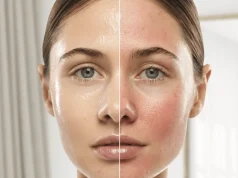
The skin is not a passive surface waiting to absorb whatever you give it. It’s a living organ with its own regulatory intelligence one that can be genuinely overwhelmed. What we’re seeing more of in dermatology offices and aesthetician chairs isn’t neglect. It’s overcare. People arriving with compromised barriers, mystery sensitivities, and breakouts that appeared only after they started “taking better care” of themselves.
When More Becomes the Problem
The beauty industry has a financial interest in convincing you that your routine is incomplete. There’s always a new serum, a targeted treatment, a “skin cycling” protocol that requires another product to function. This isn’t inherently sinister many of those products are genuinely effective. The issue is cumulative load.
Your skin’s outermost layer, the stratum corneum, acts as a physical and chemical barrier between your body and the environment. It’s held together by a mix of lipids, proteins, and a delicate acid mantle a slightly acidic film that keeps bacteria out and moisture in. Every product you apply interacts with that system. Some reinforce it. Some disrupt it. And when you’re applying six, eight, ten different formulations in a single session, you’re introducing a chemical conversation that no dermatologist has actually tested end-to-end.
Individual ingredients are studied in isolation. Combinations rarely are.
The Signals Most People Ignore
Overloaded skin doesn’t always announce itself dramatically. It rarely presents as a sudden allergic reaction. More often, it whispers and people either don’t hear it or actively misread it.
A tight, slightly uncomfortable feeling after cleansing is often treated as normal. It isn’t. That feeling is your skin barrier telling you it’s been stripped. The instinct is usually to follow up with more moisturizer, which provides temporary relief, but the underlying problem an overly harsh cleanser, too-frequent washing, or both remains.
Increased sensitivity to products you’ve used for years is another signal. If your familiar vitamin C serum suddenly stings, or your retinol starts causing flaking where it never did before, the barrier has likely been compromised. Fragrance, alcohol, acids ingredients that a healthy barrier can handle become irritants when the skin is already stressed.
Then there’s the particularly cruel irony of overhydration. Yes, it exists. Applying too many occlusive or humectant layers can actually interfere with the skin’s own moisture regulation. The skin stops producing what it needs when it’s constantly receiving it externally. Some people with perpetually “dry” skin are dry in part because their routine has trained their skin to be dependent.
Active Ingredients Are Not Automatically Better
There’s a tendency to treat active ingredients retinoids, AHAs, BHAs, vitamin C, niacinamide, peptides as unambiguously good. And in the right context, at the right concentration, used appropriately, they are. The trouble is that many people are using multiple actives simultaneously, under the assumption that more efficacy is always better.
Layering an AHA exfoliant with a retinol with a high-dose vitamin C in a single evening routine is not advanced skincare. It’s a recipe for a disrupted barrier, potential chemical interactions, and inflammation that looks confusingly like the skin problems you were trying to solve. Purging and overreaction can be almost identical on the surface. Many people spend months treating overreaction as purging, waiting for results that will never come, because the issue isn’t what’s happening below the skin. It’s what’s being done to the surface.
pH matters too, and almost no one thinks about it in practice. Vitamin C is most effective at a low pH. Retinol works differently in an alkaline environment. Certain acid combinations create compounds that aren’t in the original formulation. You’re not just applying products. You’re conducting chemistry, without a lab and without controls.
The Particular Problem With Trending Routines
Social media has made skincare communal in ways that are mostly wonderful access to information, demystification of ingredients, community support. But it’s also created a kind of aspirational mimicry that doesn’t account for individual skin biology.
Someone with oily, resilient skin in a humid climate can tolerate a layered acid routine that would devastate someone with dry, reactive skin in a low-humidity environment. When you adopt a routine because it worked for someone with a different skin type, in a different climate, at a different age, with a different hormonal profile you’re essentially running someone else’s experiment on your face.
Skin cycling the practice of rotating actives across different nights to reduce overload became popular precisely because people were experiencing the consequences of using too much too often. It’s a sensible harm-reduction strategy. But its very existence is an admission that the maximalist approach had gone too far.
What Stripping Back Actually Does
There’s an uncomfortable but well-documented phenomenon: when people dramatically simplify their routines, their skin often improves sometimes dramatically and quickly. A basic cleanser, a moisturizer, SPF. That’s it for two or three weeks. For many people with “problem skin,” this produces results that years of targeted treatments didn’t.
This isn’t a case for minimalism as a philosophy. It’s a case for understanding what your baseline actually is. When you’re applying twelve things and your skin is reacting, you don’t know what’s causing the reaction. You don’t know what’s working. You’ve lost the signal in the noise.
Stripping back is diagnostic as much as it is therapeutic. It lets the barrier recover, reduces the inflammatory load, and gives you a clean baseline from which to introduce things one at a time, with intention, watching for response.
Rethinking the Relationship
The cultural framing around skincare tends to position it as an act of generosity toward yourself the more you do, the more you care, the better the outcome. But the skin doesn’t experience effort as virtue. It doesn’t reward commitment to a lengthy routine. It responds to what’s actually happening at the cellular level.
A face that gets seven products every morning and evening isn’t necessarily morecared for than one that gets three. It might actually be more burdened.
The question isn’t whether you’re doing enough. It’s whether what you’re doing is serving the skin’s actual function or slowly undermining it while you wait for results that keep not arriving. That’s a harder question, because it requires listening to the skin rather than the routine. And the skin, when it’s been talked over for long enough, tends to stop being subtle about what it needs.