
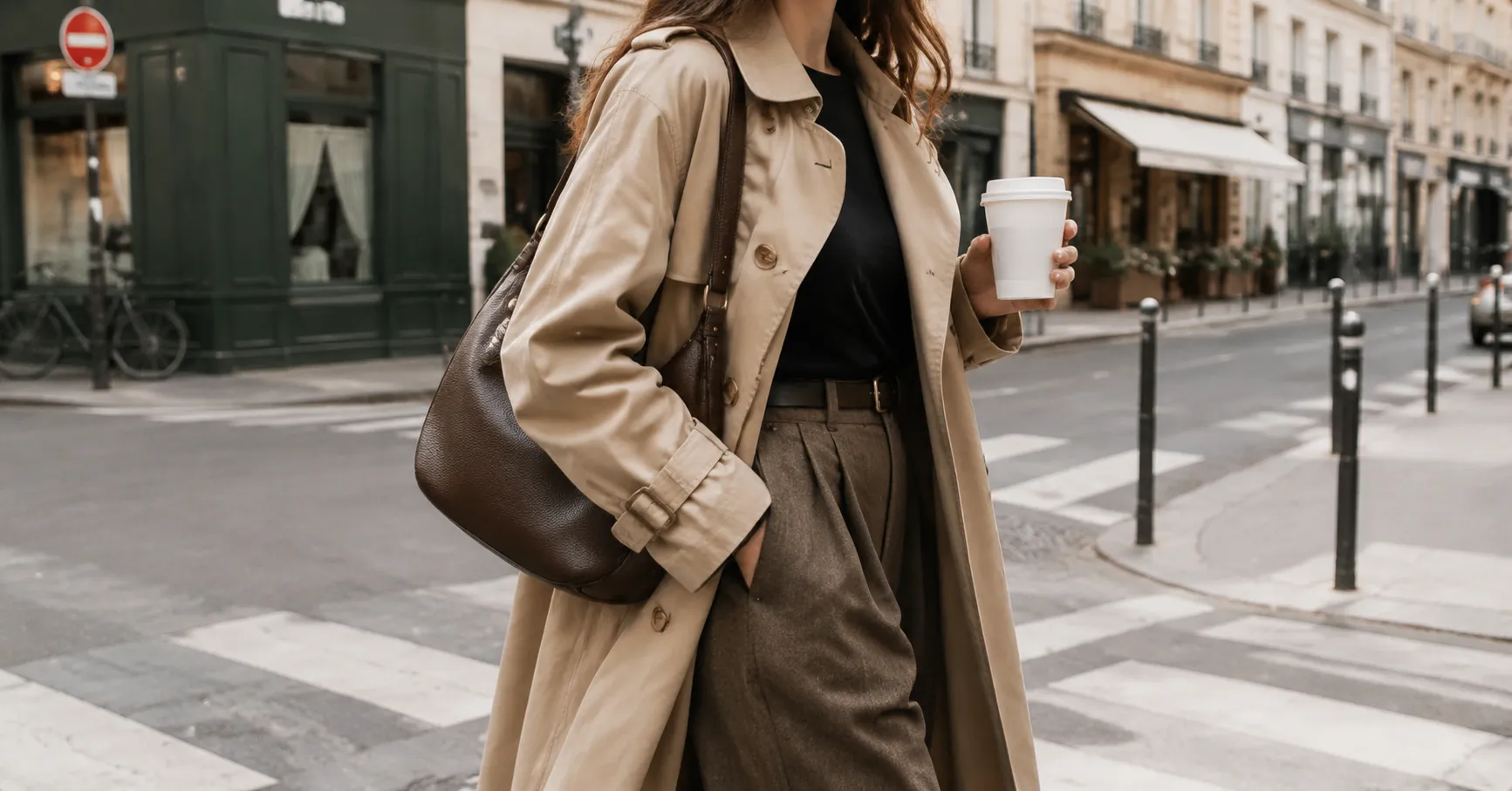
There’s a particular kind of woman you notice in Paris. She’s not the one wearing the most expensive outfit or carrying the most coveted handbag. She’s the one whose bag seems to belong to her draped over a shoulder or dangling from a forearm like it grew there organically. The bag isn’t the statement. She is. And somehow, that makes the bag look more extraordinary than any window display ever could.
This is the central mystery of Parisian style: it’s never really about the object itself. It’s about the relationship between the object and the person. Americans tend to think of fashion as acquisition get the right piece, and the look follows. The French think of it as authorship. You don’t wear a bag; you make it yours. That distinction sounds abstract until you start paying attention to the specific, learnable habits behind it.
Here are five of them.
Carry It Like You’ve Had It for Years
The single most powerful thing you can do for any bag’s appearance is stop treating it like something precious. The moment you clutch a bag too tightly, hold it away from your body, or adjust it constantly, you signal newness and newness, in Parisian aesthetics, reads as insecurity rather than wealth.
Watch how a French woman handles a worn leather tote versus how most people carry a brand-new designer bag. The worn tote gets slung over one shoulder, slightly off-center, maybe with a scarf halfway out of the top. The new bag gets carried with both hands or balanced carefully on a forearm like a ceremonial object. The paradox is that the worn tote possibly vintage, possibly inexpensive looks far more chic.
This is partly about body language, but it’s also about conditioning yourself out of reverence. Let the bag slouch if it slouches naturally. Let the leather develop its own patina. Use it on a Tuesday to buy bread. The way something is handled reveals your relationship with it, and ease is the whole aesthetic.
The Scarf Trick Isn’t Just Decoration
If there’s one Parisian accessory secret that’s been discussed to death yet remains somehow underused, it’s the bag scarf a silk or lightweight cotton scarf tied around a handle, looped through hardware, or draped through the top of an open tote. Every blogger has photographed it. Far fewer people actually do it with any confidence.
The reason it works isn’t purely visual. It works because it personalizes an otherwise anonymous object. A beige leather bag with a knotted printed scarf is no longer just a beige leather bag it becomes identifiable, specific to whoever chose that scarf and tied it in that particular way. It introduces texture, color, and movement in a way that no bag charm or keychain quite replicates.
The key is the knot itself. A French knot loose, slightly imperfect, with both ends trailing unevenly reads as intentional. A tight, symmetrical bow reads as craft-project. Leave it undone enough to look considered but not labored. The scarf should seem like it arrived there accidentally, even if you adjusted it four times.
Match the Bag to the Errand, Not the Outfit
This one runs counter to a lot of styling advice, and it’s worth sitting with. In Paris, the decision about which bag to carry is far less often driven by whether it coordinates with the outfit and far more often by what the day actually requires. A woven market basket for the Saturday market. A structured leather tote for work. A small crossbody for evening drinks that might run late.
The result is that Parisian bags always look purposeful rather than decorative. Purpose, it turns out, reads as confidence and confidence is the hidden variable in almost every equation of personal style.
There’s also something quietly liberating about this approach. It removes an entire category of decision-making anxiety. You’re not asking “does this bag match my coat” but rather “what do I need to carry today.” The outfit wraps around that practical choice, which tends to produce more interesting combinations than starting from a purely aesthetic coordination standpoint. A slightly battered canvas tote over a beautiful tailored blazer has a visual tension that a perfectly matched bag never achieves.
Proportion Is Everything, and Most People Get It Wrong
Walk through any major city and you’ll notice the most common bag mistake: scale mismatch. A petite woman swallowed by an enormous weekender. A tall woman carrying a micro bag so small it reads as an afterthought. The proportions feel off in a way that’s hard to articulate but immediately visible.
Parisian women and more specifically, the stylists and designers who have codified this particular aesthetic are ruthless about proportion. The bag shouldn’t compete with the body. It should complete it. For a relaxed, oversized silhouette, a slightly structured medium bag grounds the look. For a fitted, streamlined outfit, a slouchy or oversized bag introduces the necessary counterweight.
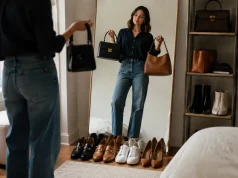
The test is simple: look at yourself in a full-length mirror before leaving, and ask whether the bag feels like it belongs to the same composition as the rest of your body. Not whether it matches the colors. Whether it belongs spatially whether the shapes are in conversation. This is how a $40 canvas bag can look more considered than a $1,200 designer piece carried at the wrong scale.
Let the Interior Betray Nothing
This last one is less about styling and more about a philosophy that underpins all the rest. French women are notably almost clinically controlled about what shows at the top of an open bag or spills out of a tote. Not because they’re obsessive minimalists, but because they understand that visual noise cancels out even the most beautiful bag.
A gorgeous leather tote with five pens, a crumpled receipt, two phone chargers, and an open cosmetics bag visible at the top reads as chaotic, regardless of the bag’s own quality. The bag becomes a container of mess rather than an object of beauty. Conversely, even a plain canvas bag with a single folded item and nothing visible at the top reads as composed.
The discipline isn’t about owning less. It’s about organizing what you carry so that the bag’s exterior impression remains intact. Pouches help. So does the habit of tucking things in rather than dropping them. It sounds minor until you test it reorganize your bag before you leave the house, tuck everything below the top line, and notice how differently the same bag feels on your arm.
There’s a larger principle hiding inside all five of these habits. Parisian chic, at its core, is a practice of editing not just of possessions, but of signals. Every visible choice is a decision about what you want to communicate, and what you want to communicate, ideally, is that you weren’t trying too hard. The bag is never the point. You are. The bag just happens to look extraordinary in your company.