

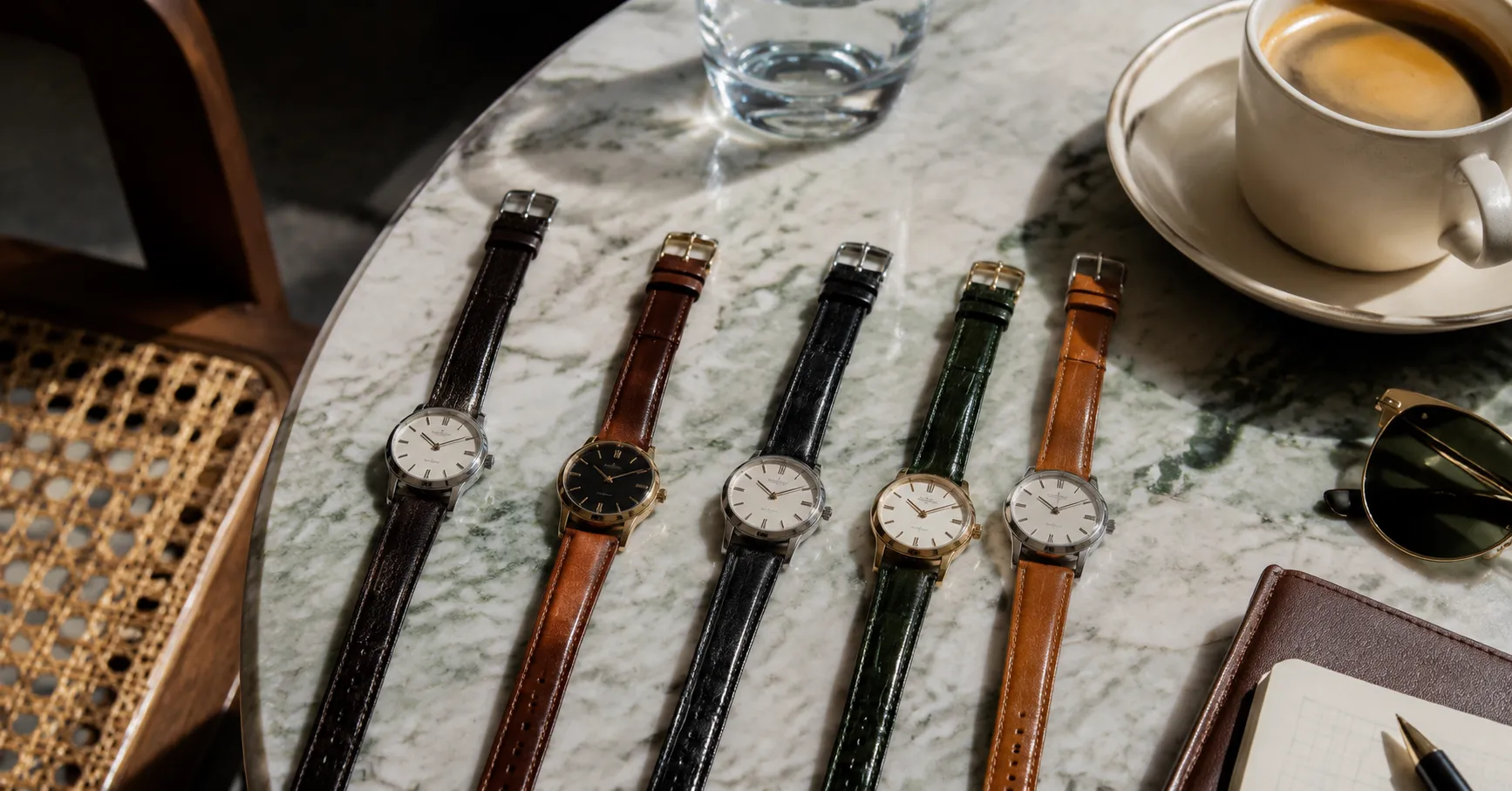
The Wrist Has Become a Statement About Who You Are
There’s a particular kind of person you keep noticing lately. At the coffee shop, at the gallery opening, in the elevator at work. Their watch sits quietly on their wrist small, almost understated, a little vintage in spirit. No flashy bezel. No chunky case announcing itself from across the room. Just a clean dial, a slim profile, and a leather strap that looks like it’s been worn in over years. You notice the watch because, somehow, it makes you notice the person more.
This is not an accident. The small watch revival is one of the most culturally loaded aesthetic shifts happening right now, and it’s worth understanding why it landed the way it did, and why it’s sticking around.
How We Got Here: The Overcompensation Era
To understand the obsession, you have to remember what came before it. Through most of the 2000s and into the early 2010s, bigger was definitively better in watch culture. The industry was drunk on excess. Cases pushed past44mm, 46mm, occasionally beyond. Dials were busy. Bezels were thick. Watches doubled as armor. The logic was transparent a large watch read as a large life, a large income, a large presence in the room.
Brands fed the appetite enthusiastically. Even names with histories rooted in elegance started producing oversized pieces, because the market rewarded spectacle. Wearing something small in that era carried an almost accidental eccentricity, like you hadn’t gotten the memo.
Then, quietly, the pendulum started swinging. It always does.
The Exhaustion of Loudness
What changed wasn’t just taste it was something closer to fatigue. Cultural loudness peaked somewhere around 2016 to 2019, not just in watches but across design, fashion, and self-presentation broadly. Everything was maximalist, everything was a flex, everything competed for attention with the aggressive optimism of a startup pitch deck. And people got tired.
There’s a specific kind of exhaustion that sets in when every object around you is trying to say something, when even your accessories feel like they’re performing for an invisible audience. Minimalism came back not because people discovered some deep philosophical truth about restraint, but because restraint started to feel like relief.
A 36mm watch on your wrist doesn’t demand anything from the people around you. It asks no one to be impressed. That quiet quality became, almost paradoxically, its own kind of sophistication.
Vintage References and the Seduction of the Archive
The small watch trend didn’t emerge from a vacuum. It rode in on the back of a broader vintage obsession that has quietly colonized every corner of fashion and material culture. People are hunting deadstock sneakers, wearing their grandmother’s scarves, buying film cameras. The past, at this particular cultural moment, feels more legible than the present and certainly more beautiful than the algorithmic churn of the new.
In watches, this translated into a renewed fascination with references from the 1950s, 60s, and 70s. Those decades produced some of the most quietly beautiful dials in watchmaking history. Thin cases. Simple indices. Proportions that were calibrated for elegance rather than visibility from a distance. When collectors and enthusiasts started pulling these out, photographing them, writing about them, a new generation caught the signal.
Brands noticed. Rolex reintroduced a36mm Datejust and found it moving faster than anticipated. Cartier’s Tank a watch that never really left, but spent years being overlooked in favor of larger options suddenly became the piece everyone wanted. Smaller independents built entire brand identities around producing cases at 38mm or below and charging handsomely for it.
Gender and the Dissolving of Old Boundaries
Something else is happening inside this shift that doesn’t get discussed enough. The traditional division of watch sizing along gender lines women wore small, men wore large is collapsing. And the collapse is coming from multiple directions simultaneously.
Men are reaching for what were historically classified as women’s watches, not with any particular ideological intent but simply because they look better. A 34mm Cartier Baignoire on a man’s wrist is an aesthetic choice, a deliberate departure from convention that signals a certain comfort with one’s own taste. Women, meanwhile, are no longer interested in miniaturized versions of watches designed for men, and they’re equally uninterested in pieces so delicate they read as jewelry rather than instruments.
What’s emerging is something more interesting: a size range, roughly 30mm to 40mm, that belongs to no gender in particular. Just to people who care about proportion and design.
The Phone Already Does Everything
It would be naive to analyze the small watch trend without acknowledging the deep irony embedded in it. We live with devices in our pockets that track time down to the millisecond, that sync automatically across time zones, that never need winding or servicing. The mechanical watch, strictly speaking, is a completely redundant object.
And yet. Maybe because of that redundancy, wearing a watch has become a choice in a way it never quite was before. You don’t wear it because you need to know what time it is. You wear it because of what it means to choose an object that serves no practical purpose your phone can’t handle better. There’s something almost philosophical in that decision an insistence on the analog, the imprecise, the thing that needs to be wound or worn or maintained.
A small watch amplifies this logic. A smartwatch is relentlessly functional, notifications buzzing on your wrist, data streaming, the screen lighting up to tell you to stand or breathe or move. A small mechanical watch sits there doing almost nothing by comparison. It tells time, loosely. It looks beautiful. It asks nothing of you. In2025, that restraint is a kind of luxury that money alone doesn’t quite explain.
The Psychology of the Understated
There’s a concept that keeps appearing in conversations about this shift, though rarely named directly: the idea that true status has migrated away from legibility. When everyone can access the symbols of luxury through fast fashion, through knockoffs, through the relentless democratization of aesthetics on social media the only move left for those who care about distinction is to make themselves less readable, not more.
A small, obscure watch from a niche brand or a vintage market stall communicates nothing to most people. To the right people, it communicates everything. This is the insider logic of contemporary taste: the signal gets quieter as the audience gets smaller and more knowing.
It’s not quite as cynical as pure status-seeking, though. Many people who gravitate toward small watches are genuinely just drawn to beautiful objects without the performance element. But the psychology works on both levels at once, which is part of why the trend has proven more durable than trends usually are.
What the Wrist Says Now
Small watches are not going away. If anything, the appetite seems to be deepening, pulling in people who would never have described themselves as watch people five years ago. The conversation has moved from collector forums into general culture, from boutiques onto resale platforms where1970s dress watches from forgotten Swiss brands are trading at prices that would have seemed absurd a decade ago.
Something in the culture decided, more or less collectively, that it was done being loud. That the most interesting thing you could put on your wrist was something that didn’t immediately announce itself, that rewarded attention rather than demanded it. That the pleasure of a beautiful object didn’t require an audience to be real.
The watch is still ticking. You just have to get close enough to hear it.