

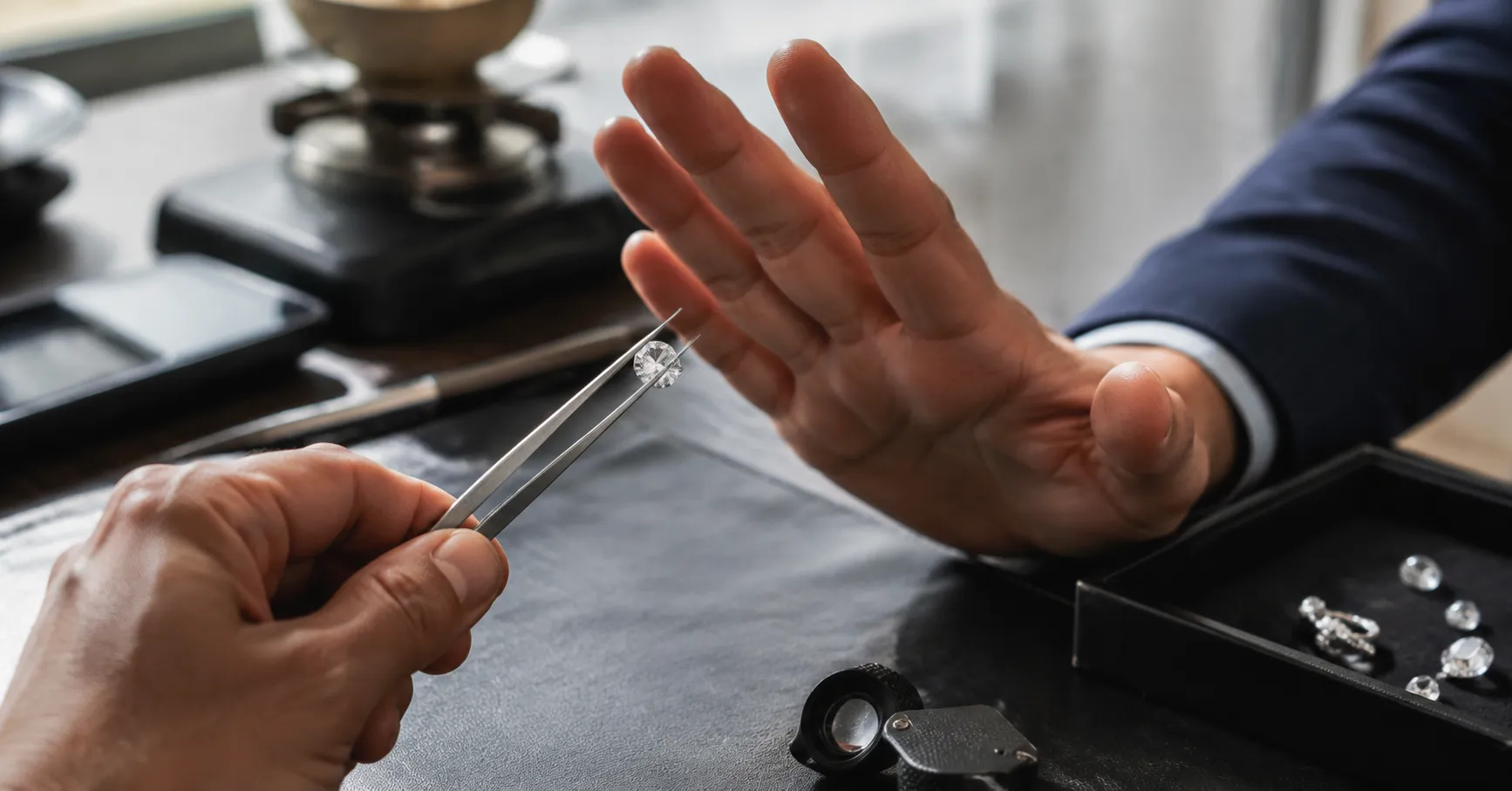
There’s a particular kind of confidence that comes with holding a diamond. It fits in your palm, it catches the light, and for decades it carried an almost mythological promise: this will always be worth something. Jewelry stores built their pitch around it. Engagement culture reinforced it. Financial advisors, when pushed, never quite talked you out of it. The stone became not just a luxury but a quiet form of insurance a fallback dressed in sentiment.
That myth is now cracking under pressure from multiple directions at once.
The Liquidity Problem Nobody Warned You About
Start with the most practical problem: you cannot easily sell a diamond. Not for anything close to what you paid.
Walk into a jewelry store today with a one-carat diamond ring you bought five years ago. The retailer will offer you, on a generous day, 20 to 40 percent of the original retail price. Pawn shops will go lower. Diamond resale platforms like Worthy or I Do Now I Don’t have created more transparency, but transparency only reveals the uncomfortable truth retail markup on diamonds has always been staggering, and the secondary market reflects the actual commodity value, not the emotional premium.
Compare this to gold. You can sell gold bullion at a spot price published globally, within a narrow spread, on virtually any trading day. Real estate takes time but produces rental income while you hold it. Even fine wine has a functioning auction ecosystem. Diamonds have none of that infrastructure. The resale market is fragmented, illiquid, and deeply unfavorable to individual sellers.
The traditional investment thesis for diamonds buy and hold quietly assumed you’d never actually need to sell. Once you do, the economics fall apart fast.
The Lab-Grown Revolution Has Broken the Supply Illusion
For most of the20th century, De Beers controlled roughly 80 to 90 percent of the world’s rough diamond supply. That monopoly power gave the natural diamond market something rare and precious in commodity economics: artificial scarcity. Prices held not because demand was irresistible but because supply was ruthlessly managed.
That control is gone. And what replaced it is far more destabilizing than competition from another mining company.
Lab-grown diamonds chemically, physically, and optically identical to mined stones have gone from novelty to mainstream in less than a decade. In 2016, a one-carat lab-grown diamond cost roughly $4,000. By 2023, that same stone was selling for under $800. Production costs continue to fall as the technology scales. There is no meaningful ceiling on supply.
The consequences for natural diamond prices have been significant and are ongoing. Mid-range natural diamonds the one-to-two-carat range that forms the backbone of the engagement ring market have seen retail prices fall 20 to 40 percent since 2021. Wholesale prices dropped even further. Mining companies including De Beers itself began selling lab-grown diamonds, a quiet acknowledgment that the old pricing power was finished.
When the premium you’re paying is largely based on origin story rather than material properties, and when that origin story becomes optional for most buyers, the price premium erodes. That erosion is structural, not cyclical.
Sentiment Is Shifting, and It’s Shifting Young
Investment value, in any asset, ultimately traces back to future demand. Who will want this thing, and how badly, in ten or twenty years?
Younger generations are answering that question in ways the diamond industry finds genuinely alarming. A 2023 survey by The Knot found that lab-grown diamond engagement rings now represent over 40 percent of all engagement ring sales in the United States, up from roughly 10 percent just four years earlier. Beyond the lab-versus-natural debate, a growing share of couples are opting out of diamonds entirely choosing sapphires, opals, or unadorned bands.
Part of this is economic. Millennials and Gen Z entered their prime marrying years carrying student debt, facing housing costs that earlier generations didn’t, and maintaining a generally sharper skepticism toward conspicuous spending. But it’s not purely financial. There’s a cultural shift too, a weariness with the idea that romantic commitment must be denominated in carats. The “A Diamond Is Forever” campaign, launched in 1947and often cited as one of the most effective advertising campaigns in history, shaped a century of behavior. Its hold is loosening.
When the primary demand driver for a luxury good is cultural custom, and that custom is weakening among the generation about to inherit the most spending power in history, the long-term demand picture dims considerably.
The Price Discovery Problem
Stocks have ticker symbols. Commodities have futures markets. Real estate has comps. Diamonds have GIA certificates and individual appraisers with wildly divergent opinions.
Two diamonds can share identical GIA grades same cut, color, clarity, and carat weight and trade at significantly different prices based on fluorescence, specific proportions, origin certification, or simply which retailer is selling them. There is no diamond equivalent of a spot price. Rapaport publishes a price list used within the trade, but retail consumers don’t have access to it, and even within the trade it’s treated as a starting point for negotiation rather than a fixed reference.
This opacity is not accidental. Opacity has always served the industry. But for investors, opacity is a serious structural flaw. You cannot build a coherent investment thesis around an asset class where price discovery is murky, where two identical-looking stones can diverge in value based on factors only a trained gemologist can assess, and where the verification process requires physical custody, specialized equipment, and expert interpretation.
What Changed, and What It Means
None of this means diamonds have no value. As objects, as art, as symbols they remain extraordinary. A well-cut diamond catches light in a way that still commands attention. The craft and history embedded in antique diamond jewelry carries a different kind of worth entirely.
But “beautiful” and “investable” are different categories. For decades, the diamond industry worked hard to collapse that distinction. The collapse is now going in reverse.
The conditions that made diamonds seem like a reasonable store of value controlled supply, cultural lock-in, lack of alternatives, and pricing opacity have each been eroded by technology, generational change, and increased market transparency. What remains is an asset that’s expensive to buy retail, difficult to sell fairly, subject to ongoing price pressure from an unlimited synthetic supply, and dependent on a demand base that is quietly shrinking.
That’s not a safe investment. That’s an asset in the middle of a long, slow re-pricing.
The diamond sitting in a velvet box somewhere in your house hasn’t changed. What’s changed is everything around it.