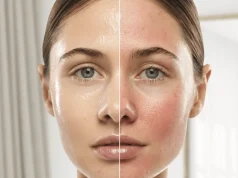


Your skin has been trying to tell you something for years. That tightness after washing your face? Not clean. That redness that never fully goes away? Not normal. The flaking along your nose and chin even though you’ve been moisturizing religiously? Not just your skin type. These are distress signals, and if you’ve been using a routine built around exfoliating acids, foaming cleansers, astringent toners, and retinoids stacked on top of each other, your skin has likely been in a state of quiet emergency for longer than you realize.
The moment you stop really stop everything changes. And it doesn’t always feel good at first.
The First Two Weeks: Things Often Get Worse Before They Get Better
This is the part that makes people give up. Within the first week of ditching harsh products, many people experience increased breakouts, unusual texture, or skin that feels simultaneously oily and dry in ways it never did before. It’s disorienting. The instinct is to reach back for the clarifying toner or the 2% BHA that “always worked.”
But what’s actually happening is your skin’s barrier the outermost layer of protection made up of lipids, ceramides, and skin cells is beginning to recalibrate. Harsh products, especially strong acids and stripping cleansers, deplete the natural oils and disrupt the microbiome that keeps skin balanced. When those products are removed, your sebaceous glands, which had been overproducing oil to compensate for constant stripping, don’t immediately shut off. It takes time. Your skin has essentially been in survival mode, and now it needs to relearn what equilibrium feels like.
The breakouts during this phase are often a combination of purging (if you were using actives that accelerate cell turnover) and the skin simply reacting to the absence of ingredients it had become reliant on. It feels backward, but this discomfort is not a sign that your skin “needs” the harsh products back. It’s the withdrawal period.
What Happens to Your Skin Barrier When You Finally Leave It Alone
Skin barrier repair is not a marketing concept. It’s a measurable physiological process. The stratum corneum the outermost layer of your skin functions like a brick-and-mortar wall, where skin cells are the bricks and lipids are the mortar. Repeated use of harsh surfactants, high-concentration acids, and abrasive exfoliants erodes that mortar over time.
Once you remove the offending products, the skin begins producing ceramides and fatty acids again without constant interference. Studies on barrier function show that transepidermal water loss (TEWL) essentially how much moisture is escaping through your skin begins to decrease as the barrier strengthens. This is why people who cut back on aggressive routines often report that their skin starts holding moisture better, even if they’re using the same moisturizer they always have.
There’s something almost counterintuitive about it. You start doing less, and your skin starts performing better on its own. The products that promised to fix your skin were often the source of the problem.
The Inflammation Question
Chronic low-grade inflammation is one of the most underdiagnosed skin concerns, partly because it doesn’t always look dramatic. It doesn’t have to mean bright red, burning skin. It can show up as persistent dullness, a subtle roughness that never resolves, or a baseline sensitivity that makes new products feel reactive.
Strong actives glycolic acid, salicylic acid, benzoyl peroxide, prescription retinoids used too aggressively can trigger this kind of inflammation when used without adequate recovery time. The skin’s immune cells, particularly mast cells, become chronically activated. Over months and years, this contributes to collagen degradation, not the opposite.
When people transition away from these products, or at least space them out dramatically, the inflammatory signals begin to quiet. After about four to six weeks, many people notice that the baseline redness they assumed was just their skin type has faded. Skin that seemed permanently reactive becomes visibly calmer. This isn’t anecdotal it’s what happens when you stop asking an already-stressed organ to process chemical stress on a daily basis.
Your Microbiome Gets a Chance to Recover
The skin microbiome the ecosystem of bacteria, fungi, and other microorganisms that live on the surface of your skin is increasingly understood to be central to skin health. It’s not a fringe idea anymore. The relationship between microbiome disruption and conditions like acne, rosacea, eczema, and accelerated aging is well-documented in dermatological research.
Harsh cleansers and high-pH products don’t discriminate. They strip the beneficial bacteria along with everything else. Some preservatives and synthetic fragrances common in aggressive skincare formulations have demonstrated antimicrobial effects that alter microbial diversity on the skin surface.
When you stop using products that continuously disrupt this ecosystem, the balance begins to restore. Commensal bacteria that help regulate sebum production, protect against pathogenic microbes, and modulate the local immune response return to healthier populations. This is one of the reasons people who simplify their routines often report fewer breakouts over time, even if the first few weeks looked worse. The skin’s own defense system is getting back online.
The Psychological Shift Is Real Too
There’s a layer to this conversation that rarely gets discussed: the anxiety that builds around a complex skincare routine. When you have seven or eight products, layered in a specific order, with active ingredients that require spacing and timing, the routine itself becomes a source of stress. Missing a step feels like a failure. A new breakout is immediately interrogated was it the new serum? Did I skip the toner? Should I add back the acid?
This creates a hypervigilant relationship with your own face. Every change is monitored and analyzed. The skin, meanwhile, is getting the message that it’s a problem to be managed rather than a system that largely knows what it’s doing.
Stepping back from aggressive routines often produces a quieter relationship with your skin. Not indifference, but less surveillance. And there’s evidence that chronic stress including the low-level anxiety that a complicated routine can generate has measurable effects on cortisol levels, which in turn affect sebum production and inflammatory response. The psychological simplification is not separate from the physical results. They’re connected.
What a Simpler Routine Actually Looks Like
None of this means abandoning skincare entirely. A gentle, pH-balanced cleanser, a straightforward moisturizer with ceramides or hyaluronic acid, and daily SPF form the scaffolding that most skin genuinely needs. Actives retinoids, acids aren’t inherently harmful, but they work better when used occasionally and strategically rather than layered aggressively every day.
The goal is to support what your skin is already trying to do, not override it. Skin is designed to regulate itself. It produces its own oils, its own acids, its own antimicrobial peptides. A skincare routine that works with those functions rather than against them looks boring by industry standards. It doesn’t require a ten-step system or a new product every month.
But the skin that emerges from that kind of restraint steadier, calmer, less reactive, genuinely more resilient tends to look better than the skin that’s been in a constant battle with its own routine.
There’s a certain irony in realizing that some of the best things you can do for your skin involve stopping. Not adding more, not finding the right combination of actives, not optimizing the routine further. Just stopping, and giving your skin the space to remember what it already knows how to do.