
When Less Becomes a Language
There’s a particular kind of person who walks into a room and, without announcing anything, commands attention. No logo visible. No flash of color demanding your eye. Just the weight of a perfectly cut wool coat, the understated gleam of a simple gold band, the quiet confidence of someone who has nothing to prove. This is quiet luxury in its purest form not a trend, but a psychology made visible.
The aesthetic has been simmering for years beneath the surface of fashion and interior design, but it exploded into cultural conversation somewhere around 2022and hasn’t let go. The question worth asking isn’t what it looks like we’ve all seen the neutral palettes, the cashmere, the Loro Piana bags without so much as a visible zipper but why it resonates so deeply, and what it says about the moment we’re living in.
The Exhaustion Beneath the Surface
To understand quiet luxury, you have to understand what people are running from. The 2010s were a decade of maximalism in the most psychological sense. Social media rewired the logic of personal presentation. Everything became content. Outfits became performances. Homes became backdrops. The loudest, most attention-grabbing version of yourself was, algorithmically speaking, the most valuable one.
That’s exhausting. And it’s not a superficial exhaustion it’s a kind of identity fatigue, a slow erosion of the sense that you have an interior self that isn’t performing for an audience. Quiet luxury arrives as a corrective to that noise. It’s the aesthetic equivalent of closing a browser with forty tabs open.
The philosopher Byung-Chul Han writes about “the transparency society” a world in which everything is made legible, exposed, consumed. Quiet luxury is, in its own modest way, a refusal of that transparency. The unmarked bag, the tonal outfit, the room with no statement piece these are acts of deliberate opacity. They say: I am not here to be decoded.
Status Without Spectacle
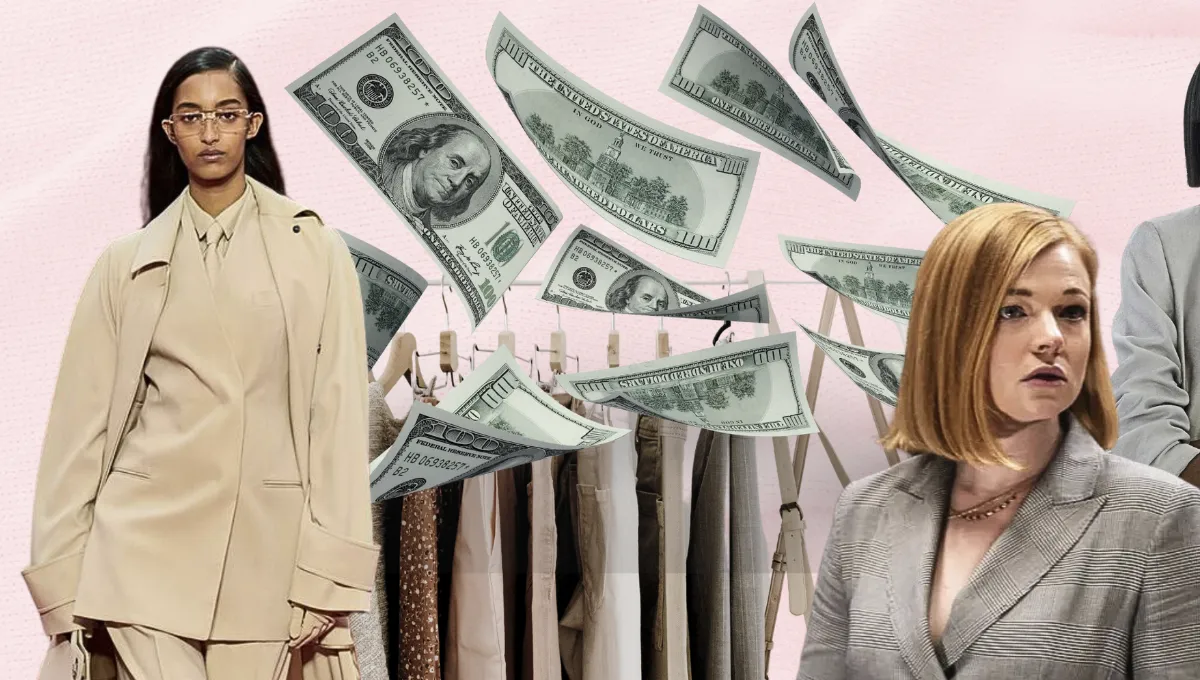
But let’s be honest about something. Quiet luxury is still luxury. Stripping away the logos doesn’t strip away the economics. A $4,000 cashmere sweater doesn’t becomeegalitarian just because it lacks a visible brand name. The psychology here is more complicated than mere aesthetic preference it’s also a recalibration of how status signals work.
Old money has always operated this way. The Kennedys, the Rothschilds, the landed aristocracy of any European country conspicuous consumption was always considered a little tacky, a tell that someone was new to the room. Real wealth, in that worldview, announces itself through quality you can feel but can’t immediately price. The threadcount, the provenance, the tailoring so precise it seems effortless.
What’s happening now is a broader class of people adopting that codebook. The upper-middle class, disillusioned with the hypebeast cycle of streetwear or the obvious luxury of logomania, is migrating toward this older, quieter mode of signaling. There’s a sociological term for this: conspicuous inconspicuousness. The flex is knowing how to dress in a way that only other people with real taste will recognize. The audience has narrowed, and somehow that makes it more powerful.
The Interior Dimension
What makes quiet luxury psychologically interesting rather than just sociologically is how it maps onto our inner lives, not just our social ones.
Psychologists who study aesthetics and environment have long noted that visual complexity has a cost. Cluttered, overstimulating environments increase cortisol levels and reduce our capacity for sustained attention. The clean room, the neutral palette, the absence of competing visual information these aren’t just stylistically pleasing, they’re neurologically calming. When we surround ourselves with quiet luxury, we’re also creating conditions for a quieter mind.
There’s something to the way minimalist interiors have become the dominant aspiration of a generation that grew up glued to maximally stimulating screens. The $12,000 Axel Vervoordt-inspired living room isn’t just a status symbol it’s a sanctuary. It’s the material expression of a longing for stillness that’s hard to achieve in the actual texture of contemporary life.
This is also why quiet luxury has seeped beyond fashion and interior design into wellness culture, into the language of retreat and restoration. The unmarked spa. The silent meditation center. The hotel room with nothing on the walls but a single piece of handmade art you can’t immediately Google. The aesthetic and the psychological aspiration have merged into something coherent: a desire to inhabit a version of yourself that isn’t constantly being pulled outward.
Gender, Power, and the Politics of Restraint
It’s worth noting that quiet luxury reads differently depending on who’s wearing it. For women, particularly, the choice to dress without ornamentation has a specific charge. In a culture that has long expected women to perform femininity visibly through color, embellishment, the body itself choosing restraint can feel like a reclamation of authority.
Think about how female power dressers have historically navigated this. Hillary Clinton’s pantsuit. Christiane Amanpour’s field jacket. The women in finance who learned that dressing louder often worked against them, that neutrality could be its own armor. Quiet luxury, for women in professional spaces especially, carries an implicit message: I am not here to decorate this room.
That dynamic doesn’t map cleanly onto men, where the expectations are reversed restraint in dressing is often the default professional mode, and the choice to dress quietly can sometimes read as authority or sometimes as simply following convention. The psychology bifurcates depending on context, which is part of what makes the aesthetic so rich to unpack.
The Craft Behind the Calm
One thing that often gets lost in trend coverage is what quiet luxury actually demands of its objects. The reason those cashmere pieces cost what they cost isn’t marketing it’s because at this level of craft, simplicity is the most unforgiving standard. There’s nowhere to hide. No pattern to distract from a bad seam, no embellishment to compensate for inferior fabric, no branding to create the illusion of value. The quality has to be genuinely there.
This is, in some way, the most philosophically coherent version of the aesthetic’s appeal. It’s a bet on substance over surface. In a world flooded with things designed to look impressive at a glance, there’s something almost countercultural about investing in things that reveal their quality slowly, through use and time. The leather that develops a patina. The linen that softens with every wash. The coat that fits better at year three than it did at year one.
That kind of relationship with objects is older than modernism and older than capitalism. It’s what artisans have always understood that the deepest form of respect for craft is letting the work speak without amplification.
What We’re Really Longing For
Strip away the price tags and the class dynamics and the algorithmic timing, and there’s something genuinely moving at the heart of quiet luxury’s appeal. It’s a longing for authenticity not in the debased, influencer sense of the word, but in the older sense: something that is what it appears to be, that doesn’t need to overclaim, that has arrived at its own form through function and care rather than spectacle.
We live in a moment saturated with things that perform being more than they are. Brands that signal values they don’t hold. People who present lives they don’t actually live. Content designed to trigger rather than illuminate. Against all of that, the quiet room with good bones, the simple garment made by someone who knew exactly what they were doing these feel like small acts of honesty.
Maybe that’s the real secret underneath the psychology. It’s not about wealth, exactly, or even taste. It’s about the hunger for something that simply is and doesn’t need to tell you so.