
The Loudness We Got Tired Of
There’s a particular kind of exhaustion that comes from being constantly sold to. For about a decade, luxury fashion operated on a principle that felt closer to broadcasting than dressing logos stacked on logos, monograms blown up to absurdity, brand names worn like sandwich boards. It worked, for a while. Visibility was currency. To wear a brand was to announce an affiliation, a tax bracket, a set of aspirations. But somewhere in the early2020s, quietly and without a press release, something shifted.
The shift didn’t announce itself. That would have been beside the point.
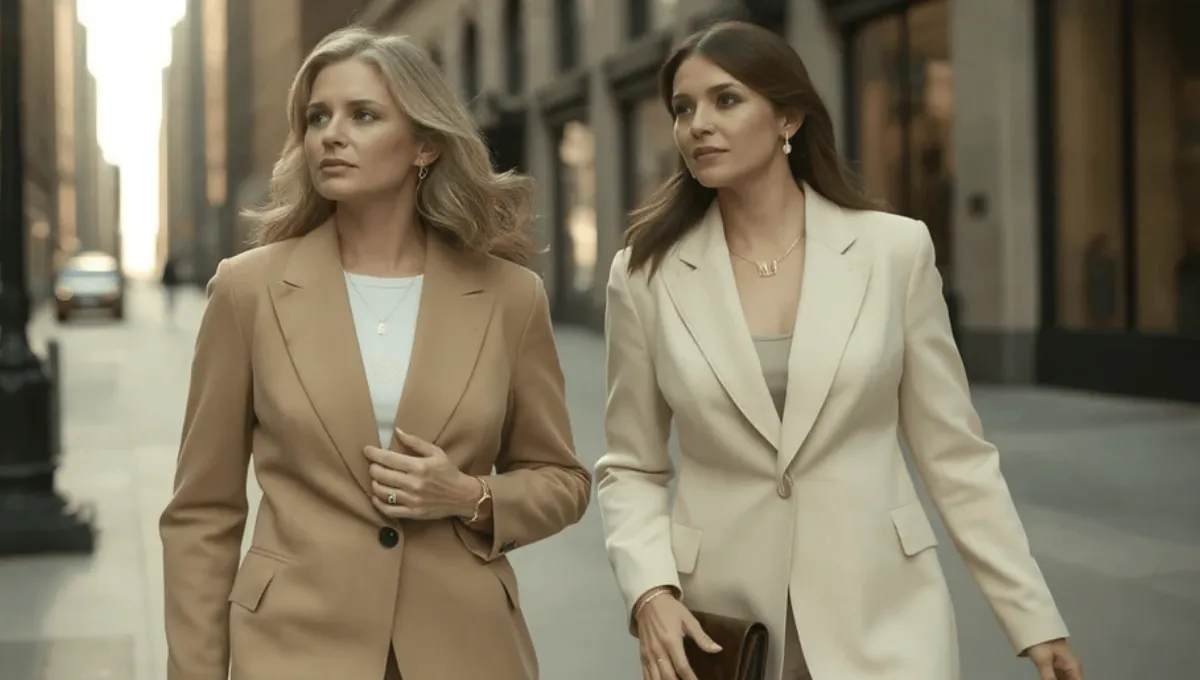
Quiet luxury sometimes called “stealth wealth,” though that term carries a faintly sinister edge is the aesthetic of restraint. Cashmere in bone and camel. Tailoring that fits so well it renders trends irrelevant. Hardware that’s matte instead of polished. The brand, if it’s visible at all, is legible only to those who already know. This isn’t a minor fashion correction. It’s a recalibration of what it means to signal status in contemporary culture, and the implications stretch well beyond what’s in anyone’s closet.
Old Money Made New Again
To understand quiet luxury, you have to understand what it’s reacting against and also what it’s excavating from the past.
The aesthetic draws heavily from a particular strain of American patrician style: the kind associated with old New England money, prep school hallways, and estates that haven’t been redecorated since the 1970s because there’s never been a reason to. Think Ralph Lauren without the theater of it. The Kennedys on holiday. A Nantucket where nobody is performing anything because there’s no audience worth performing for.
This sensibility has always existed. What’s new is its cultural visibility. HBO’s Succession became, unexpectedly, a style document not because the Roy family was aspirational in any moral sense, but because their clothing said something interesting. These were people so wealthy that logos would have been a step down. Their uniform was anonymity: perfectly cut navy trousers, soft-shouldered blazers, loafers that cost more than most people’s rent but looked, to the untrained eye, completely ordinary. The show’s costume designer, Michelle Matland, spoke about this deliberately the idea that real power doesn’t need to announce itself.
When Succession aired its final season in 2023, searches for “quiet luxury” spiked. TikTok ran with it. Suddenly the aesthetic was everywhere, which created its own particular irony: a look defined by its rejection of trend was itself trending.
Why Now, Exactly
Timing matters. Quiet luxury didn’t emerge in a vacuum. It arrived during a period of compounding anxieties economic instability, widening inequality, a cultural reckoning with excess in multiple registers simultaneously. After years of influencer maximalism and the dopamine economy of conspicuous display, a significant segment of the consuming public was ready for something that felt more considered. Less hungry.
There’s also a generational dimension worth taking seriously. Younger high-earning consumers particularly those in tech, finance, and the creative industries came of age in an era that theoretically valorized authenticity above all else. The irony is that the most effective performance of authenticity, it turns out, looks a lot like not performing at all. Quiet luxury became the wardrobe equivalent of a curated minimalism that says: I don’t need your validation.
And then there’s the reaction to social media itself. Instagram’s visual economy rewarded maximalism bold colors, statement pieces, outfits built to photograph. But as social media fatigue set in and the discourse around “performative living” grew more sophisticated, a counter-aesthetic gained traction. Dressing for real life rather than for a feed. The very absence of content became a kind of content.
What It Actually Costs
Here’s where things get complicated, and where the conversation deserves more honesty than it usually gets.
Quiet luxury is not cheap luxury. In many ways, it’s the most expensive form of dressing there is it just hides that fact within its texture rather than advertising it on its surface. A Loro Piana cashmere zip-up costs upward of $1,500. The Bottega Veneta intrecciato leather bags that became touchstones of the aesthetic start around $2,000. The Brunello Cucinelli shirt that looks like a simple white shirt is $600. The entire premise rests on quality so evident that price tags become redundant which means, structurally, that this is a code available only to those with significant financial access.
This is worth sitting with. Quiet luxury, for all its visual humility, is not a democratizing force. It’s a way of stratifying through knowledge rather than display which is, in some historical sense, an older and arguably more durable form of hierarchy. You’re not excluded by not recognizing the brand. You’re excluded by not being able to afford things that don’t look like they should cost what they cost. The barrier shifts from visibility to literacy to capital, in that order.
Fast fashion has, predictably, tried to bridge the gap. The “quiet luxury” aesthetic can now be approximated at Zara or & Other Stories the neutral tones, the clean lines, the absence of obvious branding. And this approximation works, visually, at a distance. Which tells you something important: the aesthetics travel better than the economics. The look can be reproduced; the material reality underneath it cannot.
Beyond Clothes: A Broader Hunger
Strip away the fashion context and quiet luxury is expressing something more fundamental a desire for quality over spectacle, for things that last over things that trend, for a relationship with objects that doesn’t require constant external validation to feel meaningful.
You see it beyond wardrobes. In interiors, the maximalist terrarium-and-gallery-wall aesthetic of early Instagram gave way to a quieter palette: linen, natural wood, objects with history. In food culture, the prestige has shifted back toward technique and simplicity the omakase counter rather than the theatrical smoke-and-foam tasting menu. In travel, “experiential luxury” increasingly means fewer amenities and more authenticity, the boutique property over the resort. Even in technology, there’s a nascent premium placed on devices that are less intrusive, less attention-demanding.
All of this is pointing in the same direction. A recalibration of what sophistication looks like, away from accumulation and toward refinement. Whether this represents a genuine cultural maturation or simply a new aesthetic regime with its own forms of exclusion is an open question and probably both are true simultaneously.
The Contradiction at the Center
What makes quiet luxury genuinely interesting isn’t the clothes. It’s the tension it embodies. It represents a rejection of conspicuous consumption even as it remains, structurally, one of the most expensive ways to consume. It performs authenticity through aesthetics while aesthetics are never not performance. It claims to be about personal taste while being, like every trend, deeply social in its logic.
But perhaps that tension is the point. Perhaps every dominant aesthetic contains its own critique, and the most enduring ones are those comfortable enough with contradiction to let it breathe.
What’s clear is that the appetite for quietness for restraint, for quality that doesn’t shout, for spaces and objects that don’t demand your attention reflects something real in how a significant portion of the culture is feeling about noise right now. Not everyone can afford a Loro Piana sweater. But the weariness with relentless spectacle is fairly evenly distributed.
And that weariness doesn’t seem to be going anywhere.