
There’s a particular feeling that comes when you step out of a crowded city street and suddenly find yourself standing at the edge of a wide, unobstructed field. The shoulders drop. The breath slows. Something in the chest that you hadn’t even noticed was tight begins to release. It’s not dramatic. It’s almost embarrassingly simple just space, just light, just the sensation of the horizon sitting far enough away that you feel like you can finally exhale.
We rarely stop to ask why.
We assume it’s aesthetic preference, or a need for quiet, or maybe just the contrast effect of leaving somewhere loud. But the pull toward open landscapes runs deeper than any of those explanations can fully account for. It’s woven into the architecture of how we perceive safety, belonging, and even time itself.
The Evolutionary Case We Can’t Ignore
The most foundational explanation comes from evolutionary psychology, specifically from what researchers call the savanna hypothesis. The idea is straightforward: our visual preferences were shaped during the long stretch of human prehistory when our ancestors lived on the open grasslands of East Africa. In that environment, open space was genuinely survival-relevant. You could see predators coming. You could track game. You had options.
The psychologist Gordon Orians spent decades developing this framework, and the data it generated is hard to dismiss. Across dozens of cultures, including many with no historical connection to savanna environments, people consistently rate landscapes with moderate openness, scattered trees, proximity to water, and visible horizon lines as more beautiful and more desirable than dense forest or flat, featureless terrain. Children who have never seen a photograph of an African savanna will draw landscapes that look remarkably like one when given free choice.
What makes this more than just a fun evolutionary trivia point is that the preference appears involuntary. It activates before conscious evaluation. Show someone a photograph of an open meadow and the stress response measurably decreases within seconds before they’ve had time to form an opinion about it.
When Space Becomes a Form of Freedom
There’s a psychological distinction between constraint and containment. Containment can feel safe acozy room, a familiar neighborhood, a car on a highway at night with the window cracked. Constraint is something else. It’s the feeling of not having options, of walls that don’t invite you but merely hold you.
Open spaces, neurologically speaking, signal optionality. When your visual field extends far in multiple directions, the brain registers something close to freedom of movement, even if you’re standing completely still. This is why people who live in apartments with views report lower levels of anxiety than those whose windows face walls or other buildings at close range. The view doesn’t change their actual circumstances. It changes the story their nervous system is telling about those circumstances.
Roger Ulrich’s landmark studies in the 1980s initially designed to examine hospital recovery rates found that patients whose windows overlooked trees and open ground recovered measurably faster after surgery than patients looking at brick walls. They also required less pain medication. The visual information of openness wasn’t decorative. It was metabolic.
This extends into how we process stress more broadly. Urban environments, by design, demand a constant low-level vigilance. There are things moving at the edges of your vision. There are sounds you can’t source. There are decisions which way, how fast, is this safe being made continuously below the threshold of conscious thought. Open landscapes, particularly natural ones, demand almost none of this. The nervous system can, in the truest sense of the phrase, stand down.
Space, Self, and the Strange Geometry of Thinking
There’s something else open spaces seem to do, and it’s harder to quantify but no less real: they change how people think about themselves.
Multiple studies in environmental psychology have found that physically expansive environments correlate with what researchers call abstract thinking the capacity to consider longer timeframes, bigger categories, broader implications. It’s as if the geometry of the space around us becomes a template for the geometry of our cognition. Walk into a grand cathedral or stand on a cliff overlooking the ocean, and you find yourself thinking about your life in longer arcs. The petty irritation that consumed you an hour ago suddenly feels oddly small.
Part of this is the awe response, which psychologists Dacher Keltner and Jonathan Haidt have extensively studied. Awe, they argue, is triggered specifically by encounters with things that are vast and that challenge our existing frameworks for understanding the world. It reliably produces a temporary but measurable shift in self-perception what they call a “shrinking of the self” where individuals report feeling smaller but paradoxically calmer and more connected.
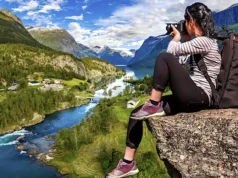
Open landscapes are among the most reliable awe triggers available to ordinary people without extraordinary circumstances. You don’t need the Grand Canyon. A wide empty beach at low tide can do it. A flat prairie under a sky full of weather. A mountain vista that keeps revealing more of itself as you climb.
The Tension We Don’t Talk About Enough
None of this means open spaces are universally comforting, and any honest account of the psychology has to make room for the other side.
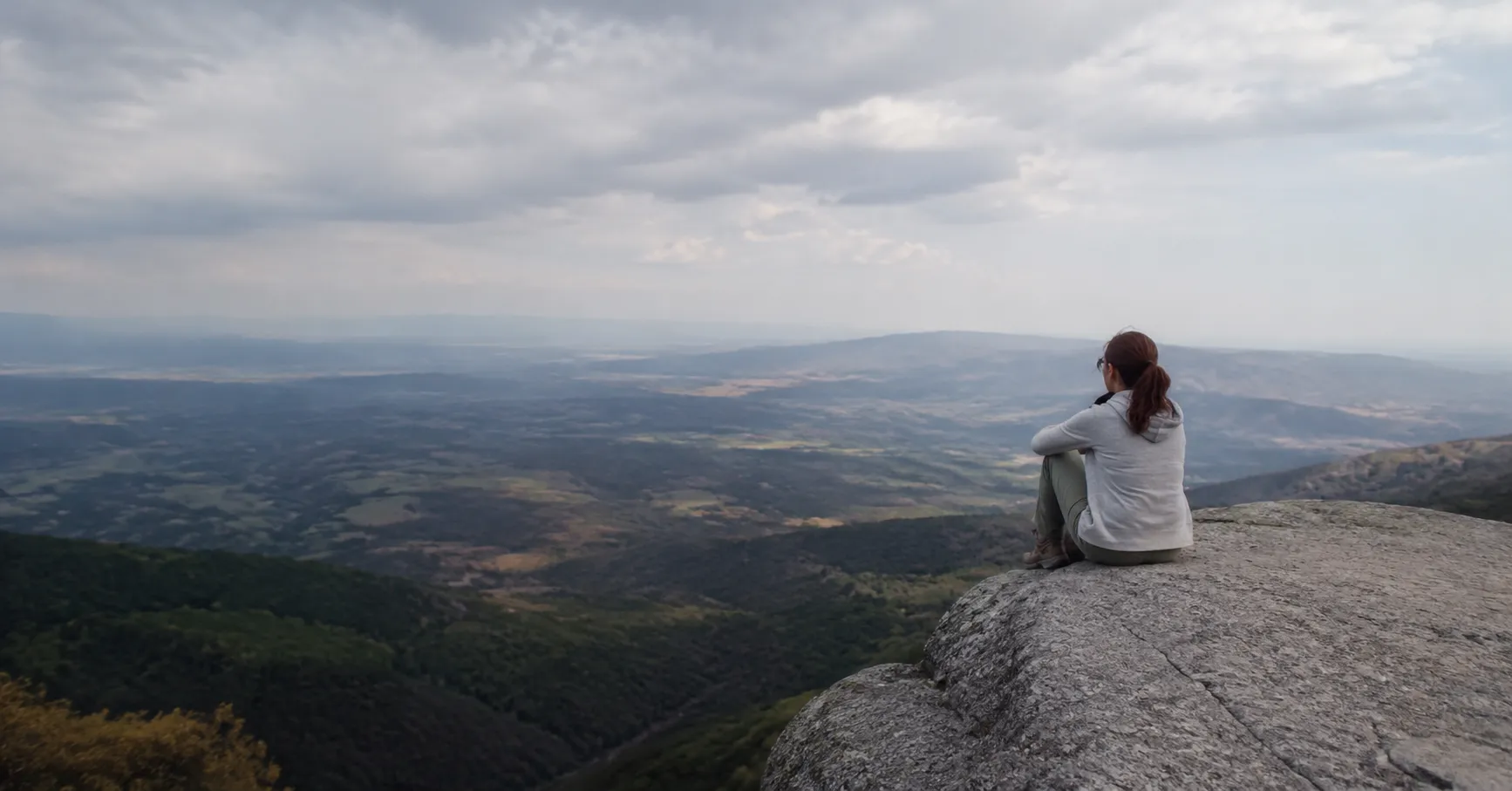
Agoraphobia is the most extreme expression, but well short of clinical anxiety there exists a real and common discomfort with too much openness. Vast, featureless environments salt flats, dense fog over open water, an empty parking lot at3 a.m. can feel threatening rather than liberating. The same spatial freedom that reads as opportunity in one context reads as exposure in another. The savanna hypothesis includes this nuance: our ancestors didn’t want to stand in the middle of open ground; they wanted to be near its edge, in what researchers call “prospect and refuge” the ability to see without being seen.
A position of oversight with a retreat available. That’s the sweet spot. Pure openness, with nowhere to shelter, activates a different kind of alertness entirely.
This is why the most beloved open spaces in human experience tend not to be purely open. The ideal picnic spot is the hill with the view, not the exposed ridge. The preferred beach position is often near the dunes, not at the waterline. We want the horizon, but we want our backs covered.
What We’re Actually Looking For
When people say they need to “get away,” they rarely mean they need to go somewhere exciting or new. More often, they mean they need to go somewhere that doesn’t ask so much of them somewhere that lets the noise settle, that offers the visual and neurological cues of safety and option, that allows the self to briefly expand into more space than the daily routine provides.
Open landscapes offer something that no interior design, no wellness product, and no productivity system can replicate: the primal experience of standing somewhere that was not made for you, that does not need anything from you, and that will be exactly as it is whether you’re there or not.
There’s relief in that. Real, physical, cellular relief.
We keep returning to open spaces for the same reason we keep seeking stillness not because we want to disappear, but because something in the spaciousness reflects back a version of ourselves we don’t often get to meet. Something quieter, less defended, with a longer view of things.
The horizon has always been that invitation. We just forget to take it seriously.