

There’s a specific kind of frustration that hits when you’re standing in front of a full closet, wearing what should be a perfectly fine outfit, and feeling like something is off. Not wrong, exactly. Just flat. Like a sentence that’s grammatically correct but somehow lifeless on the page.
The truth is, most people don’t have a wardrobe problem. They have a finishing problem.
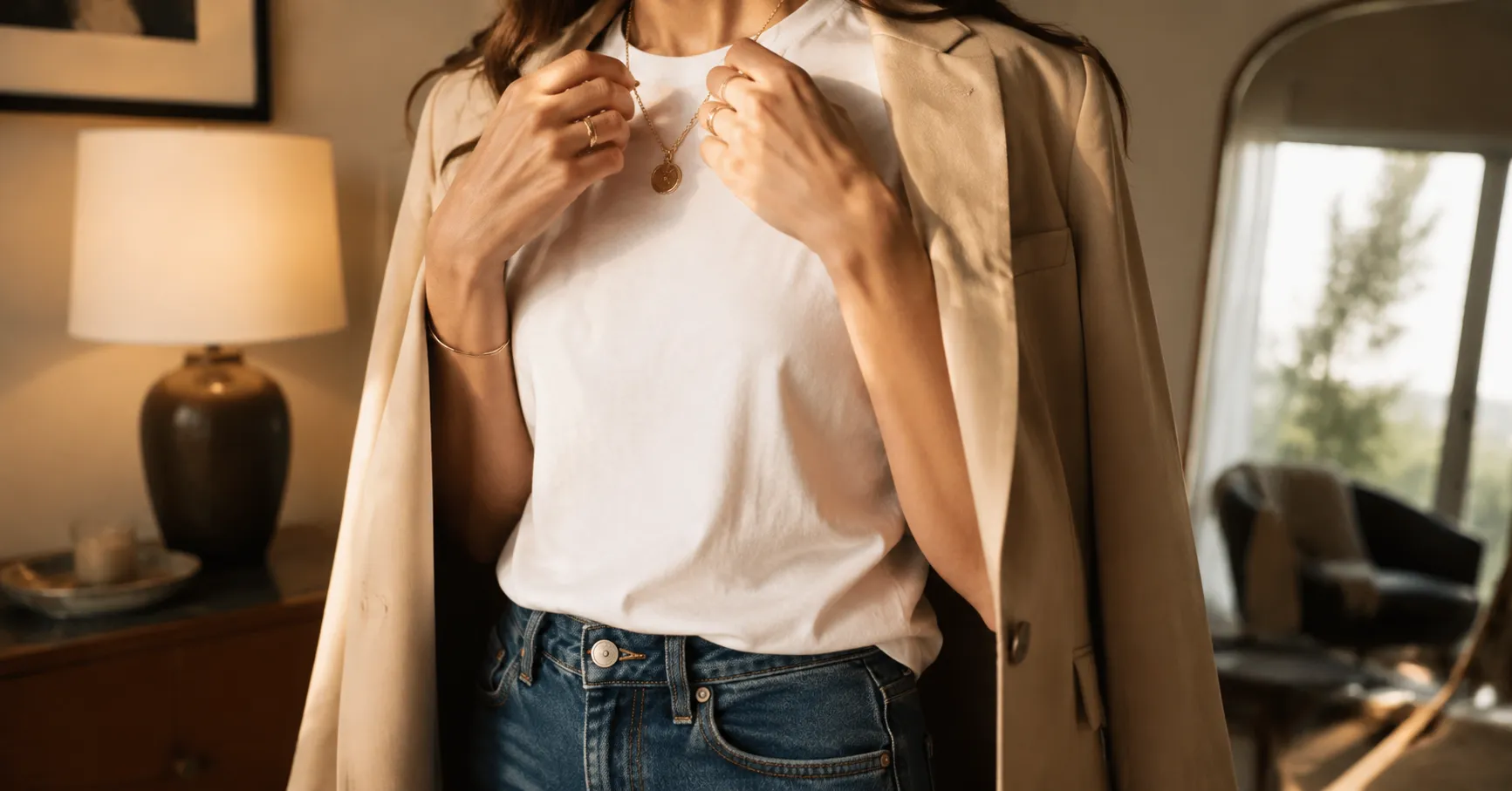
The basics are already there the jeans that fit well, the clean white tee, the blazer that cost more than you’d like to admit. What’s missing isn’t a new piece. It’s the one move, the small deliberate adjustment, that shifts everything from assembled to considered. And that shift can happen in ten seconds or less, if you know what you’re actually doing.
The Collar Flip That Changes the Room
Pop one side of a collar. Just one. Not both that’s cosplay. One.
It takes about three seconds and it signals something that’s genuinely hard to manufacture: the impression that you got dressed without trying too hard. That you have somewhere to be and you’re already thinking about what happens when you get there. Fashion people call this studied carelessness, but the reality is it’s just asymmetry working the way it always does drawing the eye, creating movement, breaking the visual monotony of a too-tidy silhouette.
This works on Oxford shirts, on denim jackets, on light overcoats. It works in boardrooms and at Sunday markets. The rule isn’t about the garment. The rule is that the human body reads as more interesting when it’s not perfectly mirrored.
One Unexpected Texture Against Everything Else
When an outfit reads as flat, nine times out of ten it’s because every fabric in it belongs to the same visual family. Cotton with cotton. Matte with matte. The eye has nothing to push against.
The fix is tactile contrast. Tie a silk scarf around a canvas tote strap. Wear a chunky knit over a sleek slip skirt. Put a leather belt through the loops of linen trousers. None of these changes what you’re wearing in any meaningful sense the outfit is still the outfit. But now there’s tension in it, and tension is what makes clothes feel alive rather than just present.
In styling, this is sometimes called the rule of one strange thing. Every outfit benefits from exactly one element that doesn’t entirely belong not in a jarring way, but in a way that makes a viewer’s brain slow down, even briefly, to process what they’re seeing. That pause is where style actually lives.
The Tuck That Isn’t a Tuck
The half-tuck has been photographed so many times it’s practically cultural infrastructure at this point, but people still get it wrong by being too precise about it. The goal isn’t a perfectly folded front panel. The goal is to suggest that your shirt started to come untucked and you didn’t entirely care.
Front tuck just enough to break the shirt’s hem line and hint at a waist. Leave the sides out. If it looks like you did it on purpose, undo it slightly and try again. The charm of this technique is that it’s not about the tuck at all it’s about the visual story it tells. You’re a person with momentum. Things are slightly in motion. The clothes are keeping up with you, not the other way around.
This works with everything from boyfriend jeans to tailored trousers, and it takes maybe five seconds once you’ve practiced it twice.
Where You Wear Something Matters as Much as What You Wear
A watch worn on the inside of the wrist. A ring on an unexpected finger. A necklace at a length that doesn’t follow the neckline of the shirt. Sunglasses hooked on the back of a collar rather than the front.
These are all micro-choices that take zero extra time and zero extra money, and they quietly communicate that you have a genuine relationship with how you dress not a performed one. The difference between someone who looks stylish and someone who looks like they’re trying to look stylish is almost always in details this small. The big pieces are secondary. It’s the placement, the proportion, the tiny decisions that most people don’t consciously register but absolutely feel.
When you wear a delicate bracelet stacked against a masculine watch, you’re creating a conversation on your own wrist. When you let a silk tankstrap slip slightly off one shoulder before walking out the door, you’ve just introduced narrative to what would otherwise be a static image.
The Shoe Rotation That Rewrites an Outfit
Take any basic outfit. Now imagine it three times: once with crisp white sneakers, once with pointed-toe flats, once with chunky loafers. You don’t have a different outfit in any of those scenarios you have three completely different people. The shoes aren’t completing the look. They’re authoring it.
This is the fastest elevation move that exists, and it requires no time at all if you’ve already thought about it before you get dressed. The error most people make is treating shoes as something to decide after everything else is settled. Flip the process. Start from the shoes and let the rest of the outfit organize itself around that anchor point. You’ll find that what constitutes a “basic” outfit changes dramatically depending on what’s on your feet.
Sneakers read casual but, paired with a blazer and tailored trousers, they become directional. A ballet flat in a unexpected color burnt sienna, forest green, anything outside the neutral family rewrites a monochrome outfit without touching a single other element. Shoes are not an afterthought. They’re the argument.
The Light Source Problem
Here’s a thing nobody talks about enough: most outfits that look dull actually look dull because of how they interact with light, not because of anything inherently wrong with the clothes themselves.
Matte fabrics absorb light and read as grounded, serious, substantial. Shiny fabrics reflect it and read as energetic, high-contrast, attention-grabbing. The trick is to choose one dominant light quality and introduce one element from the opposite end of the spectrum. A matte outfit with one satin element a clutch, a shoe, the lining of a turned-up cuff suddenly has depth. A glossy, high-contrast outfit with one soft, nubby texture has somewhere to rest.
This is less about rules and more about understanding that your outfit is always in conversation with its environment. Natural light, fluorescent light, candlelight they all interact differently with fabric. When you dress with this awareness, even slightly, the results feel intentional in a way that’s genuinely hard to explain but immediately visible.
The Last Ten Seconds
Before you walk out the door, do one thing. Move something. Roll a sleeve differently than you usually do. Switch your bag from one shoulder to the other and notice whether it changes how the whole thing reads. Pull two inches of an oversized shirt out over a waistband. Put your hands in your pockets and see if the silhouette improves.
Getting dressed is a static act but wearing clothes is dynamic. The people who always look put-together are usually just the people who understand that the outfit isn’t finished when they button the last button it’s finished when they actually inhabit it. That last moment of adjustment, of inhabiting rather than just wearing, is where basic ends and considered begins.
Ten seconds. You had them the whole time.