
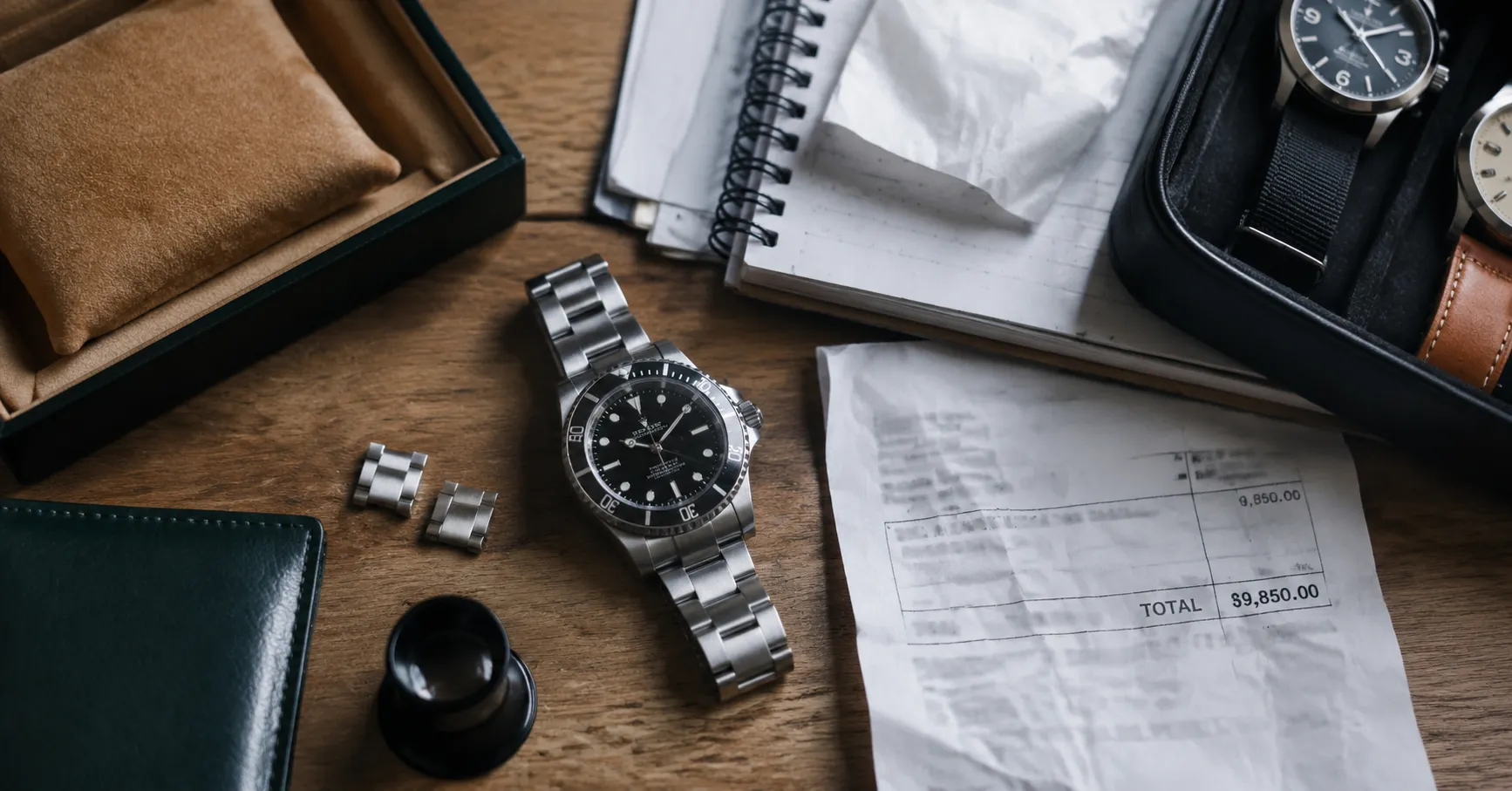
There’s a particular kind of buyer’s remorse that only watch collectors understand. It’s not the sharpsting of overpaying for a meal or a flight upgrade. It’s slower, heavier the kind that settles in weeks after the purchase, usually when you’re doing research you should have done before. The watch sits on your wrist, technically beautiful, technically fine, and yet something nags at you. You paid too much. You bought the wrong reference. You trusted the wrong seller. And now the education has a price tag.
Every collector goes through some version of this. The expensive part isn’t necessarily the watch itself it’s the gap between what you thought you knew and what the market actually demands.
Buying for Investment Before Buying for Love
The single most corrupting idea in modern watch collecting is that you should think like an investor from day one. Somewhere along the way, the story of a guy who bought a Daytona in 1995 for three thousand dollars became a kind of founding myth proof that watches are assets, not objects of desire. That myth has sent thousands of new collectors chasing the wrong things for the wrong reasons.
When you buy a watch purely because you expect it to appreciate, you skip the most important foundation: understanding what you actually enjoy wearing. You end up with a stainless steel sports watch you’re afraid to scratch, sitting in a box, because the whole point was to protect its resale condition. That’s not collecting. That’s storing metal.
The deeper problem is that speculative watches are, almost by definition, the most crowded trade. By the time a reference becomes famous enough for a new collector to hear about it as an “investment,” the premium is already baked in. You’re buying at peak enthusiasm, often from someone who got in earlier and is happy to let you hold the bag through the next correction.
Buy watches you would wear if the market collapsed tomorrow. That discipline protects you financially and, more importantly, keeps the hobby worth having.
Underestimating the Significance of Condition
New collectors tend to evaluate watches visually from a distance. The case looks good in photos. The dial looks clean. The seller says it runs well. That’s enough, right?
It isn’t. Not even close.
Watch condition is a layered subject that takes years to read fluently. A case that has been polished even once, by a professional has lost something irreversible. The crisp bevels on a Nautilus or a Royal Oak, the sharp lugs on a vintage Rolex, those edges are part of what makes the watch the watch. Once polished away, they don’t come back. The watch looks newer and is worth less, often significantly less to a knowledgeable buyer, even though to an untrained eye it appears to be in better shape.
Then there’s the dial. Collectors who spend time in the market develop an almost obsessive attention to dial condition, because it’s where authenticity and originality converge. Refinished dials are a persistent hazard in vintage collecting. They can look perfect precisely because they’re fake reprinted to cover up damage, to deceive, or simply to restore cosmetic appeal. The tell is usually in the printing: text that’s too crisp, lume plots that sit slightly off-center, a color temperature that’s close but not quite right.
The lesson here isn’t that every watch is suspect. It’s that condition vocabulary matters, and developing it before spending serious money is non-negotiable.
Ignoring the Full Cost of Ownership
The price of the watch is the starting point of the financial commitment, not the end of it. New collectors routinely underestimate what comes next.
Mechanical watches need servicing. Depending on the brand, movement complexity, and service interval, that can run anywhere from a few hundred dollars for a straightforward ETA-based movement to well over a thousand for a complicated in-house caliber from a major manufacture. If you buy a watch that hasn’t been serviced in a decade a common scenario with vintage pieces that cost is coming due almost immediately. It should be factored into the purchase price, and often isn’t.
There’s also the question of authentication and pre-purchase inspection. Buying a vintage Rolex without having it examined by a specialist, or at minimum running it past a trusted community source, is gambling. The cost of getting a watch checked before purchase is trivial compared to the cost of discovering it’s a frankenwatch after. The parts on a Submariner dial, for instance, can be swapped from different generations or outright faked, and the wrong combination destroys a significant portion of the watch’s value.
Insurance is another line item that too few people account for early. A watch worth ten thousand dollars sitting in a drawer without a rider on your homeowner’s policy is a watch you’re one burglary away from losing entirely.
The Gray Market Trap
The gray market is seductive because it solves a real problem: authorized dealers for popular references either won’t sell to you without a purchase history, or they don’t have the watch you want in stock. Gray market dealers have it, right now, and they’ll sell it to you today. The premium feels painful but manageable. You just want the watch.
What you’re often buying, in addition to the watch, is a set of complications that don’t appear in the transaction.
Some gray market pieces carry warranty implications. Rolex, for instance, has historically been protective about honoring warranties on pieces sold outside the authorized dealer network, and while practices vary, there are documented cases of service complications arising from gray market provenance. Beyond warranty, there’s the matter of price anchoring. Buying a watch at a significant gray market premium sometimes 150 or 200 percent of retail means you’ve entered the market at a point where any normalization in demand will hurt you. The people who paid retail, or who got on a list and waited, have an enormous cushion. You don’t.
The gray market exists because of genuine supply constraints and real consumer impatience. Those are legitimate frustrations. But walking into it with eyes open is different from walking in assuming it’s simply a parallel retail channel with a markup.
Collecting Opinions Instead of Developing Taste
There’s an irony in the era of watch forums, YouTube reviews, and Instagram communities: never has there been more free information available to new collectors, and never has it been easier to outsource your taste entirely to other people.
Spending six months consuming watch content before buying anything sounds prudent. And some of it is. But the noise-to-signal ratio in collector communities is poor. What rises to the top algorithmically tends to be the most emphatic, the most controversial, the most commercially adjacent. The watch that gets discussed most isn’t necessarily the watch that’s right for you it’s the watch that generates engagement.
The collectors who build genuinely interesting collections over time tend to develop what you might call an internal compass early. They know why they like what they like, not just that the community validates it. They can tell you the specific thing about a dial layout, a case proportion, a historical context, that pulls them toward a reference. That specificity is protective. It means they’re less likely to buy something because it’s trending and more likely to hold onto what they buy because the reasons were real.
The expensive mistake here isn’t a single purchase. It’s arriving years into the hobby with a collection that represents a curated list of other people’s opinions, none of which quite fit and realizing the cost of unwinding all of it.
Watch collecting done well is one of the more absorbing long games available to anyone who cares about design, history, and craft. The mistakes are survivable. Most collectors who stick around will tell you the early errors were part of how they learned to see. What separates the people who grow from the ones who burn out is usually just this: they started asking the right questions before the check cleared, not after.