

If Your Skin Feels “Off,” Read This First
Something Changed, and You Can’t Quite Name It
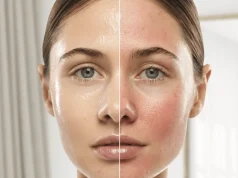
You know the feeling. You wash your face the same way you always have, use the same products you’ve trusted for years, and yet something feels different. Your skin feels tight when it shouldn’t. Or dull in a way that sleep doesn’t fix. Maybe there’s a low-grade irritation that flares up without any obvious trigger, or a texture that wasn’t there six months ago. Nothing dramatic enough to call a dermatologist over, but persistent enough that you keep noticing it.
That ambiguous “off” feeling is one of the most common things people experience with their skin, and also one of the most dismissed. We tend to wait it out, assuming it’ll pass. Sometimes it does. But often, it’s your skin trying to communicate something specific and learning to interpret that signal is more useful than any single product you could buy.
Your Skin Barrier Is Probably Involved
The skin barrier has become a buzzword in skincare, and like most buzzwords, it’s both overused and genuinely important. The outermost layer of your skin the stratum corneum functions as a physical shield, keeping moisture in and irritants out. When it’s healthy, you don’t think about it. When it’s compromised, everything feels wrong in ways that are hard to pinpoint.
A disrupted barrier doesn’t always announce itself with redness or peeling. More often, it shows up as that vague sensitivity, the feeling that your moisturizer isn’t absorbing the way it used to, or that your skin feels “reactive” without a clear cause. Products that were once fine start to sting slightly. Fragrances you’ve used for years suddenly feel like too much.
What damages the barrier is a longer list than most people expect. Over-exfoliation is a common culprit acids and physical scrubs used too frequently erode the protective surface before it can regenerate. But so is under-moisturizing in cold, dry air. Hard water, which is high in mineral content, leaves a residue that can disrupt skin pH over time. Even long, hot showers the kind that feel like self-care strip the natural lipids that keep the barrier intact.
The path back is usually simpler than people anticipate: fewer active ingredients, more occlusive moisturizers, time. The problem is that when skin feels off, the instinct is to do more add something, fix something. Often, the right answer is to subtract.
The Season Your Skin Is Living In
There’s a mismatch that happens every year, and almost everyone falls into it. You build a skincare routine that works well in one season, and then you keep using it as the environment shifts around you. Your skin adapts to temperature changes, humidity levels, and UV intensity in ways that your routine doesn’t automatically account for.
In winter, transepidermal water loss increases because cold air holds less moisture and indoor heating creates an artificially dry environment. The same lightweight gel moisturizer that felt perfect in September can leave your skin starved for hydration by December. In summer, the opposite problem: heavier formulas sit on the skin, mix with sweat, and can contribute to congestion or breakouts in people who don’t normally experience them.
It’s not that your skin is broken it’s that it’s responding rationally to an irrational set of inputs. Matching your routine to the actual climate you’re living in, rather than the routine that once worked, is often the simplest explanation for why things have gone sideways.
What Stress Actually Does to Your Face
This sounds like the kind of thing people say when they don’t have a better explanation, but the physiology is real and specific. Cortisol, the primary stress hormone, has measurable effects on skin function. It increases sebum production, which is why stress tends to bring on breakouts even in people who don’t have acne-prone skin. It also slows cellular turnover and impairs wound healing meaning small irritations take longer to resolve.
There’s another mechanism that’s less discussed: stress compromises the gut-skin axis. The gut microbiome influences systemic inflammation, and chronic stress disrupts gut flora in ways that can manifest on the skin as redness, reactivity, or flare-ups of conditions like eczema and rosacea. It’s a roundabout path, but it’s why two people with identical skincare routines can have dramatically different skin during periods of high stress.
None of this means the solution is simply to “stress less,” which is advice that helps no one. But it does mean that if your skin has shifted and your life has also shifted a new job, a difficult season, a disrupted sleep schedule those things are connected. The skin isn’t being dramatic. It’s being honest.
Hormones, Quietly Running the Show
Hormonal fluctuations affect skin in ways that most people don’t fully map until they start paying close attention. The menstrual cycle, for people who have one, creates a predictable pattern: estrogen levels rise in the first half, supporting collagen and hydration, then drop before menstruation, often triggering dryness, dullness, or breakouts along the jawline and chin.
Perimenopause brings a more sustained version of this declining estrogen means less collagen synthesis, reduced natural moisture, and skin that begins to feel thinner or less resilient. This isn’t a failure of the skin; it’s a biological shift that a routine built for your twenties or thirties isn’t necessarily equipped to address.
Thyroid function is another piece that goes overlooked. An underactive thyroid can cause skin to become dry, rough, and pale, and it’s frequently mistaken for a topical problem when the root is systemic. If your skin has changed in ways that feel more fundamental than a reaction or a seasonal shift particularly if it’s accompanied by fatigue, hair changes, or temperature sensitivity a blood panel is worth more than any serum.
The Product You Added Three Months Ago
Skincare product timelines are tricky. Reactions aren’t always immediate. Some ingredients accumulate in their effect over weeks; some sensitivities develop through repeated exposure rather than first contact. It’s entirely possible to use something for two months without issue and then begin noticing that your skin feels off and not connect it to the product because the timing seems wrong.
Retinoids are the most common version of this. They’re introduced gradually, tolerated well initially, and then overused as confidence builds until suddenly the skin is red, flaking, and miserable, and it’s hard to trace back to the source. Vitamin C serums can oxidize and become irritating if stored improperly. Niacinamide, widely considered gentle, causes a flushing reaction in some people due to impurity conversion.
A useful exercise when skin feels off: list everything you’ve added or changed in the last ninety days, not just the last two weeks. Look at the full timeline. Sometimes the answer is sitting right there, waiting to be noticed.
When “Off” Means Something Worth Investigating
Most of the time, skin that feels off is responding to something manageable a disrupted barrier, a seasonal mismatch, a stress response, a product that’s quietly not working. But there are cases where the signal is pointing somewhere that requires more than a routine adjustment.
Persistent redness concentrated on the nose and cheeks that worsens with heat, alcohol, or spicy food may be rosacea, which has specific triggers and specific treatments. Skin that’s uniformly dry and rough despite consistent moisturizing can be a thyroid or nutritional issue. New or changing moles, patches that don’t heal, or texture changes that are localized and persistent warrant a dermatologist, not a skincare overhaul.
The distinction worth making is between skin that’s reacting and skin that’s signaling. Reactions are noisy, temporary, and usually traceable. Signals are quieter, more persistent, and often involve the body beyond the surface.
Your skin has been paying attention to everything the sleep, the stress, the seasons, the products, the hormones, the years. That “off” feeling isn’t a malfunction. It’s a message. The question is whether you’re willing to listen carefully enough to hear what it’s actually saying.